Mobile Suit Gundam F91 — Complete Guide— Story, Mobile Suits & Iconic Scenes
Contents
- 01What Is Mobile Suit Gundam F91? A New Chapter in the Universal Century
- 02Understanding the Setting: Universal Century 0123 and the Era of Miniaturized Mobile Suits
- 03Complete Story Guide: Full Plot Summary of Gundam F91 [Spoilers]
- Prologue: Everyday Life on Frontier IV
- Act One: The Crossbone Vanguard's Assault
- Act Two: Cecily's True Identity and the Ronah Family's Ambition
- Act Three: Gundam F91 Activates and Seabook Enters the Fight
- Act Four: Reunion on the Battlefield
- Act Five: Iron Mask's Rampage and the Horror of the Bugs
- Act Six: The Final Battle, Gundam F91 vs. Rafflesia
- Epilogue: Cecily's Return and the Light of Hope
- 04Complete Character Guide: The Compelling Cast of F91
- 05Complete Mobile Suit Encyclopedia: Machines and Mechanics of F91
- 06Thematic Analysis: The Questions F91 Asks
- 07Music and Visual Expression: "ETERNAL WIND" and Theatrical-Quality Animation
- 08Production History and Reception: F91's Journey
- 09Connection to Crossbone Gundam: F91's Story Continues Here
- 10Viewing Guide: How to Get the Most Out of F91
- 11Frequently Asked Questions (FAQ): Answering Your F91 Questions
- 12Conclusion: F91, An Unfinished Masterpiece and an Eternal Wind
What Is Mobile Suit Gundam F91? A New Chapter in the Universal Century
Mobile Suit Gundam F91 is a theatrical anime film released on March 16, 1991, through Shochiku theaters in Japan. Directed by Yoshiyuki Tomino, the creator of the original Mobile Suit Gundam, this film was produced to commemorate the 10th anniversary of Gundam's theatrical debut and represented an ambitious attempt to propel the Universal Century into a new era.
Set in Universal Century 0123, approximately 44 years after the One Year War of the original Mobile Suit Gundam and roughly 30 years after Char's rebellion in Char's Counterattack, F91 introduces a completely new generation of characters. The story centers on Seabook Arno, a high school student, and his childhood friend Cecily Fairchild, as they are swept up in the invasion of the armed organization known as the Crossbone Vanguard, which espouses an ideology of aristocratic rule.
The film's tagline asks: "When will people be able to forget war?" Against the backdrop of a world where the Federation government's corruption has reached its peak and new flames of conflict are igniting, Tomino poses a question that resonates across time. Condensed into approximately 120 minutes of screen time, the story captivates with its beautiful animation, emotionally charged drama, and gripping mobile suit combat. More than three decades after its release, F91 continues to be beloved by fans worldwide.
Basic Production Information
| Official Title | Mobile Suit Gundam F91 |
|---|---|
| Release Date | March 16, 1991 (Shochiku theatrical release) |
| Runtime | Approximately 120 minutes |
| Format | Original theatrical animation |
| Director | Yoshiyuki Tomino |
| Original Story | Hajime Yatate, Yoshiyuki Tomino |
| Screenplay | Tsunehisa Ito, Yoshiyuki Tomino |
| Character Design | Yoshikazu Yasuhiko (original concept), Kenoh Kitahara (animation director) |
| Mechanical Design | Kunio Okawara |
| Music | Satoshi Kadokura |
| Theme Song | "ETERNAL WIND" by Hiroko Moriguchi |
| Production | Sunrise (now Bandai Namco Filmworks) |
| Distribution | Shochiku |
| Setting | Universal Century 0123 |
The staff roster reunited key members from the original Gundam: Yoshikazu Yasuhiko for character design concepts and Kunio Okawara for mechanical design. Sunrise had specifically requested that the film be made with the original creative team, aiming for a work that would carry forward the spirit of the first Gundam while charting new territory for the franchise.
The Significance of "Gundam's 10th Theatrical Anniversary"
In 1981, the theatrical compilation film of Mobile Suit Gundam shattered anime box office records and became a social phenomenon. Ten years later, F91 was conceived as the "10th Anniversary Commemorative Work." It was not merely a celebration piece but was positioned as a "next-generation Gundam" that would advance the Universal Century timeline into a new age.
Originally, F91 was planned as a television series. A concept for a 50-episode TV anime existed, with story outlines completed for the first 13 episodes. However, production scheduling issues and difficulties coordinating among staff made a TV broadcast impossible. The bold decision was made to condense those 13 episodes' worth of plot into a roughly two-hour theatrical film. This history is both a defining characteristic and a notable challenge of F91.
From TV Series to Theatrical Film: The Phantom "F91 TV Version"
Around January 1990, the project was officially reformulated as a theatrical film. Director Tomino reworked the 13-episode TV structure into a self-contained movie plot. In some cases, storyboarding began before scripts were finalized, indicating just how tight the production schedule was.
As a result, F91 is sometimes criticized for being "overstuffed." With too many characters and insufficient time to develop their backgrounds and motivations, this has been a point of discussion since the film's original release. However, this also speaks to the richness of the original narrative concept. Had the TV version been realized, audiences would have experienced a much deeper exploration of each character and the unfolding military situation.
The story that was meant to continue beyond the "phantom TV version" of F91 would later find expression in the manga Mobile Suit Crossbone Gundam, as discussed later in this guide.
Understanding the Setting: Universal Century 0123 and the Era of Miniaturized Mobile Suits
To fully appreciate F91's story, it is essential to understand the state of the world in UC 0123. Decades have passed since the original Gundam and Char's Counterattack, and significant changes have reshaped the Earth Sphere.
The Earth Sphere, 40 Years After the One Year War
The One Year War of UC 0079, the Gryps Conflict of 0087, the First Neo Zeon War of 0088, and Char's Rebellion of 0093 had subjected the Earth Sphere to decades of conflict. UC 0123, the setting of F91, is approximately 30 years after Char's Rebellion.
On the surface, a prolonged period of "peace" appears to have prevailed. But the reality is quite different. The Earth Federation government has become more corrupt and weakened than ever, its bureaucracy bloated and dysfunctional. The military has grown complacent, with readiness for new threats drastically reduced. The remnants of Zeon have effectively disappeared, and a pervasive attitude of "there will never be another major war" has taken hold.
New residential areas called "Frontier Side" had been constructed in space. Multiple colonies, from Frontier I to Frontier IV, served as new frontiers for settlers. Frontier IV, where protagonist Seabook and his friends lived, was a peaceful and vibrant colony, until the day the Crossbone Vanguard arrived.
Federation Corruption and the Rise of "Cosmo Aristocratism"
At the heart of F91's narrative is the corruption of the Earth Federation government. Since the beginning of the Universal Century, the Federation had consistently favored Earth residents (Earthnoids) while marginalizing space colonists (Spacenoids). Zeon's rebellion was born from that very frustration.
Yet despite numerous wars, the Federation never fundamentally changed. If anything, the extended peace only accelerated its decline. Bureaucrats enriched themselves, the military became hollow, and public discontent continued to grow.
Into this vacuum stepped the Ronah family and their ideology of "Cosmo Aristocratism" (Cosmo Nobility). This philosophy held that democracy had devolved into mob rule and that humanity should be guided by those with truly noble spirits and superior abilities, the "aristocrats." In theory, aristocracy was defined by merit and moral character rather than bloodline.
This ideology gained a degree of support among those disillusioned with the Federation. In practice, however, the Ronah family's ideals would be pursued through violent means.
The Miniaturized Mobile Suit Era and the Formula Project
The most significant technological change in F91's world is the miniaturization of mobile suits. Standard mobile suits from the One Year War era, such as the Zaku II and Gundam, stood approximately 18 meters tall. Starting in the UC 0110s, however, mobile suit miniaturization and performance enhancement accelerated rapidly, and by the time of F91, machines approximately 15 meters tall had become the standard.
The benefits of miniaturization were substantial:
- Reduced target profile: Smaller machines are harder for enemies to hit
- Improved mobility: Lower weight means better thrust-to-weight ratio and faster movement
- Cost reduction: Less material required means lower production costs
- Operational efficiency: Smaller machines require smaller carrier vessels
Additionally, new technologies such as Minovsky Flight (flight using Minovsky particles) and beam shields (defensive barriers formed from beam energy) had been put into practical use.
The Earth Federation's miniaturized MS development initiative was called the "Formula Project." "Formula," as in Formula 1 racing, refers to a set of specifications. The project aimed to standardize the development of next-generation mobile suits. The culmination of this project was the machine that gives the film its title: the Gundam F91 (Formula 91).
Frontier Side and Colony Structure
The primary setting of the story is the Frontier Side colony cluster. Frontier IV is where Seabook and his friends live and where the Crossbone Vanguard's attack occurs at the film's opening. Frontier I is a neighboring colony where the Federation training ship Space Ark was docked.
The colonies follow the standard Universal Century cylinder design: enormous artificial structures with cities and natural environments recreated on their inner walls, with rotation generating simulated gravity. The Frontier Side colonies were relatively new constructions, well-equipped but militarily vulnerable.
Complete Story Guide: Full Plot Summary of Gundam F91 [Spoilers]
The following section covers the entire film's story in chronological order. Spoilers are included, so proceed with caution if you have not yet seen the film.
Prologue: Everyday Life on Frontier IV
March 16, UC 0123. On the space colony Frontier IV, people go about their peaceful daily lives. Seabook Arno, a student in the mechanical engineering department of a local high school, is busy with his classmates preparing for the school festival.
Among his close friends are the earnest Arthur Jung, the computer-savvy Dorothy Moore, and George Azuma from a wealthy family. And then there is his childhood friend Cecily Fairchild, a beautiful and intelligent girl with whom Seabook shares unspoken mutual affection.
On the day of the festival, Seabook watches Cecily compete in the school's beauty contest. An ordinary moment in an ordinary day, but this peace is about to be shattered.
Act One: The Crossbone Vanguard's Assault
In the midst of the school festival, the armed organization Crossbone Vanguard launches a sudden invasion of Frontier IV. Unfamiliar mobile suits pour into the colony's ports and begin overwhelming the interior with devastating firepower. The stationed Earth Federation forces prove completely unable to respond and are annihilated almost instantly.
The Crossbone Vanguard's mobile suits are sleek, angular machines unlike anything the Federation fields: the Den'an Zon, the more advanced Den'an Gee, and the Evil S equipped with shot lancers (physical projectile spears). They deploy beam shields that render Federation beam rifles useless, a stark demonstration of the technological gap between the two forces.
In the chaos, Seabook attempts to evacuate with his younger sister Reese Arno and his friends. However, during the escape, Cecily is seized by Crossbone Vanguard soldiers. She screams and resists, but the soldiers address her as "My Lady" and carry her away with a mixture of deference and force.
Unable to rescue Cecily, Seabook and the others barely manage to escape Frontier IV. With many casualties left behind, Seabook, Reese, Arthur, Dorothy, and a handful of others flee into space.
Act Two: Cecily's True Identity and the Ronah Family's Ambition
The reason for Cecily's abduction lies in her bloodline. Cecily Fairchild's real name is Berah Ronah, the granddaughter of Meitzer Ronah, patriarch of the Ronah family and founder of the Crossbone Vanguard.
Years ago, Cecily's mother Nadia Ronah fled the family, terrified by the transformation of her husband, Carozzo Ronah. Taking young Berah (Cecily) with her, Nadia remarried a man named Theo Fairchild, and Berah grew up as Cecily Fairchild, unaware of the Ronah family's existence.
The Crossbone Vanguard is the armed wing of the Ronah family's movement to establish a new nation called "Cosmo Babylonia," based on the principles of Cosmo Aristocratism. Its military operations are commanded by Carozzo Ronah, Meitzer's adopted son-in-law, known by his chilling epithet: "Iron Mask." Carozzo permanently wears a platinum mask over his face and leads with cold, ruthless efficiency.
Meitzer intends Cecily to serve as the symbol of Cosmo Babylonia. As the legitimate heir of the Ronah bloodline, a beautiful princess, she is to become the standard-bearer for the new nation. Cecily is conflicted but finds herself moved by her grandfather Meitzer's idealism: the vision of a better world to replace the corrupt Federation.
Act Three: Gundam F91 Activates and Seabook Enters the Fight
After escaping Frontier IV, Seabook's group drifts to Frontier I, where the Federation training vessel Space Ark is docked. As a training ship, its combat capability is limited, but stored aboard in a state of ongoing maintenance is a single, extraordinary mobile suit.
This is the Gundam F91, the culmination of the Formula Project and the most advanced miniaturized mobile suit ever built. Remarkably, Seabook's mother Monica Arno was deeply involved in its development. A researcher specializing in bio-computers, Monica led the development of the bio-computer system that forms F91's core.
A mother who prioritized research over family, living apart from her husband and children. Carrying complicated feelings toward her, Seabook nevertheless boards the F91 to fight the Crossbone Vanguard. With no trained pilot available, Seabook's mechanical engineering knowledge and an inherited aptitude from his mother combine to bring the F91 to life.
Despite it being his first sortie, Seabook demonstrates extraordinary combat ability. The F91's overwhelming performance, combined with Seabook's latent Newtype potential, allows him to destroy Crossbone Vanguard mobile suits one after another, downing three enemies in his very first battle.
Act Four: Reunion on the Battlefield
Having been given the custom mobile suit Vigna Ghina as a member of the Crossbone Vanguard, Cecily confronts Seabook on the battlefield. Former classmates who once shared everyday moments now face each other as enemies with weapons drawn. This is the dramatic heart of F91.
While outwardly assuming the role of Berah Ronah, Cecily struggles internally. She sympathizes with aspects of Meitzer's ideals, but the Crossbone Vanguard's violent methods, especially Iron Mask Carozzo's cold-blooded directives, are something she cannot accept.
During combat, Seabook calls out to Cecily. Certain that the pilot of the Vigna Ghina is his childhood friend, he resolves to fight to bring her back. Here, F91's narrative takes on the quality of not just a war film but a story about reclaiming a lost loved one.
Act Five: Iron Mask's Rampage and the Horror of the Bugs
As the story progresses, the true nature of Carozzo Ronah, Iron Mask, is revealed. The "Rafflesia Project" he has been advancing is a horrifying plan far removed from Meitzer's ideals.
At its core are weapons called "Bugs": autonomous disc-shaped killing machines. The Bugs detect metal, pursue their targets, and slice them apart with spinning blades. They target not only military objectives like mobile suits but humans as well, anyone wearing or carrying metal becomes a target. The Bugs are, in essence, weapons designed for "human hunting."
Iron Mask releases the Bugs inside Frontier I's colony, initiating a massacre of civilians. The sight of fleeing citizens being cut down one after another by Bugs is among the film's most shocking sequences. The indiscriminate slaughter of the elderly and children alike portrays a level of "madness" that transcends the ordinary cruelty of war.
Iron Mask's true objective is the extermination of the Earth Sphere's "surplus population." His plan is to eliminate 90% of humanity and build a new order with the remaining 10% of "superior" individuals. The ultimate expression of his ideology is selection through mass murder. Cosmo Aristocratism has been twisted into its worst possible form under Iron Mask's hand.
Facing this horror, Cecily makes her decision. She must stop Iron Mask, her own biological father. Cecily defects from the Crossbone Vanguard and chooses to stand by Seabook's side.
Act Six: The Final Battle, Gundam F91 vs. Rafflesia
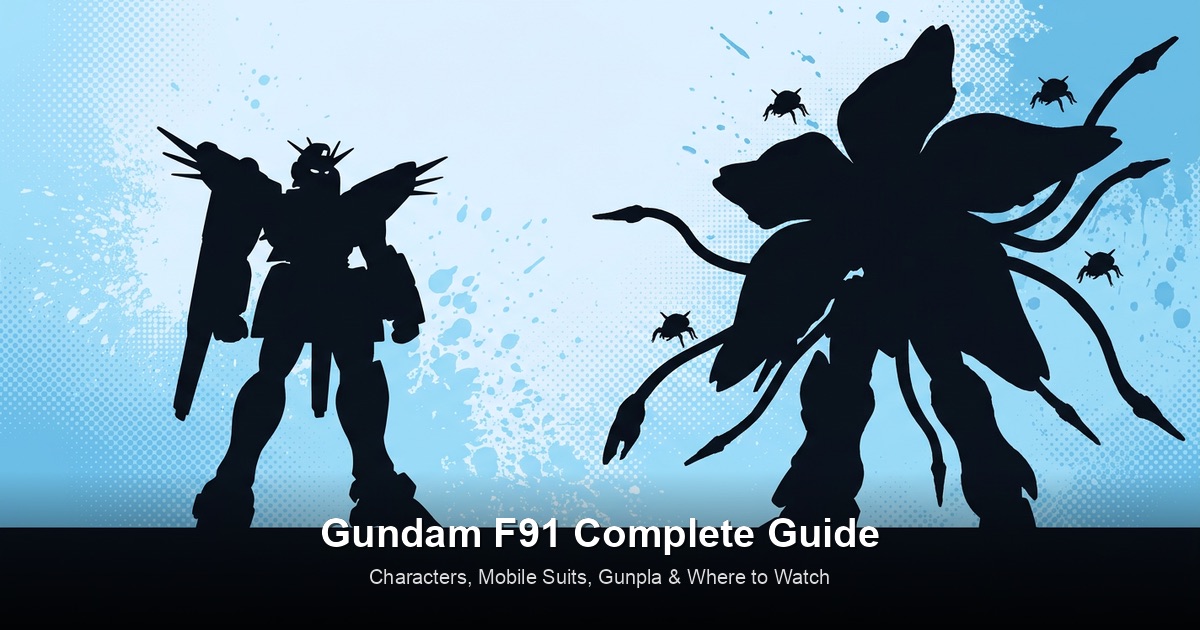
The film's climax is the battle against the Rafflesia, a massive mobile armor piloted by Iron Mask. Resembling the parasitic flower for which it is named, the Rafflesia is a grotesque giant that wields multiple tentacle-like Tentacular Rods and fires devastating beams. Controlled directly through Iron Mask's enhanced brainwaves, the machine possesses overwhelming combat power that ordinary mobile suits cannot match.
Seabook unleashes the Gundam F91's full potential. During the fierce battle, the F91 reaches its maximum operational limit, triggering a remarkable phenomenon. The F91's M.E.P.E. (Metal Peel-off Effect) system activates: the extreme heat causes sections of the machine's surface armor to peel away and scatter into space. These armor fragments contain metal and electronic components, causing enemy sensors to register them as "additional F91 units."
As a result, the Rafflesia's computer displays multiple F91s. Iron Mask, confirming visually that what he sees are merely afterimages, exclaims in shock:
"Afterimages with mass?!"
This is F91's signature scene and most famous line. What is essentially a design flaw, a heat management solution for an overheating problem, becomes an extraordinary tactical advantage in combat. Moving at high speed like a series of phantoms, the F91 overwhelms both the Rafflesia's sensors and Iron Mask's own judgment.
Riding this state to its fullest, Seabook weaves through the Rafflesia's tentacles and closes to point-blank range. He then fires the VSBR (Variable Speed Beam Rifle) at maximum output, piercing through the Rafflesia and destroying Iron Mask.
Epilogue: Cecily's Return and the Light of Hope
Iron Mask is defeated, but in the chaos of battle, Cecily is cast adrift in open space. Her Vigna Ghina destroyed, she floats through the void in nothing but a normal suit (space suit).
Finding a single person in the vastness of space is virtually impossible. But Seabook refuses to give up. Piloting the battered F91, he searches the void. He removes his helmet and relies on his own senses, his Newtype empathy, to feel for Cecily's presence.
And Seabook, pushing the damaged F91 beyond its limits, finds Cecily drifting in space. He reaches out and grasps her hand.
As the two are reunited, the theme song "ETERNAL WIND" plays. Hiroko Moriguchi's crystalline voice envelops the two young people who have survived the battle. Torn apart by war and brought back together, their figures against the backdrop of space embody the new hope of the Universal Century.
Cosmo Babylonia's establishment continues, and the war is far from over. But even amidst the fires of conflict, people can reach out to one another. F91 closes with this message.
Complete Character Guide: The Compelling Cast of F91
F91 features an unusually large cast for a 120-minute film, a remnant of its origins as a planned television series. Here we examine the principal characters in detail.
Seabook Arno: An Ordinary Young Man's Extraordinary Strength
The protagonist. A 17-year-old student in Frontier IV's high school mechanical engineering department. Skilled with machines and trusted by his friends as a reliable companion. His personality is straightforward, action-oriented, and loyal. Among Gundam protagonists, he stands out for being depicted as a relatively "normal" young man.
Unlike Amuro Ray's introversion or Kamille Bidan's intensity, Seabook is a "healthy, ordinary youth." Yet it is precisely this ordinariness that amplifies the power of his story, as the suffering of civilians caught in war and the simple desire to protect loved ones resonate all the more strongly.
Seabook's mother Monica is a bio-computer researcher who prioritized work over family, while his father Leslie is a gentle man who tried to hold the household together. Seabook harbors complex feelings toward his mother, a mixture of respect and resentment, and piloting the F91 becomes a way of confronting her legacy.
In combat, Seabook shows remarkable results from his very first battle and gradually awakens as a Newtype. However, F91's depiction of Newtype abilities is relatively restrained, focusing less on superhuman combat reflexes and more on "the power to sense and empathize." The final scene where he removes his helmet to "feel" Cecily's presence perfectly encapsulates the essence of what it means to be a Newtype.
Cecily Fairchild (Berah Ronah): A Girl Torn Between Two Names
The heroine. Seabook's childhood friend and classmate. Bright, graceful, and popular. Her true identity is Berah Ronah, legitimate granddaughter of the Ronah family. Taken from the family as a child by her mother Nadia, she was raised as Cecily Fairchild.
Forced to confront her origins when the Crossbone Vanguard reclaims her, Cecily's internal conflict forms the dramatic core of F91. While she finds some resonance with her grandfather Meitzer's ideals, she cannot condone the violence used to achieve them, particularly the cruelty of her biological father Carozzo (Iron Mask).
Torn between "who she is as Cecily Fairchild" and "her role as Berah Ronah," she ultimately chooses Cecily's heart: a heart that cares for others and rejects violence. This choice represents a clear "no" to the ideology of Cosmo Aristocratism run amok, and lies at the very core of F91's message.
Carozzo Ronah (Iron Mask): A Father's Descent into Madness
The film's primary antagonist. Commander of the Crossbone Vanguard's military operations, he is known as "Iron Mask" for the platinum mask he permanently wears. An adopted member of the Ronah family, he was married to Meitzer's daughter Nadia.
Carozzo's tragedy is that of "a man driven to despair by abandonment." When his wife Nadia took their daughter Berah (Cecily) and left for another man, something in Carozzo broke. He concealed his shame, rage, and grief behind a mask and gradually shed his humanity entirely.
He further modified his own body, becoming a cyborg capable of directly interfacing with psycommu systems. No longer truly human, he became consumed by a twisted vision of "purifying humanity" and executed mass genocide through the Bugs.
The Gundam franchise features many "masked men," from Char Aznable to Quattro Bajeena to Full Frontal. Among them, Iron Mask is the one who has most completely "lost the humanity beneath the mask." His mask is not a symbol of anonymity but a testament to having abandoned what it means to be human.
Meitzer Ronah: The Light and Shadow of an Idealist
Patriarch of the Ronah family and founder of the Crossbone Vanguard. The architect of Cosmo Aristocratism, he envisions Cosmo Babylonia as a new order to replace the corrupt Federation.
Meitzer himself is portrayed as a non-violent idealist. His goal is a world guided by "aristocrats" of noble spirit and ability, not one ruled through massacre or terror. But in reality, revolution cannot be achieved without military force, and his ideals are ultimately co-opted by extremists like Iron Mask.
Meitzer's tragedy lies in the dilemma of "ideals realized through violence," a recurring theme in Tomino's works: well-intentioned ideals that imperceptibly become justifications for brutality.
Other Key Characters
| Reese Arno | Seabook's younger sister, approximately 10 years old. She adores her brother and stays by his side throughout the conflict. Her vulnerability symbolizes the toll war takes on civilians |
|---|---|
| Monica Arno | Seabook's mother. A bio-computer researcher deeply involved in the Gundam F91's development. Her decision to prioritize career over family created a rift with her son |
| Leslie Arno | Seabook's father. A gentle man who tried to maintain the family despite his wife's absence. He is injured during the Frontier IV attack |
| Zabine Chareux | Ace pilot of the Crossbone Vanguard, piloting the custom Berga Giros. A skilled soldier with a sense of chivalry who is critical of Iron Mask's extremism. He later appears as an important character in Crossbone Gundam |
| Annamarie Bourget | A female pilot of the Crossbone Vanguard assigned as Cecily's instructor. She begins to question the organization's methods |
| Leahlee Edaberry | A Federation female officer serving as acting captain of the Space Ark. She commands actual combat operations despite her vessel being a training ship |
| Birgit Pirjo | A pilot assigned to the Space Ark who serves as Seabook's combat mentor. An earnest and dedicated soldier |
| Dorel Ronah | Carozzo's son and Cecily's half-brother. He serves as a unit commander in the Crossbone Vanguard and participates in combat personally |
Complete Mobile Suit Encyclopedia: Machines and Mechanics of F91
The mobile suits of F91 represent a dramatic departure from previous Gundam series with their "miniaturized MS" concept. Standing approximately 15 meters tall, this new generation of machines features fresh designs and innovative technical specifications. Kunio Okawara's mechanical designs retain recognizable Gundam DNA while clearly signaling the arrival of a new era.
Gundam F91: The Formula Project's Ultimate Achievement
| Model Number | F91 |
|---|---|
| Official Name | Gundam F91 (Formula 91) |
| Head Height | 15.2 meters |
| Empty Weight | 7.8 tons |
| Full Weight | 19.9 tons |
| Generator Output | 4,250 kW |
| Armor | Gundarium alloy high-ceramic composite |
| Main Armament | Beam rifle, beam sabers x2, beam launcher, VSBR x2, beam shield |
| Special Systems | Bio-computer, M.E.P.E. (Metal Peel-off Effect) |
| Developer | SNRI (Strategic Naval Research Institute) |
| Pilot | Seabook Arno |
The Gundam F91 was developed by the Strategic Naval Research Institute (SNRI, also known as "Sanary") as the culmination of the Formula Project. Despite being approximately 3 meters shorter than conventional 18-meter-class mobile suits, it surpasses them in output, mobility, and firepower. It is the embodiment of "smaller, faster, stronger."
The bio-computer, developed by Seabook's mother Monica, is a revolutionary system that reads the pilot's brainwaves and biological data, reflecting them in the machine's controls. It represents the practical realization of human-machine integration and can be considered an evolution of the psycommu system. As Seabook's Newtype abilities awaken, the bio-computer's limiters are released, unlocking the F91's true potential.
The VSBR (Variable Speed Beam Rifle) is the F91's most powerful weapon. Two units are mounted on the waist and deployed when in use. Its defining feature is the ability to vary the beam's velocity. In low-speed, high-penetration mode, it can pierce the thickest armor. In high-speed mode, the beam is nearly impossible to dodge. This versatility makes it a supremely adaptable weapon system.
The M.E.P.E. (Metal Peel-off Effect) occurs when the F91 operates at maximum capacity. Surface armor sections peel away due to extreme heat, a safety mechanism built in to address an engineering limitation in heat dissipation. On the battlefield, however, this flaw produces an unexpected benefit: the shed armor fragments register on enemy sensors as additional F91 units. This is the true nature of the "afterimages with mass."
Crossbone Vanguard Mobile Suits
The Crossbone Vanguard's mobile suit lineup is built on a distinctive design philosophy. Their sharp, angular aesthetics evoke European knights and are immediately distinguishable from Federation machines.
| Den'an Zon | The Crossbone Vanguard's main production unit. Equipped with a shot lancer (physical projectile spear) and beam shield. Vastly outperforms Federation mass-production suits. The knight's lance-inspired shot lancer symbolizes the Crossbone Vanguard's chivalric ideals |
|---|---|
| Den'an Gee | A commander variant of the Den'an Zon with enhanced communications and sensor capability. Superior baseline performance to the Den'an Zon |
| Evil S | A high-performance production unit from a different design lineage than the Den'an series, built with a more aggressive combat focus |
| Berga Giros | Zabine Chareux's custom ace unit. Features diverse armament including shot lancer and beam sabers. Distinguished by its purple color scheme |
| Vigna Ghina | A custom unit given to Cecily (Berah Ronah). Represents the pinnacle of Crossbone Vanguard technology, with a white and red color scheme befitting "the princess of the Ronah family." Excels in mobility with beam rifle and beam shield |
| Rafflesia | A massive mobile armor piloted by Iron Mask (Carozzo Ronah). Modeled after the rafflesia flower, this enormous machine wields multiple Tentacular Rods (tentacle-like attack terminals). Controlled by Iron Mask's enhanced brainwaves. Also serves as the mothership for the Bug units |
Earth Federation Mobile Suits
Federation machines are clearly outdated compared to the Crossbone Vanguard's suits. In F91's narrative, the Federation's technological inferiority symbolizes its organizational decay.
| Heavygun | The Federation's standard production suit. A miniaturized MS, but vastly inferior to Crossbone Vanguard machines. The Frontier IV garrison's Heavyguns were overwhelmed by invading Den'an Zons |
|---|---|
| Jegan | A versatile Federation MS in service since the Char's Counterattack era. Obsolete by UC 0123 but still operational. A conventional-sized machine, not a miniaturized MS |
| G-Cannon | A mass-production MS developed under the Formula Project. Built by SNRI like the F91, focused on fire support roles. Carried aboard the Space Ark |
VSBR and Beam Shield: F91-Era Technologies
The F91 era saw the practical deployment of numerous technologies that did not exist during the One Year War.
The VSBR, as described above, is a beam rifle with variable projectile velocity. Previous beam weapons were simply "powerful but straightforward." The VSBR expands tactical options by varying beam speed: low-speed beams melt through armor with penetrating force, while high-speed beams are nearly impossible to evade.
The beam shield creates a defensive barrier from beam energy. Unlike physical shields (metal plates), beam shields can completely block beam attacks. Crossbone Vanguard machines are equipped with beam shields as standard, which is a major reason why Federation beam rifles proved largely ineffective against them. The F91 also carries a beam shield.
The shot lancer is the Crossbone Vanguard's signature weapon: a lance-type close-combat arm with a built-in physical projectile launcher. In environments where Minovsky particles disable radar, having a weapon independent of beam technology is invaluable. Its design, reminiscent of a European knight's lance, aligns with the chivalric imagery of Cosmo Aristocratism.
Thematic Analysis: The Questions F91 Asks
F91 is far more than a robot action movie. Director Yoshiyuki Tomino wove multiple profound themes into the 120-minute narrative. Here we examine the major thematic threads.
"Aristocracy vs. Democracy": Which Is Right?
At the foundation of F91's story is the question: "What should humanity do when democracy stops functioning?" The Earth Federation is thoroughly corrupt. Politicians serve only themselves. The military is a hollow shell. The Ronah family sees this as "democracy's failure" and proposes aristocratic rule as the alternative.
Meitzer Ronah's vision sounds partially reasonable. A corrupt organization needs principled leadership to reform it, and this is hard to argue against. But who decides who is "superior" or "fit to lead"? When a single family (the Ronahs) claims that authority, it becomes merely a different form of dictatorship.
In practice, Cosmo Aristocratism is co-opted by madmen like Iron Mask and used to justify genocide. F91 coldly depicts the process by which "noble ideals" degrade into "rule through terror," a universal warning that echoes throughout real-world history.
"Family Collapse and Rebuilding": The Homes of Seabook and Cecily
Another crucial theme in F91 is "family." Most major characters grapple with family dysfunction.
Seabook's home is fracturing because his mother Monica is consumed by her research. His father Leslie tries to hold things together, but the gap left by an absent mother cannot be filled. Piloting the F91 means confronting the legacy of the mother who was never there.
Cecily's family situation is even more complex. Her biological father Carozzo has descended into madness. Her biological mother Nadia fled with another man. Her stepfather Theo Fairchild was merely a guardian. Her grandfather Meitzer is an idealist who inadvertently created instruments of violence. Cecily faces the fundamental question: "Who is my real family?"
Fascinatingly, Iron Mask Carozzo is himself a victim of family collapse. A man whose wife and daughter abandoned him channels that pain into hatred for the world and plots humanity's annihilation. This is Tomino's characteristic insight: individual tragedy escalating into global catastrophe.
"Young People Caught in War": The Meaning of the Tagline
"When will people be able to forget war?" F91's tagline is a question that runs through the entire work.
Forty-four years have passed since the One Year War. Humanity experienced the horrors of conflict and vowed "never again." Yet the Gryps Conflict, Neo Zeon Wars, and Char's Rebellion followed in succession, and in F91's era, the fires of war ignite once more.
Seabook was a boy living a life completely untouched by war. Then a sudden invasion destroys everything, and he is forced into a mobile suit cockpit. "Why me?" "Why now?" The confusion and anger of a young person caught in war mirrors the experiences of real people in real conflicts around the world.
F91 is both a warning that "war comes when you have forgotten it" and a story of hope that "even so, people can face forward." Seabook grasping Cecily's hand in space demonstrates that even in war's despair, human bonds can become hope.
A New Interpretation of Newtype Theory
The concept of "Newtypes" has always been central to Gundam. In the original series, Newtypes were depicted mystically as "the next stage of human evolution." From Zeta Gundam onward, the emphasis shifted to their exploitation as "weapons of war."
F91's treatment of Newtypes is relatively understated but represents an important evolution. Seabook's Newtype abilities manifest less as superhuman combat reflexes and more as "the power to sense others' feelings." The final scene where he removes his helmet to "feel" Cecily's presence succinctly expresses the essence of what Newtypes truly are: the capacity for deep human understanding.
Iron Mask, by contrast, gained the ability to directly operate psycommu through cybernetic modification, but lost his humanity in the process. The contrast between technological "enhancement" and natural "awakening" lies at the heart of F91's Newtype philosophy.
Music and Visual Expression: "ETERNAL WIND" and Theatrical-Quality Animation
F91 is celebrated not only for its narrative content but also for the beauty of its visuals and music. The theatrical production quality elevates the emotional impact of the story.
Theme Song: "ETERNAL WIND"
The theme song "ETERNAL WIND ~Hohoemi wa Hikaru Kaze no Naka~" is a ballad performed by Hiroko Moriguchi. Moriguchi made her debut with Zeta Gundam's opening theme "Water Star" (Mizu no Hoshi e Ai wo Komete) and returned to the Gundam franchise for F91.
"ETERNAL WIND" is widely regarded as one of the finest songs in the entire Gundam franchise. Its transparent melody and hopeful lyrics match the film's ending with absolute perfection. The moment the song begins to play as Seabook finds Cecily drifting in space is frequently cited by fans as "the most beautiful ending in all of Gundam."
In NHK's "All Gundam Popular Vote" in 2019, "ETERNAL WIND" ranked 3rd in the Gundam Song category, demonstrating its enduring popularity more than three decades after the film's release.
Satoshi Kadokura's Film Score
The film's background music was composed by Satoshi Kadokura. His orchestra-centered, richly layered score provides the grand scale appropriate to a theatrical work, expertly supporting the tension of combat scenes, the emotion of dramatic moments, and the exhilaration of the climax.
Theatrical-Quality Animation
F91's animation was among the finest of its era for theatrical anime. The mobile suit battle sequences are particularly outstanding in their fluid motion, explosive and lighting effects, and sense of speed.
Yoshikazu Yasuhiko's involvement as character design concept artist is a major contributor. His character designs feature realistic proportions and delicate facial expressions. For fans of the original Gundam, they offer nostalgic familiarity alongside the freshness of a new-generation cast.
The theatrical release had some animation inconsistencies due to production schedule delays. A later "Complete Edition" (Director's Cut) corrected these issues, adding approximately five minutes of new footage and re-dubbing the audio track. Most currently available releases are based on this Complete Edition.
Production History and Reception: F91's Journey
F91's production process contains numerous fascinating episodes. Let us examine its reception at release and the ongoing trajectory of reappraisal.
Staff Composition: "Reuniting the Original Team"
Sunrise issued a strong request for the film to be made by the original creative team. In response, Yoshiyuki Tomino returned as director, Yoshikazu Yasuhiko provided character design concepts, and Kunio Okawara handled mechanical design, reuniting the core staff of the first Gundam.
Notably, Yasuhiko served as character design "concept artist" only; actual animation direction was handled by Kenoh Kitahara. Yasuhiko was shifting his career focus toward manga at this time and his direct involvement in anime production was limited. Nevertheless, his design sensibility is clearly alive in F91's characters.
The Impact of Converting from TV to Theatrical Format
As previously discussed, F91 was originally planned as a TV series. The compression of a 50-episode story into 120 minutes created several notable effects:
- Insufficient character development: Many characters simply "appear" without receiving adequate screen time for proper development
- Rapid story progression: Scene transitions are fast, and causal relationships in the plot can be difficult to follow in places
- Underexplained worldbuilding: Details about Cosmo Aristocratism and the Formula Project are not fully conveyed within the film
- Difficulty with emotional investment: Character psychology can shift in ways that feel abrupt
At the same time, the compression creates a compelling pace and scene-to-scene density that function as strengths of a theatrical work. F91's "overstuffed" nature is, for better or worse, part of its identity.
Reception at Release
Upon its March 1991 release, F91 achieved respectable but modest box office results compared to its predecessor Char's Counterattack (1988). Critical response centered on "stunning visuals but a rushed narrative."
The absence of popular characters like Amuro and Char, replaced by an entirely new-generation cast, was also a barrier for some fans. Reception was divided between those excited by "a new beginning for Gundam" and those unsettled by "a cast of strangers."
The Path to Reappraisal: From "Underappreciated" to "Beloved"
In the years following its release, F91 gradually gained new appreciation. Several factors contributed:
- Rediscovery of visual beauty: Repeat viewings on video, LaserDisc, DVD, and Blu-ray brought renewed recognition of the theatrical-quality animation
- "ETERNAL WIND"'s popularity: The theme song's standalone success served as an entry point to the film
- Crossbone Gundam's influence: The popular manga sequel increased interest in the F91 source material
- Gunpla development: High-quality model kits of the F91 and Vigna Ghina spread awareness of the mechanical designs' appeal
- Reinterpreting "overstuffed": The high information density came to be seen positively as "a film that reveals something new with every viewing"
Today, F91 is frequently described as an "underappreciated masterpiece" or "hidden gem." It occupies a unique position among Universal Century Gundam works and enjoys strong, dedicated fan support.
Connection to Crossbone Gundam: F91's Story Continues Here
To fully appreciate F91, one must consider its relationship with the manga Mobile Suit Crossbone Gundam. This work, which depicts the "after" of F91's story, is an essential companion that fills in what the film left untold.
What Is Crossbone Gundam?
Mobile Suit Crossbone Gundam is a manga written by Yoshiyuki Tomino and illustrated by Yuichi Hasegawa. It was serialized in Monthly Shonen Ace from 1994 to 1997. Set in UC 0133, ten years after F91.
Following the establishment of Cosmo Babylonia depicted in F91, a new threat emerges for the Earth Sphere. The "Jupiter Empire," based in the Jupiter sphere, plots an invasion of the Earth Sphere. Standing against them is an armed force calling itself the "Space Pirates Crossbone Vanguard."
What Happened to Seabook and Cecily
F91's protagonists return in major roles in Crossbone Gundam.
Seabook Arno operates under the alias "Kincade Nau," serving as the ace pilot of the Space Pirates Crossbone Vanguard. Piloting the Crossbone Gundam X1, he presents a very different image from the uncertain youth of F91: a battle-hardened warrior.
Cecily Fairchild has taken the name "Berah Ronah" and leads the Space Pirates Crossbone Vanguard. Her choice to use the Ronah name, which once threatened to define her, for the purpose of protecting people demonstrates remarkable growth from her F91 arc.
Zabine Chareux from F91 also returns in a significant role, with his actions profoundly impacting the Crossbone Gundam narrative.
Crossbone Gundam as the "Lost Continuation" of the F91 TV Series
Tomino reportedly provided original story material equivalent to 26 anime episodes for Crossbone Gundam. This can be viewed as an extension of the world envisioned for the unrealized F91 television series.
The character growth and geopolitical developments of the UC 0120s-0130s that F91 could not fully depict are supplemented by Crossbone Gundam. For anyone who watched F91 and felt "the story ended in the middle," Crossbone Gundam provides the best possible continuation.
Crossbone Gundam is a manga-only work; anime adaptation was never realized for many years. Among fans, "the anime adaptation of Crossbone Gundam" has long been a cherished wish, and anticipation has continued to build in recent years.
Viewing Guide: How to Get the Most Out of F91
For those about to watch F91 for the first time, or those looking to revisit it, here are key viewing tips.
Recommended Pre-Viewing
F91 is a Universal Century story, but its direct narrative connections to previous works are minimal. Neither Amuro nor Char appears, so it can fundamentally be enjoyed without prior viewing. However, the following background knowledge enhances the experience:
- Recommended: Familiarity with the basic Universal Century concepts (Earth Federation, space colonies, mobile suits, Newtypes) helps the worldbuilding click into place
- Helpful: Watching the original Mobile Suit Gundam (First Gundam) provides a sense of how much time has passed since the One Year War and why the Federation has become so corrupt
- For deeper engagement: Watching Char's Counterattack establishes the 30-year gap from Char's Rebellion and the complacent atmosphere of the post-war Earth Sphere
Theatrical Release vs. Complete Edition
F91 exists in two versions: the "Theatrical Release" and the "Complete Edition (Director's Cut)."
| Theatrical Release | The original version screened in theaters on March 16, 1991. Contains some animation inconsistencies due to production schedule delays |
|---|---|
| Complete Edition | A revised version produced after the theatrical run. Animation corrections, approximately 5 minutes of new footage, and re-dubbed audio. Most currently available Blu-ray and streaming versions are based on this edition |
What to Watch For
- The opening everyday scenes: The calm school festival atmosphere that is shattered by the invasion. Feel the fragility of peace
- Cecily's changing expressions: From Fairchild to Berah Ronah and back to Cecily. Her face maps the story's psychological arc
- Mobile suit scale: The fresh dynamism of machines smaller than previous Gundams moving with crisp, agile energy
- The horror of the Bugs: The depiction of indiscriminate killing by autonomous weapons. The ultimate dehumanization of war
- The final 10 minutes: Afterimages with mass, the battle against the Rafflesia, and the reunion with Cecily. The essence of F91 is concentrated here
- When "ETERNAL WIND" begins to play: The emotional impact of this moment is something you will never forget once experienced
What to Watch After F91
After enjoying F91, the following works make excellent follow-ups:
- Mobile Suit Crossbone Gundam (manga): A direct sequel set 10 years after F91. Follows Seabook and Cecily's later adventures
- Mobile Suit Victory Gundam (TV): Set another 30 years later in UC 0153. Shows the further evolution of the miniaturized MS era. Directed by Yoshiyuki Tomino
- Mobile Suit Gundam: Hathaway's Flash (theatrical): A sequel to Char's Counterattack set in UC 0105, roughly 18 years before F91. Depicts the Federation government's continued deterioration
Frequently Asked Questions (FAQ): Answering Your F91 Questions
Q. Is F91 a "failure"?
A. To call F91 a "failure" is premature. The "overstuffed" quality resulting from compressing a TV series concept into 120 minutes is undeniable. However, its visual beauty, mechanical design, music, and the Seabook-Cecily drama achieve a high level of quality. While opinions were divided at release, F91 has since been reassessed as an "underappreciated masterpiece." Fans frequently discuss "what if the TV version had been realized," a testament to the high regard for the story's potential.
Q. What are "afterimages with mass"?
A. This phenomenon occurs when the Gundam F91 operates at maximum capacity, triggered by the M.E.P.E. (Metal Peel-off Effect) system. To dissipate extreme heat, sections of surface armor peel away. Because these fragments contain metal and electronic components, enemy sensors register them as "additional F91 units." In other words, an engineering solution for overheating inadvertently creates a "phantom" effect in combat. The phrase became iconic after Iron Mask exclaims "Afterimages with mass?!" upon witnessing the phenomenon.
Q. What is the VSBR? Why is it so powerful?
A. VSBR stands for Variable Speed Beam Rifle, commonly called "Vsbr" (Vesbah). It is a beam rifle that can vary the velocity of its beam projectiles. At low speed, the beam has high penetration power and can pierce thick armor. At high speed, the beam travels too fast to dodge. This means "use low speed to punch through heavy defenses, and high speed to hit agile targets." Two units are mounted on the F91's waist and deploy for use.
Q. How does F91 connect to Victory Gundam?
A. Mobile Suit Victory Gundam is a TV series set approximately 30 years after F91, in UC 0153. While there are no direct character connections, it depicts a world where the miniaturized MS era pioneered by F91 has further evolved. The enemy faction, the Zanscare Empire, also carries ideological ties to Cosmo Aristocratism. Following the path of F91, then Crossbone Gundam, then Victory Gundam provides a clear picture of the late Universal Century.
Q. Is Seabook a Newtype?
A. Yes. While the word "Newtype" is used sparingly in the film itself, Seabook's high compatibility with the bio-computer, his extraordinary combat adaptation, and his ability to "sense" Cecily's presence in the final scene all represent Newtype awakening. However, unlike the dramatic Newtype portrayals of Amuro or Kamille, Seabook's abilities are depicted more subtly as a natural extension of empathy.
Q. Why didn't F91 become a TV series?
A. F91 was originally planned as a TV series, but production scheduling problems and staff coordination difficulties made a TV broadcast unfeasible. The decision was made to produce it as a theatrical film instead. The movie's plot was constructed from story outlines for the first 13 episodes of the TV version, condensed into approximately 120 minutes. Because it represents just the opening chapters of a much larger story, the impression of "an unfinished narrative" is an understandable reaction.
Q. Where can I watch F91?
A. F91 is available on Blu-ray and DVD, and may be available on various streaming services depending on your region. Check platforms such as Crunchyroll, Funimation, or regional equivalents for current availability. Most currently distributed versions are based on the "Complete Edition."
Conclusion: F91, An Unfinished Masterpiece and an Eternal Wind
Mobile Suit Gundam F91 is a work that carries both the weight and the energy of a grand television concept compressed into a theatrical film. The rushed pacing and underdeveloped characters are real limitations, but F91 more than compensates with its breathtaking visuals, remarkable music, and incisive thematic depth.
The story of Seabook and Cecily depicts young people buffeted by war while affirming that "even so, people can care for one another." Reaching out across the void of space to grasp a loved one's hand, that final scene carries an emotional resonance that transcends time.
By ushering in the era of miniaturized mobile suits, introducing iconic concepts like the VSBR and afterimages with mass, and laying the foundation for the Crossbone Gundam sequel, F91 serves as a vital "bridge to a new era" in Universal Century history.
"When will people be able to forget war?" The answer has not been found in the more than 30 years since this question was posed. But the importance of "continuing to remember, so that we never forget," as F91 shows us, blows on like an eternal wind.