After War Gundam X — Complete Guide— Story, Mobile Suits & Hidden Gem Legacy
Contents
- 01What Is Gundam X? — A Story of Rebirth Told by a Gundam Standing Alone in the Wasteland
- 02The After War World — What It Means to Live on a Shattered Earth
- 03Garrod Ran and Tiffa Adill — The Purest Love Story in All of Gundam
- 04Complete Character Guide — The Freeden Crew, the Nemeses, and the Movers of a World
- 05Complete Mobile Suit Guide — Gundam X, Double X, and the Enemy Machines
- 06Full Story Guide — Gundam X's Journey in Four Acts
- Act I: "Encounter and Departure" (Episodes 1–10) — A Boy, a Girl, and a Gundam in the Wasteland
- Act II: "The Journey Across the Land" (Episodes 11–20) — Artificial Newtypes and the Illusion of "Evolution"
- Act III: "The Rise of the New Federation" (Episodes 21–30) — War's Approach and a New Generation of Machines
- Act IV: "To Space, and the Moon" (Episodes 31–39) — The Final Answer to "What Is a Newtype?"
- 07"What Is a Newtype?" — The Only Definitive Answer in Gundam History
- 08The Truth Behind the "Cancellation" — Why Gundam X Was Shortened
- 09Top 10 Iconic Scenes and Lines — The Moments That Define Gundam X
- #1: "Is the Moon Out?" / "I Can See the Moon!"
- #2: D.O.M.E.'s Rejection of the Newtype Myth
- #3: Episode 1, "The Moon Is Out" — The First Satellite Cannon Firing
- #4: Garrod Obtains the Gundam Double X
- #5: Jamil's Past — The Satellite Cannon Trauma
- #6: The Resolution with Carris — "The Tragedy of the Artificial Newtype"
- #7: The Frost Brothers Unmasked — The Shame of "Category F"
- #8: Witz and Roabea's Unspoken Declaration of Loyalty
- #9: The Finale — "The Moon Will Always Be There"
- #10: The Opening Theme "DREAMS" — A Song That Captures the Series' Soul
- 10Why You Should Watch Gundam X — It's Time to Discover This Underrated Masterpiece
- 11Conclusion — Gundam X Is a Masterpiece That Demands to Be Discovered
What Is Gundam X? — A Story of Rebirth Told by a Gundam Standing Alone in the Wasteland
After War Gundam X is the most underrated and most overdue-for-reappraisal entry in the entire Gundam franchise.
Broadcast in 1996 with 39 episodes, the label of "cancelled show" preceded its reputation for years, consigning it to the lower ranks of the Gundam pantheon. Yet those who have actually watched it invariably ask the same question: "Why isn't this more widely celebrated?"
The setting is After War (A.W.) year 15. During the catastrophic 7th Space War, a massive number of space colonies were dropped onto Earth, reducing the global population from roughly 10 billion to a mere 98 million. In this post-apocalyptic world — a wasteland littered with the debris of civilization — a 15-year-old boy named Garrod Ran scrapes by however he can, surviving on grit and resourcefulness.
One day he encounters a girl: Tiffa Adill, a Newtype with powerful precognitive abilities. Determined to protect her, Garrod plunges into battle and climbs into a legendary weapon abandoned in the desert — Gundam X. When he asks, "Is the moon out?" and the Satellite Cannon roars to life, the story truly begins.
At its core, this series is a pure love story wrapped in the shell of a mecha anime, a philosophical inquiry into the nature of Newtypes, and a coming-of-age tale about the relationship between adults and children. It is the only Gundam work that tackles head-on the franchise's most enduring question — "What is a Newtype?" — and delivers a definitive, unambiguous answer from an angle no other series has attempted.
Series Data (TV Series, 39 Episodes, 1996)
| Official Title | After War Gundam X (機動新世紀ガンダムX) |
|---|---|
| Format | TV Series |
| Episodes | 39 (originally planned as 4 cours / ~50 episodes, shortened to 3 cours) |
| Broadcast Period | April 5, 1996 – December 28, 1996 |
| Network | TV Asahi (moved to Saturday 6:00 AM slot from episode 27 onward) |
| Director | Shinji Takamatsu |
| Series Composition | Hiroyuki Kawasaki |
| Character Design | Nobuyoshi Nishimura |
| Mechanical Design | Kunio Okawara, Junya Ishigaki |
| Music | Yasuo Higuchi |
| 1st OP | "DREAMS" by ROMANTIC MODE |
| 2nd OP | "Resolution" by ROMANTIC MODE |
| 1st ED | "HUMAN TOUCH" by Warren Wiebe |
| 2nd ED | "Gin'iro Horizon" by Rie Tanaka |
| Studio | Sunrise |
| Timeline | After War (A.W.) year 15 |
| Continuity | Standalone alternate universe (not part of Universal Century) |
Gundam X's Place in the Franchise — The Final Chapter of the "Heisei Trilogy"
Gundam X is the closing chapter of the so-called "Heisei Trilogy", following 1994's Mobile Fighter G Gundam and 1995's New Mobile Report Gundam Wing. Where G Gundam bet on martial arts spectacle and Wing on political intrigue and bishōnen characters, Gundam X attempted a return to the themes of the original Mobile Suit Gundam.
But this was no simple nostalgia trip. It took the concept of the "Newtype" — the very idea that the original Gundam had introduced — and asked a radical question: "Is the Newtype truly the next step in human evolution, or merely a collective fantasy?" The Universal Century saga spent decades wrestling with this dilemma without ever reaching a clear answer. Gundam X, operating from the outside vantage point of an alternate universe, delivered one. That is its literary significance.
Director Shinji Takamatsu — Born from "A Single Gundam Standing Alone in the Wasteland"
Director Shinji Takamatsu was best known for his work on the Brave (Yuusha) series, particularly Brave Exkaiser. In November 1995, Sunrise abruptly told him, "You're doing Gundam," and he was thrust into creating Gundam X on a tight schedule.
In truth, Takamatsu had already served an uncredited role rescuing the latter half of Gundam Wing after its original director stepped away. His competence in that crisis earned him this new assignment.
As Takamatsu sifted through ideas, one image refused to leave his mind: "A single Gundam, seen from behind, standing alone in a barren wasteland." Not a glamorous launch sequence. Not a fierce battle. Just a mobile suit quietly existing in a world where the war had already ended. From that image, the entire world of Gundam X was born.
This founding vision is precisely why Gundam X possesses a "quietness" and "poetic sensibility" unlike any other entry in the franchise — and why it pioneered the uniquely evocative genre of post-apocalyptic Gundam.
The After War World — What It Means to Live on a Shattered Earth
The world-building of Gundam X is, across the entire Gundam franchise, the most brutal and the most hauntingly beautiful.
The 7th Space War — The Day 10 Billion Became 98 Million
The 7th Space War was an all-out conflict between the Earth Federation and the Space Revolutionary Army (SRA), a coalition of space colony nations.
The Federation deployed Newtype pilots in Flash System–equipped Gundams en masse. The Satellite Cannon — powered by microwave energy transmitted from a lunar base — served as a strategic superweapon that overwhelmed the colony forces. Cornered, the SRA resorted to a final, desperate measure: they dropped a massive number of space colonies onto Earth.
The colony drops reduced Earth's population from approximately 10 billion to 98 million. The environment was devastated and civilization collapsed. This cataclysm marked the transition from the old calendar to the After War (A.W.) era. The story begins in A.W. 15, when Earth's environment has only just begun to stabilize.
Vultures — The "Scavengers" Who Roam the Wasteland
In the ruins of civilization, a class of people arose who make their living salvaging the remnants of the old world — particularly mobile suits, weapons, and other military materiel. They are called "Vultures."
Some Vultures are decent people simply trying to survive; others are ruthless bandits who plunder and kill. Jamil Neate's ship, the Freeden, falls into the former category and is unique in that its primary mission is the protection of Newtypes. Opposing them are numerous hostile Vultures seeking to seize Gundam X for themselves.
This Vulture culture provides the perfect framework for a post-apocalyptic adventure saga. The Freeden traverses the wasteland like a ship crossing a desert sea, encountering incidents, meeting diverse characters, sometimes fighting, sometimes forming bonds. This journey structure gives Gundam X the compelling flavor of a road movie.
The New United Nations Earth and the Space Revolutionary Army — The Drumbeat of War Returns
In the second half of the series, a new order begins to emerge on the devastated Earth. Remnants of the old Federation military reorganize into the New United Nations Earth (NUNE) and set about reunifying the planet. Meanwhile, the Space Revolutionary Army in orbit is also rebuilding its colonial state.
Both powers drift back toward confrontation, and efforts to exploit Newtypes as weapons accelerate. "What did we learn from that war?" — this question becomes the backbone of the narrative, generating a rich ensemble drama in which the mistakes of the older generation collide with the will of the young.
A Uniquely Post-Apocalyptic Vision
Most Gundam series are wartime stories. The original Mobile Suit Gundam and Zeta Gundam both unfold during active conflicts. Gundam X stands apart because it is set after the war has already ended.
Most of humanity is dead. Cities are rubble. Governments have ceased to function. In this lawless wasteland, people survive however they can. Yet amid the ruin, there is not only despair but also a quiet, budding hope — a determination to start over.
This commitment to depicting "the beginning after the end" is what makes Gundam X fundamentally different from every other Gundam series. The world broke once — and now the question is what can be rebuilt from the pieces.
Garrod Ran and Tiffa Adill — The Purest Love Story in All of Gundam
At the heart of Gundam X lies not war, not politics, but the simple story of a boy who refuses to stop protecting the girl he loves.
Garrod Ran — The Strength of an "Ordinary Boy" Who Is Not a Newtype
Garrod Ran is an unusual Gundam protagonist. He is not a Newtype. He is not a soldier. He does not possess innate genius-level piloting talent (at least not initially). He is simply a 15-year-old war orphan who has survived on his own in the wasteland — nothing more.
His weapons are natural boldness and sheer nerve, and above all, a pure, unwavering desire to protect Tiffa. His reason for piloting a Gundam is not "to save the world" or "to avenge someone." It is simply and straightforwardly "to protect the girl I love." This unadorned honesty makes him stand out sharply among Gundam protagonists.
"I'll protect you!" — Garrod repeats this line throughout the series. In another show it might sound trite. When Garrod says it, it is neither a joke nor a metaphor. It is literally the only reason he fights.
And Garrod grows. From the reckless brawling of the early episodes, through Jamil's mentorship in the middle stretch, to the seasoned competence of the finale, his development as a pilot is steady and convincing. The precision shot in episode 33 — deliberately missing with the Twin Satellite Cannon at extreme range — stands as the definitive proof of how far he has come.
Tiffa Adill — The Quietest Heroine in Gundam History
Tiffa Adill is a 15-year-old girl with powerful Newtype precognitive abilities. She was held captive by a research institution and nearly exploited as a living weapon.
Her characterization is unique among Gundam heroines. She speaks very little, expresses her emotions sparingly, and communicates her inner world through drawing. Yet within that silence lie deep sensitivity and quiet strength.
Tiffa never directly participates in combat. But her precognitive visions guide the Freeden's course and repeatedly save the crew from disaster. More importantly, her very existence serves as Garrod's reason to fight and the engine that drives the story forward.
The scene where Tiffa first smiles at Garrod of her own accord. The moment she calls his name. Each of these small gestures is treated as a major event in this series. No dramatic confessions, no theatrical twists — the gradual, wordless deepening of understanding between two quiet souls is the essence of Gundam X's romance.
"Is the Moon Out?" — The Satellite Cannon as a Bond Between Two Hearts
Gundam X's Satellite Cannon is a superweapon that fires by receiving microwave energy transmitted from a lunar base. Consequently, it can only be activated when the moon is visible.
"Is the moon out?" — initially a purely tactical question about weapon readiness. As the story progresses, however, these words transform into a symbol of the bond between Garrod and Tiffa.
Moon visible = Satellite Cannon usable = Tiffa can be protected. This chain of logic imbues "the moon" with deeply romantic meaning. In the final arc, when Garrod reaches space and reunites with Tiffa on the lunar surface before unleashing the Twin Satellite Cannon, weapon and love fuse into one in a moment of breathtaking catharsis.
"I can see the moon!" — Garrod's shout at the moment of reunion simultaneously announces the Satellite Cannon's activation and the reconnection of two hearts. It is one of the greatest lines in all of Gundam.
The Happiest Ending in Gundam History
Gundam protagonists and their heroines typically meet tragic fates. Amuro and Lalah. Kamille and Four. Judau and Puru. The loss of loved ones is Gundam's recurring bass note.
Gundam X is different. In the final episode, Garrod and Tiffa both survive and walk hand in hand into the future. Freed from the curse of Newtype powers, they face tomorrow as an ordinary boy and girl.
This ending is one of the rarest things in Gundam: a genuine happy ending — and it is itself the message of the work. Whether you are a Newtype or not, living alongside the person you cherish is the most important "revolution" a human being can achieve.
Complete Character Guide — The Freeden Crew, the Nemeses, and the Movers of a World
The Freeden Crew — Jamil Neate and His Companions
| Garrod Ran | Protagonist. A 15-year-old war orphan who pilots Gundam X to protect Tiffa. Not a Newtype, but grows through sheer determination and courage. Voice: Wataru Takagi |
|---|---|
| Tiffa Adill | Heroine. A Newtype girl with powerful precognition. Quiet and seemingly fragile, but possessing inner steel. Gradually opens her heart through Garrod's presence. Voice: Mika Kanai |
| Jamil Neate | Captain of the Freeden. Former Gundam X pilot during the 7th Space War. Haunted by the trauma of using the Satellite Cannon, he has dedicated himself to protecting Newtypes. Serves as Garrod's adult mentor. Voice: Kenyu Horiuchi |
| Witz Sou | Pilot of Gundam Airmaster. A cheerful freelance Vulture who initially works for the Freeden for money but gradually develops genuine camaraderie. Voice: Kazuya Nakai |
| Roabea Loy | Pilot of Gundam Leopard. A flirtatious ladies' man with a surprisingly thoughtful side. Forms an excellent combat partnership with Witz. Voice: Takumi Yamazaki |
| Kid Salsamille | The Freeden's chief mechanic. A young prodigy responsible for maintaining and upgrading Gundam X and later Gundam DX. Voice: Motoko Kumai |
| Techs Farzenberg | The Freeden's physician. Calm and composed, he serves as Jamil's trusted confidant and the story's moral anchor. Voice: Bin Shimada |
| Sara Tyrell | The Freeden's first officer. A competent woman who supports Jamil with unwavering loyalty. Voice: Yumi Kakazu |
| Toniya Malme | The Freeden's operator and resident morale booster, with a bright and energetic personality. Voice: Kotono Mitsuishi |
| Shingo Mori | The Freeden's operator. Voice: Daisuke Sakaguchi |
The Frost Brothers — The Most "Quietly Terrifying" Antagonists in Gundam
| Shagia Frost | The elder twin. A cold, calculating strategist. Pilots Gundam Virsago, later upgraded to Gundam Virsago Chest Break. Voice: Toshiyuki Morikawa |
|---|---|
| Olba Frost | The younger twin. More emotional and volatile than his brother. Pilots Gundam Ashtaron, later upgraded to Gundam Ashtaron Hermit Crab. Voice: Nozomu Sasaki |
The Frost Brothers are the most critical antagonists in Gundam X and the living embodiment of the show's central theme.
They possess a special ability called "Twins Synchronicity": telepathic communication between siblings, the ability to share senses and perceptions, and instantaneous information exchange regardless of distance or obstacles. This power enables their two mobile suits to execute devastatingly coordinated attacks.
However, their ability could not activate the Flash System — the Newtype-responsive interface required by the Satellite System. They were consequently classified as "Category F" (F for Fake) by the government reconstruction committee, dismissed as counterfeit Newtypes.
That humiliation drives everything the Frost Brothers do. Cast out by the "Newtype" label, branded as fakes, they swear revenge against a world that worships Newtypes. They manipulate both the New United Nations Earth and the Space Revolutionary Army from behind the scenes, reigniting war so they can seize power in the ensuing chaos.
In the climax they go so far as to seize the lunar facility and assassinate both faction leaders, but ultimately fall to Garrod's Gundam DX in a brutal final duel. The last scene shows Olba pushing a wheelchair-bound Shagia — the brothers' bond, at least, remains unbroken. Antagonists who nonetheless evoke a haunting sense of pathos.
Other Key Characters
| Carris Nautilus | An artificial Newtype. Raised by Fort Severn's leader Nomoa Long as the "ideal Newtype," Carris is a tragic youth who eventually joins Garrod's allies. Voice: Oumi Minami |
|---|---|
| Pala Sys | A Space Revolutionary Army pilot. A Newtype girl like Tiffa, and a pivotal figure in the space arc. Voice: Mariko Suzuki |
| Lancerow Dawell | An officer in the New UNE military. A former Gundam pilot who once fought alongside Jamil — his old comrade-in-arms and rival. Voice: Jouji Nakata |
| D.O.M.E. | A mysterious entity residing on the moon. Known as the "First Newtype," D.O.M.E. delivers the story's definitive answer to the question "What is a Newtype?" |
| Nomoa Long | The ruler of Fort Severn. A scientist with the fanatical ambition of artificially creating Newtypes. Voice: Shinpachi Tsuji |
| Ennil El | A skilled mobile suit pilot. Initially an enemy of Garrod's, she becomes entangled in the story through a complex web of emotions. Voice: Chieko Honda |
Jamil Neate — The Finest "Adult Mentor" in Gundam History
Jamil Neate is the character who embodies "adult responsibility" in Gundam X.
He fought in the 7th Space War as the Federation's Gundam X pilot and used the Satellite Cannon. Knowing its destructive power firsthand, he carries the weight of guilt for the war's outcome. In the years since, he has dedicated himself to preventing Newtypes from being weaponized ever again.
Gundam series frequently portray adult characters as incompetent, as officers issuing irrational orders, or as outright enemies. Jamil breaks this pattern. He scolds the young for their recklessness yet watches over them. He does not hide his own past mistakes. He strives to give the next generation the knowledge and freedom to make the right choices.
For Garrod, Jamil is father, teacher, and the model of what an adult should be. And Jamil himself, through his interactions with Garrod and the crew, is gradually freed from his own trauma. This structure of mutual growth between adults and children elevates Gundam X into a deeply human drama.
Complete Mobile Suit Guide — Gundam X, Double X, and the Enemy Machines
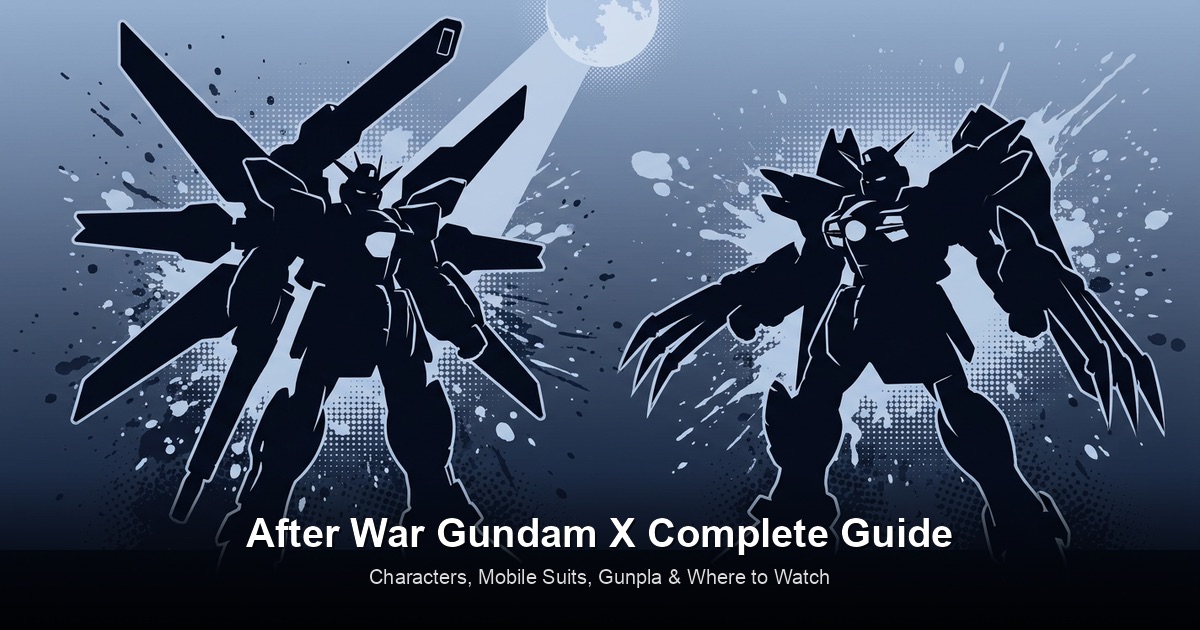
Gundam X (GX-9900) — The Legendary Weapon Sleeping in the Wasteland
| Model Number | GX-9900 |
|---|---|
| Head Height | 17.1 m |
| Weight | 7.5 t |
| Armor Material | Luna Titanium Alloy |
| Main Armament | Satellite Cannon, Shield Buster Rifle, Breast Vulcans, Beam Sword |
| Special Equipment | Flash System, Satellite System |
| Pilot | Jamil Neate (during the war) → Garrod Ran |
Gundam X was a decisive weapon developed by the Earth Federation during the 7th Space War. Its signature feature is the Satellite Cannon — a massive beam weapon mounted on the back that receives microwave energy from a lunar base, focuses it, and fires.
The Satellite Cannon's destructive output is staggering — a single shot can destroy a space colony. During the 7th Space War, multiple Gundam X units firing their Satellite Cannons simultaneously was a key strategy that drove the Space Revolutionary Army to the brink.
The weapon comes with significant restrictions, however. It requires microwave transmission from the lunar base, meaning the moon must be visible. Additionally, activation originally required the Flash System — a Newtype-responsive neural interface. Garrod initially relied on Tiffa's Newtype abilities to activate it.
At the start of the story, Garrod discovers the Gundam X abandoned in the wasteland and boards it. A legendary Gundam reawakening after 15 years of dormancy — this scene is the crystallization of Director Takamatsu's founding image of "a single Gundam standing alone in the wasteland."
Gundam Double X (GX-9901-DX) — The Overwhelming Power of the Twin Satellite Cannon
| Model Number | GX-9901-DX |
|---|---|
| Head Height | 17.0 m |
| Weight | 7.8 t |
| Armor Material | Luna Titanium Alloy |
| Main Armament | Twin Satellite Cannon, Hyper Beam Sword, Defense Plate, Machine Cannons, Breast Launcher |
| Special Equipment | G-Controller, Satellite System |
| Pilot | Garrod Ran |
Gundam Double X (commonly called Gundam DX) is Gundam X's successor and the most powerful mobile suit in the After War timeline. Developed by the New United Nations Earth, it becomes Garrod's new machine midway through the series.
Its defining feature is the Twin Satellite Cannon: two Satellite Cannons that vastly surpass the original's firepower. Furthermore, the new G-Controller interface replaces the Flash System, allowing the Satellite System to be activated without Newtype abilities.
This is narratively momentous. Garrod — who is not a Newtype — can now operate the Satellite Cannon on his own, without relying on Tiffa. "Independence from Newtype power" — this technological evolution embodies the show's theme of liberation from the Newtype concept at the level of mechanical design itself.
By docking with the G-Falcon support craft, the DX gains enhanced mobility and even atmospheric escape capability. In the final battle, it engages the Frost Brothers' upgraded Gundam Virsago Chest Break and Gundam Ashtaron Hermit Crab in a titanic clash.
The Freeden's Arsenal — Gundam Airmaster and Gundam Leopard
| Gundam Airmaster (GW-9800) | A transformable MS capable of switching to a high-speed "Fighter Mode." Boasts overwhelming mobility. Piloted by Witz Sou. Later upgraded to Gundam Airmaster Burst. |
|---|---|
| Gundam Leopard (GT-9600) | A heavily armored, heavy-firepower bombardment MS. Equipped with both beam and ballistic weapons in abundance, plus caterpillar treads in its feet for high-speed ground travel. Piloted by Roabea Loy. Later upgraded to Gundam Leopard Destroy. |
Airmaster and Leopard, along with Gundam X, form a trio of Gundams developed during the 7th Space War. With contrasting design philosophies — one specialized in mobility, the other in firepower — the three units together form a complete tactical package covering offense, defense, and maneuver.
Witz and Roabea initially serve the Freeden as freelance contractors with no allegiance beyond their paycheck. As the story unfolds, however, genuine bonds form, and by the finale both men fight for the Freeden without expecting a single credit in return. This evolution in their relationships is one of Gundam X's most satisfying subplots.
The Frost Brothers' Machines — Gundam Virsago and Gundam Ashtaron
| Gundam Virsago (NRX-0013) | Shagia's machine. Features extendable claw-beams for close combat dominance. Later upgraded to Gundam Virsago Chest Break. |
|---|---|
| Gundam Ashtaron (NRX-0015) | Olba's machine. Equipped with massive claw arms and capable of transforming into a mobile armor configuration. Later upgraded to Gundam Ashtaron Hermit Crab. |
The names "Virsago" and "Ashtaron" derive from the demonology figures Vassago and Astaroth — grand dukes of Hell. Gundams bearing the names of demons: the nomenclature itself symbolizes the Frost Brothers' status as outcasts from the legitimate Newtype lineage. Their devastatingly coordinated combat, powered by Twins Synchronicity, is among the show's most spectacular highlights.
Full Story Guide — Gundam X's Journey in Four Acts
The narrative of Gundam X divides naturally into four arcs: the meeting in the wasteland, the journey across the land, the confrontation with the New Federation, and the final battle in space and on the moon.
Act I: "Encounter and Departure" (Episodes 1–10) — A Boy, a Girl, and a Gundam in the Wasteland
The story begins when Garrod accepts a job to rescue Tiffa from a band of Vultures. In the process of saving her, he discovers the Gundam X abandoned in the desert and takes the controls.
Under the guidance of Freeden captain Jamil, Garrod and the crew battle various forces pursuing Tiffa. The first episode's Satellite Cannon firing — the defining set-piece of the series — establishes the show's direction. Microwave energy streams down from the moon and a blinding beam cleaves the wasteland. The awesome destructive power, juxtaposed with the psychic toll it exacts on Tiffa, instantly communicates the weapon's nature as a double-edged sword.
This arc introduces Witz and Roabea, depicts the brutal realities of Vulture-on-Vulture conflict, and painstakingly establishes the harshness of the post-apocalyptic world. Garrod's single-minded determination — "I just want to protect Tiffa" — carries every scene.
Act II: "The Journey Across the Land" (Episodes 11–20) — Artificial Newtypes and the Illusion of "Evolution"
The Freeden's voyage doubles as a mission to locate and protect scattered Newtypes. The centerpiece of this arc is the Fort Severn saga.
Nomoa Long, ruler of the city-state of Fort Severn, is conducting research to create artificial Newtypes. His "success story" is Carris Nautilus — a boy who has been artificially granted Newtype abilities. Carris fights in service of Nomoa's ideals, but through his battles with Garrod he begins to question the meaning of his own existence.
The ethical horror of forcibly making someone a Newtype, the danger of Newtype-worshipping ideology — the themes raised here serve as critical foreshadowing for D.O.M.E.'s ultimate conclusion in the final arc.
This section also deepens the character of Ennil El: her animosity toward Garrod, her entanglement with Jamil, her struggle with her own identity. Her story illustrates the moral complexity that Gundam X refuses to reduce to simple good-versus-evil binaries.
Act III: "The Rise of the New Federation" (Episodes 21–30) — War's Approach and a New Generation of Machines
At the story's midpoint, the New United Nations Earth military enters the stage in force. The remnants of the old Federation reorganize and begin projecting power toward global reunification. Simultaneously, the Space Revolutionary Army renews its interference with Earth.
The arc's centerpiece event: Garrod transitions from Gundam X to Gundam Double X. Acquiring the DX — which the New Federation had been developing — Garrod gains the devastating Twin Satellite Cannon along with the G-Controller, a piloting interface that does not depend on Newtype abilities.
Jamil's former comrade Lancerow Dawell appears as an officer of the New UNE, generating a complex tension between old friends who have chosen different paths. This structure — adults confronting their shared past while young people fight for their future — sharpens one of Gundam X's most compelling thematic contrasts.
The Frost Brothers' machinations also escalate, and it becomes increasingly clear that they are pulling strings on both sides of the emerging conflict.
Act IV: "To Space, and the Moon" (Episodes 31–39) — The Final Answer to "What Is a Newtype?"
The story shifts from Earth to space. Tensions between the New UNE and the SRA reach a breaking point, and the Freeden crew races to prevent the outbreak of an 8th Space War.
The crown jewel of this arc is Garrod and Tiffa's reunion in space (episodes 33–34). Separated for several episodes, the two finally meet again on the lunar surface. Garrod's cry of "I can see the moon!" is the scene that fans most frequently cite as the series' finest moment.
In the final stretch, all major characters converge at the lunar base where D.O.M.E. resides. D.O.M.E. is the "First Newtype" — the very origin of the Newtype concept.
D.O.M.E. speaks: "The Newtype is nothing more than a fantasy that people wished for. The manifestation of unusual powers and the evolution of humanity are two entirely different things." The foundation upon which Newtype worship was built — the first Newtype itself — repudiates the entire edifice.
After the final battle with the Frost Brothers, Garrod and Tiffa join hands on the moon. Newtype or not — it does not matter. Those who face forward and carve open a future are the true "evolution of humanity." That is Gundam X's answer.
"What Is a Newtype?" — The Only Definitive Answer in Gundam History
Within the Gundam franchise, "Newtype" is both the single most important theme and the question that has proven most resistant to a clear answer. Gundam X is the work that delivered the only unambiguous response in the series' entire history.
The "Newtype" Curse in the Universal Century
The concept of the Newtype, introduced by Yoshiyuki Tomino in the original Mobile Suit Gundam, referred to "the next stage of human evolution" — people who had adapted to life in space and developed heightened perception and empathy.
As the franchise expanded, however, the Newtype increasingly became a "psychic super-soldier." Artificially Enhanced Humans were created. Newtype-exclusive weapons were developed. The ideal of "human evolution" was buried beneath the reality of "tools of war."
Throughout the Universal Century saga, this contradiction simmered beneath the surface. "Are Newtypes meant to lead humanity, or are they doomed to repeat its tragedies?" The UC works consistently avoided — or were unable to provide — a clear answer.
Gundam X's "Critical Approach"
Gundam X addressed this dilemma through an external, critical perspective. Leveraging its position as an alternate-universe Gundam, it relativized the very concept of the Newtype.
In the After War world, Newtypes exist as individuals with extraordinary perceptual abilities — similar to but subtly differently positioned than their UC counterparts. The crucial difference is that Gundam X systematically interrogates whether those abilities actually signify "human evolution" across its entire run.
The Frost Brothers are rejected as "Category F." Carris is forcibly turned into an artificial Newtype. Tiffa is nearly exploited as a living weapon. Every Newtype-related storyline illuminates the tragedy of people being consumed by the Newtype concept.
D.O.M.E.'s "Final Answer" — "The Newtype Is Not the Evolution of Humanity"
The answer D.O.M.E. delivers at the story's climax is unequivocal:
"The Newtype is merely a fantasy that people wished into existence."
It is true that some people manifest unusual abilities. But those abilities do not represent the direction of human evolution. People projected "human evolution" onto Newtypes because, in an age of war and chaos, they desperately needed a symbol of hope.
"Anyone who faces forward, strives to build a better future, and takes action to improve the world has the potential to be humanity's next step" — D.O.M.E.'s conclusion is simultaneously the dismantling of the Newtype myth and an affirmation of every human being.
This conclusion resonates perfectly with the existence of Garrod as the protagonist. Garrod — who is not a Newtype — protected Tiffa, helped his friends, and fought to change the world. His journey was itself the practice of "human evolution."
The Meta Perspective — A Critique of the Gundam Franchise Itself
Gundam X's Newtype thesis contains a meta-critical commentary on the Gundam franchise as a whole. Within the story, "Newtype" means "the evolution of humanity." Outside the story, it is also "the defining concept of the Gundam brand."
The Newtype concept made Gundam a masterpiece — yet it also threatened to trap the franchise in a loop of "psychic powers decide everything." By deconstructing the Newtype, Gundam X attempted to open new possibilities for what Gundam could be.
"Forget Newtypes — just live for the person you love." This thesis demonstrates that Gundam X functions not merely as one installment of a robot anime franchise but as a critical essay on the franchise itself.
The Truth Behind the "Cancellation" — Why Gundam X Was Shortened
No discussion of Gundam X is complete without addressing the "cancellation." However, the reality is more nuanced than the word typically implies.
How the Broadcast Was Shortened — Ratings and the Time Slot Move
Gundam X was initially planned as a 4-cour series (approximately 50 episodes). As the broadcast progressed, however, problems surfaced.
The biggest was ratings. Over the three years since G Gundam, the franchise had maintained strong model kit sales but struggled in viewership. Non-Bandai sponsors began withdrawing, and improving ratings became an existential imperative for Gundam X. The results were flat at best and declining at worst.
From episode 27 onward, the broadcast was moved from the Friday 5:00 PM slot to Saturday 6:00 AM — effectively a demotion. The episode count was also reduced from four cours to three (39 episodes).
"Cancellation" or "Shortening"? — An Ongoing Debate
Whether this constitutes a "cancellation" has been debated for decades. Even among the production staff, some use the word and some do not.
Strictly speaking, the story was not interrupted mid-stream. Once the shortened run was confirmed, Director Takamatsu restructured the narrative to conclude coherently in 39 episodes. The show's original approach of four-episode mini-arcs proved fortuitous, enabling systematic compression.
In other words, Gundam X occupies an extremely rare position: a show whose episode count was reduced but whose story reaches a complete and satisfying conclusion.
The "Miracle" of Cancellation — A Masterwork Forged by Compression
Here is the paradox: the shortened run may have actually increased the density and quality of Gundam X.
Compressing four cours of material into three stripped away filler and left only episodes that directly served the theme. The space arc in particular barrels toward the finale with relentless momentum.
The fact that Takamatsu learned of the reduction around the production of episode 20 and still landed the finale — "The Moon Will Always Be There" — on essentially the same emotional climax he had originally envisioned is a triumph of scriptwriting and structural craft. While most truncated anime limp to unsatisfying conclusions, Gundam X is that rare case where "shorter made it tighter."
Post-Broadcast Reappraisal — From "Hidden Gem" to "Gem That Demands Discovery"
Reception at the time of broadcast was, unfortunately, underwhelming. The negative optics of low ratings and time-slot exile overshadowed the show itself, and it was labelled "the unpopular Gundam."
After the broadcast ended, however, viewers who discovered the series through home video releases, reruns, and streaming began voicing their appreciation in growing numbers. "Garrod and Tiffa's romance is the best in all of Gundam." "The Newtype thesis is something every Gundam fan needs to hear." "Jamil Neate is the greatest adult character in the franchise's history." These assessments accumulated, and today the show is widely recognized as a "hidden masterpiece that speaks for itself once you watch it."
Appearances in the Super Robot Wars game series contributed significantly to this reappraisal. Many fans encountered the characters and machines through the games first and then sought out the original anime. Garrod's line "Is the moon out?" became a franchise-wide iconic quote partly through its frequent use in these games.
Top 10 Iconic Scenes and Lines — The Moments That Define Gundam X
#1: "Is the Moon Out?" / "I Can See the Moon!"
What begins as a tactical check for the Satellite Cannon evolves into the defining symbol of Garrod and Tiffa's bond. The space-arc reunion cry of "I can see the moon!" — simultaneously activating a superweapon and declaring the reconnection of two hearts — is among the greatest moments in all of Gundam.
#2: D.O.M.E.'s Rejection of the Newtype Myth
The answer delivered in the final episode: "The Newtype is merely a fantasy." A single sentence that serves as a critical response to 30 years of Gundam lore and resonates with every fan of the franchise.
#3: Episode 1, "The Moon Is Out" — The First Satellite Cannon Firing
Gundam X awakens after 15 years in the desert. Guided by Tiffa, the Satellite Cannon fires for the first time. The spectacle of microwave energy streaming from the moon and a beam of light splitting the wasteland is unforgettable.
#4: Garrod Obtains the Gundam Double X
The upgrade from Gundam X to Double X. The G-Controller activates the Satellite System without Newtype power — a mechanical expression of Garrod's declaration that he can fight on his own terms.
#5: Jamil's Past — The Satellite Cannon Trauma
The episode that reveals Jamil's wartime use of the Satellite Cannon. An adult who carries the sins of war yet still strives to guide the young — a deeply moving portrait of responsibility.
#6: The Resolution with Carris — "The Tragedy of the Artificial Newtype"
Carris, forcibly made a Newtype, chooses through his battle with Garrod to live by his own will. The show's message — "Being a Newtype means nothing; choosing to live by your own will means everything" — distilled into a single arc.
#7: The Frost Brothers Unmasked — The Shame of "Category F"
The revelation of the brothers' past as Newtypes branded "fakes." Even as antagonists, one cannot help but sympathize — a testament to Gundam X's depth of characterization.
#8: Witz and Roabea's Unspoken Declaration of Loyalty
The moment the two mercenaries choose to fight for the Freeden without pay. They never say the word "friend" — they simply act. Men who express their bonds through deeds, not words.
#9: The Finale — "The Moon Will Always Be There"
All battles concluded, Garrod and Tiffa walk hand in hand toward the future. One of the rarest things in Gundam — a genuinely happy ending — and a message in itself: you do not need to be a Newtype. You do not need special powers. Living alongside the person you love is the truest form of "evolution."
#10: The Opening Theme "DREAMS" — A Song That Captures the Series' Soul
Performed by ROMANTIC MODE, the first opening theme "DREAMS" blends driving energy with a current of melancholy, perfectly expressing the post-apocalyptic world and the dreams of two young hearts. One of the finest opening songs in Gundam history.
Why You Should Watch Gundam X — It's Time to Discover This Underrated Masterpiece
Why It's Perfect for Gundam Newcomers
Gundam X is, perhaps surprisingly, one of the best entry points for newcomers to the franchise. Here is why:
First, no prior knowledge of the Universal Century is needed. As a standalone alternate universe, Gundam X can be fully understood and enjoyed without having seen any other Gundam series.
Second, 39 episodes is a compact run. In a franchise where 50-episode TV series are the norm, Gundam X's shorter length translates into brisk pacing that lends itself well to binge-watching.
Third, Garrod and Tiffa's romance provides a clear and accessible narrative spine. Even without understanding the complex political or military backdrop, the universal story of "a boy fighting to protect the girl he loves" works on its own.
And fourth, watching Gundam X after gaining deep familiarity with the Newtype concept gives D.O.M.E.'s conclusion an entirely different weight. In other words, the show has a dual-layer structure: entertaining for newcomers, revelatory for veterans.
Comparison with Other Gundam Series — What's the Same, What's Different
| Axis of Comparison | Gundam X | Typical Gundam Tendencies |
|---|---|---|
| Protagonist's Motivation | "I want to protect the person I love" — a private motivation | "Dragged into war" or "Save the world" — public motivations |
| Setting | Post-war, post-apocalyptic world | Usually set during active warfare |
| Newtype Concept | Critically examines and deconstructs the concept itself | Accepts the concept as a given and builds the story on it |
| Adult Characters | Jamil serves as a "good adult" who mentors the young | Incompetent officers or adversarial adults are more common |
| Ending | An unambiguous happy ending | Bittersweet or ambiguous endings predominate |
Viewing Guide — Where to Watch
| Blu-ray | After War Gundam X Blu-ray Memorial Box. HD remaster of all 39 episodes. |
|---|---|
| Streaming | Available on Crunchyroll, Bandai Channel, and other platforms (availability varies by region and period). |
| Gundam Channel (YouTube) | The official YouTube channel occasionally offers limited-time free streaming. |
Related Works and Merchandise
| Manga | After War Gundam X: Under the Moonlight — A side-story manga set in A.W. 24, several years after the main series. |
|---|---|
| Gunpla | HG kits for Gundam X, Gundam DX, Airmaster, Leopard, and others. The MG Gundam DX is a long-awaited fan-favorite kit. |
| Super Robot Wars | Featured in multiple entries of the SRW game series. A significant driver of the show's reappraisal. |
| Novels | A three-volume novelization published by Kadokawa Sneaker Bunko. |
Conclusion — Gundam X Is a Masterpiece That Demands to Be Discovered
Why It Was Underrated, and Why Reappraisal Matters
The reasons for Gundam X's historical underrating are clear: poor ratings during broadcast, the humiliating time-slot move, and the reduced episode count. These negatives overshadowed the work itself. The label "the cancelled Gundam" is a powerful deterrent, and for years it kept many potential viewers at arm's length.
But watch it and you will understand. Gundam X is the work that answered the Gundam franchise's 30-year question — "What is a Newtype?" — with the greatest honesty and the greatest clarity. And its answer is a universal and powerful message: being "special" is not what makes someone the next step of human evolution. Facing forward and choosing to live — that is what makes anyone capable of "revolution."
What Gundam X Asks of Us
In a world enslaved by the Newtype concept, a boy who is not a Newtype protects a girl who is. Through that journey, the meaning of "being a Newtype" is dismantled, and the meaning of "being human" rises to the surface.
Garrod's greatest weapon was never psychic power or genius-level piloting skill. It was his straightforward desire to protect Tiffa. And that desire proved strong enough to shatter the Newtype myth, repel the Frost Brothers' revenge, and avert a new war.
This is the most fundamental story a mecha anime can tell. You don't need to be special. You don't need power. To act for the person you love — that is humanity's truest "evolution."
"The Moon Will Always Be There"
The final episode's subtitle is "The Moon Will Always Be There." The moon is the Satellite Cannon's energy source and the symbol of Garrod and Tiffa's bond. And the moon — visible or hidden, clear or behind clouds — is always there.
Gundam X the series is much the same. Cancelled, underrated, overlooked — and yet it has been there all along. Quietly, steadily, like a moon illuminating the path ahead.
If you have not seen it, now is the time. A single Gundam stands alone in the wasteland, waiting for you.