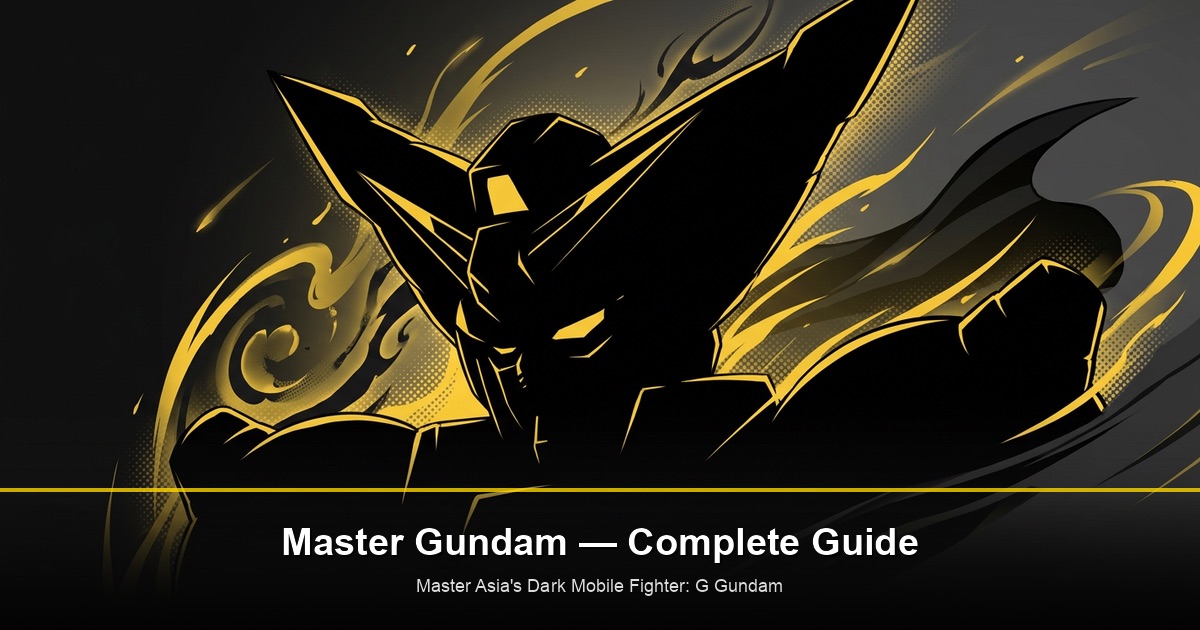
Master Gundam Complete Guide— Master Asia's Dark Mobile Fighter Explained [G Gundam]
Contents
- 01What Is the Master Gundam — The "Dark Fist" Wielded by the Master
- 02Basic Specifications — Neo Hong Kong's Strongest Mobile Fighter
- 03DG Cells and the Kowloon Gundam — The True Form Fallen to Darkness
- 04Armaments — An Unorthodox Weapon System of Fists and Cloth
- 05Fuunsaiki — The Beloved Steed That Soars the Heavens
- 06Pilot: Master Asia, the Undefeated of the East — The Strongest Man in Gundam History
- 07Key Scenes — The Arc of the Master-Student Showdown
- Episodes 13–14: From Kowloon Gundam to Master Gundam
- Episode 24 "A New Shining! The Birth of God Gundam" — The Battle at the Guyana Highlands
- Episodes 41–44: The Final Battle Royale — The Fierce Battle of Lantau Island
- Episode 45 "Farewell Master! Master Asia, Rest in Peace" — The Legendary Final Master-Student Battle
- 08Design Analysis — The Concept Behind the "Wuxia Gundam"
- 09Cultural Impact — The Gold Standard of "Strongest Master Characters"
- 10Gunpla Guide — Getting the Master Gundam in Your Hands
- 11Related Articles
- 12Sources
What Is the Master Gundam — The "Dark Fist" Wielded by the Master
"The School of the Undefeated of the East! The winds of the king! Zenshin! Keiretsu! Tenpa kyouran! Look! The East is burning red!!"
In the long history of the Gundam franchise, if asked to name just one "ultimate enemy," many fans would give this answer — Master Asia, the Undefeated of the East. And the mobile fighter he pilots is none other than the Master Gundam (GF13-001NHII).
Appearing in the 1994 series Mobile Fighter G Gundam, the Master Gundam rewrote the concept of an "enemy Gundam" within the franchise. Traditionally, a Gundam is the symbol of the hero — the protagonist's machine. But the Master Gundam delivered an unprecedented shock to audiences as the "final boss's Gundam," piloted by the protagonist's own master.
A jet-black body accented with gold. A cloak-like wing shield billowing behind it. Mounted atop the horse-type Mobile Horse "Fuunsaiki," charging across the battlefield. The image is that of a martial arts master straight out of a wuxia film. Carrying no beam rifle, no shield — proving its supremacy through fists and a single cloth alone — the Master Gundam is the ultimate "melee Gundam" born from G Gundam, a series that defied every convention.
And the Master Gundam's story transcends the realm of mere robot battles. The bond between master and student, betrayal, and reconciliation. The "true feelings" revealed as Master Asia draws his final breath. Episode 45, "Farewell Master! Master Asia, Rest in Peace," remains one of the most acclaimed episodes across the entire Gundam franchise, still bringing fans to tears over 30 years later.
This article provides a thorough examination of the Master Gundam's complete specifications, full armament loadout, its relationship with the Kowloon Gundam, its combination with Fuunsaiki, and the complete account of the legendary master-student final battle.
Basic Specifications — Neo Hong Kong's Strongest Mobile Fighter
Master Gundam Basic Specifications
| Item | Details |
|---|---|
| Model Number | GF13-001NHII |
| Unit Name | Master Gundam |
| Classification | Mobile Fighter (MF) |
| Affiliation | Neo Hong Kong |
| Head Height | 16.7m |
| Base Weight | 7.2t |
| Armor Material | Gundarium Alloy Super Ceramic Composite + DG Cells |
| Control System | Mobile Trace System |
| Pilot | Master Asia, the Undefeated of the East |
| Mechanical Designer | Kunio Okawara |
| First Appearance | Episode 13 "Big Trouble! The Enemy Is the 5 Evil Gundams" (1994) |
The Master Gundam's model number "GF13-001NHII" follows G Gundam's naming conventions. "GF13" denotes the 13th Gundam Fight, "001" indicates the first registered unit, "NH" stands for Neo Hong Kong, and "II" signifies a second-generation machine. In other words, it was officially registered as the successor to the Kowloon Gundam (GF12-035NH), which was used in the previous tournament.
At 16.7m head height, it is roughly the same class as the God Gundam (16.6m) and the Shining Gundam (16.2m). However, its base weight of 7.2t is lighter than the God Gundam (7.5t), indicating that DG Cell-based armor is lighter than standard Gundarium alloy.
Control System — Mobile Trace System
The Master Gundam employs the "Mobile Trace System" common to all machines in the G Gundam universe. The pilot wears a specialized fighting suit and enters the cockpit, where every movement of the pilot's body is directly replicated by the mobile fighter.
In other words, if the pilot extends a right punch, the mobile fighter extends a right punch. If the pilot throws a roundhouse kick, the mobile fighter throws a roundhouse kick. This system means that the pilot's martial arts skill directly translates into the machine's combat capability.
Master Asia is the grandmaster of the School of the Undefeated of the East and the champion of the previous Gundam Fight. His extraordinary martial arts, perfectly transmitted through the Mobile Trace System, allow the Master Gundam to exhibit combat performance far beyond what its specifications alone would suggest.
DG Cells and the Kowloon Gundam — The True Form Fallen to Darkness
The Transformation from the Kowloon Gundam (GF12-035NH)
The Master Gundam's greatest secret — its true identity is actually the Kowloon Gundam.
The Kowloon Gundam was Neo Hong Kong's representative machine that Master Asia piloted when he won the 12th Gundam Fight. With its distinctive Chinese-style pointed hat and long robes, it appeared to resemble a gentle old sage.
However, in the middle of the story, when Master Asia's true intentions are revealed in Episode 14, the Kowloon Gundam sheds its exterior and transforms into the jet-black machine known as "Master Gundam." The Kowloon Gundam's appearance was a disguise created by DG Cells, and hidden beneath it was the Master Gundam's true form.
DG Cells (Devil Gundam Cells)
The Master Gundam's body is composed of DG Cells. DG Cells are special cells that realize the three fundamental theories of the Devil Gundam — self-multiplication, self-regeneration, and self-evolution.
Normally, machines and pilots absorbed by DG Cells fall under the Devil Gundam's control. However, the Master Gundam is a unique case. Master Asia's indomitable willpower completely dominates the DG Cells, preventing self-multiplication and self-evolution while utilizing only the self-regeneration capability.
This self-regeneration ability allows the Master Gundam to repair its own damage during battle. Where a normal mobile fighter would require technicians spending hours on repairs, the Master Gundam can recover from damage even between combat engagements. This provided an overwhelming advantage in the melee-focused Gundam Fight.
Leader of the Devil Gundam Four Heavenly Kings
The Master Gundam serves as the leader of the Devil Gundam Four Heavenly Kings. The Four Heavenly Kings consist of the following four machines:
| Machine | Pilot | Domain |
|---|---|---|
| Master Gundam | Master Asia | Leader / Close Combat |
| Gundam Heaven's Sword | Michelo Chariot | Aerial Combat |
| Grand Gundam | Gentle Chapman | Ground Combat |
| Walter Gundam | — | Special Ops (later piloted by Allenby) |
The Four Heavenly Kings divide responsibility across land, sea, and air, but the Master Gundam serves as the command tower overseeing all of them. In the story's final arc, the Grand Master Gundam also appears — a combined machine that aggregates all Four Heavenly Kings' capabilities. With the Master Gundam's upper body as its core, the wings and claws of Gundam Heaven's Sword, the lower body of Grand Gundam, and the tail of Walter Gundam fused together, it is a grotesque mobile suit that concentrates the Devil Gundam's power into a terrifying form.
Armaments — An Unorthodox Weapon System of Fists and Cloth
The Master Gundam's armaments deviate radically from Gundam series conventions. No beam rifle. No bazooka. No shield. All it has are fists, cloth, and extendable arms. This is the pinnacle of the "melee Gundam" concept.
Darkness Finger
The Master Gundam's signature move and most devastating technique. It can be considered the dark counterpart to the "Bakunetsu God Finger" (Erupting Burning Finger) unleashed by Domon's God Gundam.
Dark energy concentrates in the Master Gundam's right hand, which seizes and crushes the enemy — its destructive power is immense, and it was the first technique to overcome the Shining Gundam's Shining Finger head-on. Against the master's Darkness Finger, the student's Shining Finger was utterly powerless.
The Darkness Finger is not a mere power move. It is imbued with the essence of Master Asia's martial arts, targeting vital points with precision after reading the opponent's movements — a secret technique where skill and destructive force converge.
The name "Darkness Finger" forms a deliberate contrast with Domon's "Shining Finger" — light versus darkness, master versus student. This contrast encapsulates G Gundam's narrative structure within the very names of its signature techniques.
Sekiha Tenkyoken (Stone-Shattering Heavenly Shocking Fist)
The greatest and most powerful secret technique of the School of the Undefeated of the East. An ultimate martial arts move that shatters the earth and shakes the heavens.
The Sekiha Tenkyoken is not so much a weapon unique to the Master Gundam as it is a martial arts technique from the School of the Undefeated of the East, reproduced through the Mobile Trace System. When Master Asia unleashes it from the Master Gundam, it is cloaked in dark energy; when Domon unleashes it from the God Gundam, it is cloaked in light energy. The idea that the same school's ultimate technique changes in nature depending on the wielder's state of heart perfectly embodies G Gundam's theme of "putting your heart into your fists."
In the final battle of Episode 45, master and student fire their Sekiha Tenkyoken at each other, and ultimately Domon's "Sekiha Tenkyoken God Finger" pierces through the Master Gundam.
Master Cloth
Master Asia's other signature weapon. A sash worn at the waist — a belt-shaped beam weapon — that he freely manipulates for both offense and defense.
The Master Cloth is actually an energy construct generated by a beam-emitting device. Through the Mobile Trace System, when the pilot manipulates the cloth at their waist, the machine's Master Cloth moves in synchronization. While it possesses cutting capability comparable to a beam saber, it also has the flexibility to entangle and restrain enemy machines.
Throughout the series, the combination of binding an opponent with the Master Cloth before finishing them with the Darkness Finger is demonstrated repeatedly. It is also used as a wide-area attack to sweep away multiple enemies at once, making its versatility unmatched in the G Gundam universe.
Considering that Master Asia could destroy Death Army units with just a piece of cloth while fighting on foot, the Master Cloth can be seen as a natural extension of his martial arts.
Near Crusher
The Master Gundam's arms are constructed with extendable sections from the elbow down. The Near Crusher is a melee technique where the forearm extends and the hand transforms into a blade shape to impale enemies.
The sharply pointed fingertips possess the cutting power to penetrate enemy armor, and the extended reach makes it effective as a surprise attack. Capable of striking beyond normal melee range, opponents must constantly contend with the risk of misjudging the Master Gundam's reach.
Far Crusher
An advanced version of the Near Crusher, this technique launches the entire forearm from the elbow, connected by a beam wire, to attack distant enemies. Essentially G Gundam's version of a "rocket punch," but with the beam wire allowing for retrieval after launch.
The Far Crusher enables the Master Gundam to execute melee attacks at medium range as well as close range. Despite being a melee-oriented mobile fighter, it possesses offensive capability at shooting range — making it an exceptionally troublesome machine to face.
Palm Beam Cannon
Small beam cannons with five barrels each built into both palms. The Master Gundam's sole ranged weapon.
While their power is modest compared to the Darkness Finger, they serve as suppressive fire during melee combat or as sweeping shots when engaging multiple enemies simultaneously. Because they fire from the palms, beam attacks can flow naturally from martial arts motions.
Wing Shield
A large cloak-shaped shield mounted on the back. Beyond defensive use, it can also be deployed to grant flight capability.
This Wing Shield enables the Master Gundam to fly within the atmosphere. Soaring through the air with a black cloak billowing behind it evokes the image of a wuxia film master performing qinggong (lightness skill) — a design that perfectly embodies G Gundam's Asian martial arts aesthetic.
In its default state, the shield folds into a cloak form covering the back, and in attack mode, it deploys like wings. Gunpla kits recreate this transformation between normal mode and attack mode through swappable parts.
Fuunsaiki — The Beloved Steed That Soars the Heavens
What Is Fuunsaiki
No discussion of the Master Gundam is complete without mentioning its companion — the Mobile Horse Fuunsaiki.
Fuunsaiki was originally a living horse presented to Master Asia as a supplementary prize when he won the 12th Gundam Fight by Neo Hong Kong. A dedicated Mobile Horse was then developed for the horse, becoming an officially sanctioned support mech under Gundam Fight rules.
| Item | Details |
|---|---|
| Name | Mobile Horse Fuunsaiki |
| Affiliation | Neo Hong Kong |
| Rider | Fuunsaiki (horse) |
| Features | Single horn (unicorn-type), silver-white exterior |
| Transformation | Can transform into Pedestal Mode |
Fuunsaiki has a single horn on its head, giving it a mystical, unicorn-like appearance. Inside the Mobile Horse rides the real horse "Fuunsaiki," whose will and movements are reflected in the machine's actions. The reins are beam-based, allowing the Master Gundam to control Fuunsaiki through these beam reins.
Pedestal Mode
Fuunsaiki also functions as a sub-flight system, capable of transforming into Pedestal Mode. In this form, it can carry one mobile fighter on its back and generate enough thrust for atmospheric flight and even stratospheric escape.
The scenes of the Master Gundam mounted on Fuunsaiki charging into battle are among G Gundam's most iconic moments. A jet-black Gundam mounted on a silver-white horse-shaped robot, cloak billowing as it gallops — this overwhelming visual power is the true essence of the Master Gundam's design.
Fuunsaiki's Final Moments
In the story's climax, Fuunsaiki remained at Master Asia's side until the very end. After Master Asia draws his final breath in Episode 45, Fuunsaiki stands in silent grief over its lost master. However, it continues to play a role in the story by lending its strength to Domon's God Gundam, fighting alongside Domon as its new rider in the final battle. From master to student — the passing of Fuunsaiki as a symbol of their bond moved countless fans.
Pilot: Master Asia, the Undefeated of the East — The Strongest Man in Gundam History
Character Overview
| Item | Details |
|---|---|
| Name | Master Asia, the Undefeated of the East |
| Real Name | Shuuji Kross |
| Voice Actor | Yosuke Akimoto |
| Age | 49 (estimated) |
| Affiliation | Neo Hong Kong Representative / Shuffle Alliance King of Hearts |
| School | School of the Undefeated of the East |
| Student | Domon Kasshu |
| Mobile Fighter | Kowloon Gundam → Master Gundam |
Master Asia, the Undefeated of the East, is one of the most important characters in Mobile Fighter G Gundam — the protagonist Domon Kasshu's master and greatest enemy.
The title "Undefeated of the East" literally means "unbeatable in the East" — in other words, undefeated. As the champion of the 12th Gundam Fight and a member of the Shuffle Alliance bearing the King of Hearts crest, he is quite literally "the strongest Gundam Fighter."
Voice Actor: Yosuke Akimoto
Yosuke Akimoto, who voiced Master Asia, gained what would become his career-defining role through this character. Akimoto himself has called Master Asia his "signature role," and in a 2024 interview celebrating G Gundam's 30th anniversary, he spoke at length about how deeply the character means to him.
His bold, commanding voice quality was a perfect match for the "master" character archetype. His performances in emotionally explosive scenes — the School of the Undefeated of the East proclamation, his final words — are highly regarded among voice acting enthusiasts.
First Appearance — Episode 12: "He's Here! The Undefeated of the East!"
Master Asia's first appearance comes in Episode 12. When Domon and his companions are ambushed by hordes of Death Army units (mass-produced weapons of the Devil Gundam) in Neo Japan's Shinjuku district, a mysterious old man appears to save them — that man is Master Asia.
This debut scene is celebrated as one of the most shocking moments in Gundam history. The reason? Master Asia does not use a mobile suit. He destroys Death Army units one after another using nothing but his bare human body.
He cuts off a mobile suit's head with a borrowed headband, pushes a bullet he caught bare-handed back into the gun barrel to make it explode, and tears off a mobile suit's joints with a single cloth. Confronted with this superhuman combat ability that completely defies common sense, Domon — and the audience — was left speechless.
"A human being defeating mobile suits with his bare hands...?"
This line from Domon voiced what every viewer was thinking. But this was precisely the moment that defined G Gundam as a series. A human who has reached the pinnacle of martial arts can surpass even robots — the willingness to depict this "impossibility" with utter conviction is the core appeal of G Gundam.
Master Asia's Past — The Despair of a Man Who Loved the Earth
To understand Master Asia's actions, one must know his past.
In his younger days, Master Asia was a martial artist who loved the Earth. But the Gundam Fight system — in which representatives from each nation battle in mobile fighters, with the winning nation gaining global hegemony — was inflicting devastating damage on Earth, which served as the battlefield. The people living in space colonies used Earth as a disposable battleground for their own interests, and nature continued to deteriorate.
Driven to despair by this reality, Master Asia came into contact with the Devil Gundam after winning the 12th Gundam Fight. The Devil Gundam was originally the "Ultimate Gundam," a machine designed for Earth's environmental restoration. But the shock of falling to Earth caused its three fundamental theories — self-evolution, self-multiplication, and self-regeneration — to go berserk, leading it to conclude that "humanity is the disease destroying the Earth."
Master Asia came to share the Devil Gundam's ideology. If humanity were eliminated, the Earth would be reborn — destroying the humanity he loved in order to save the Earth he loved. This ultimate contradiction is at the heart of Master Asia's tragedy.
The Bond and Betrayal Between Master and Student
At his first appearance, Master Asia was Domon's dependable mentor. He fought alongside Domon against the Death Army, taught his student the secrets of martial arts, and watched over his growth. But as the story progresses, Master Asia's true intentions come to light.
Master Asia was the leader of the Devil Gundam Four Heavenly Kings. His goal was to use DG Cells to exterminate humanity and return the ravaged Earth to nature.
The shock of this betrayal was more painful for Domon than losing his father. The man he called "Master," whom he respected and from whom he learned everything, turned out to be humanity's enemy. Domon's anguish, rage, and conflicted feelings toward Master Asia become a central theme running through the second half of the story.
However, the story's final revelation is that Master Asia's own body had been consumed by DG Cells, and he had only a short time left to live. He had not sold his soul to the Devil Gundam — he was trying to save the Earth with the time remaining in his dying body — his method was simply wrong. This truth elevates Master Asia from a mere "evil master" to a tragic hero torn between love and despair.
Iconic Quotes
Master Asia is one of the greatest quote machines in G Gundam — and indeed the entire Gundam franchise.
"What's wrong... A man shouldn't cry so easily!" (Episode 12, upon first meeting the crying Domon)
"Battle is the art of deception. To fight without strategy, relying solely on brute force, is the sign of defeat!" (Episode 17, teaching Domon)
"Have you forgotten my name? The one who remains undefeated is the Undefeated of the East." (Episode 24, confrontation at the Guyana Highlands)
"Domon, don't you understand yet... how I truly feel?!" (Episode 45, final words)
"And I shall defeat each and every one of you, casting aside the name 'Undefeated of the East' to become the true king — the Undefeated of East, West, South, North, and Center: Super Asia!" (13th Gundam Fight opening declaration)
"Domon... you may cry now..." (Episode 45, his final moment)
What all these quotes share is the coexistence of a "master's" dignity and deep love for his student. Master Asia was humanity's enemy, yet he wished for Domon's growth more than anyone. This contradiction is the source of his character's depth.
His final "You may cry now" forms a perfect counterpart to his debut line "A man shouldn't cry so easily!" The man who forbade tears to toughen his student grants permission to cry to the student he has entrusted everything to — in this single line, 30 years of Master Asia's feelings are distilled.
Key Scenes — The Arc of the Master-Student Showdown
Episodes 13–14: From Kowloon Gundam to Master Gundam
In Episode 13, Master Asia appears alongside the five evil Gundams, and in Episode 14, his true identity is revealed. The Kowloon Gundam's exterior shatters, and from within emerges the jet-black machine — the Master Gundam's grand unveiling.
This transformation scene, in which the fighting spirit hidden beneath the gentle sage's mask is unleashed, creates a striking contrast between the Kowloon Gundam's design and the Master Gundam's design, delivering the visual shock that "the Master was the enemy all along."
Episode 24 "A New Shining! The Birth of God Gundam" — The Battle at the Guyana Highlands
The battle between Domon and Master Asia at the Guyana Highlands serves as the climax of G Gundam's first half.
In the Shining Gundam's Super Mode, Domon is utterly outmatched by the Master Gundam's Darkness Finger. Rage-fueled power cannot defeat the Master Gundam — in his moment of crisis, Domon achieves the state of "Meikyou Shisui" (Clear Mirror, Still Water). Calming his heart, abandoning his anger, striking with a mind of perfect clarity.
At that moment, the Shining Gundam's parts separate, and a new machine — the God Gundam — is born. The God Finger unleashed from the state of Clear Mirror Still Water clashes with the Darkness Finger, and for the first time, the Master Gundam is pushed back. This is a masterful scene where the theme of "surpassing the master" is perfectly synchronized with a mechanical generational shift (from Shining to God).
Episodes 41–44: The Final Battle Royale — The Fierce Battle of Lantau Island
The finals of the 13th Gundam Fight Battle Royale are held on Lantau Island. But behind the scenes of the tournament, the Devil Gundam's revival and the Four Heavenly Kings' machinations are underway.
The Master Gundam rampages as the leader of the Four Heavenly Kings, overwhelming the members of the Shuffle Alliance. The Grand Master Gundam then appears, combining the capabilities of all four, pushing Domon and his allies to the brink.
In Episode 44, "Schwarz Dies! Domon's Tear-Filled Final Blow," Schwarz Bruder — a manifestation of Domon's brother Kyoji — sacrifices his life to destroy the Devil Gundam's core. This sacrifice defeats the Devil Gundam, but Master Asia's fury does not subside. Resolved to judge humanity with his own fists even without the Devil Gundam, Master Asia commits to one final battle.
Episode 45 "Farewell Master! Master Asia, Rest in Peace" — The Legendary Final Master-Student Battle
Episode 45 is regarded as one of the most emotionally devastating episodes across the entire Gundam franchise.
After the Devil Gundam is defeated, only Master Asia remains. Master Asia's true purpose was the restoration of Earth's environment through the extermination of humanity. Having witnessed the devastation that the Gundam Fight wrought upon the Earth, Master Asia believed that using the Devil Gundam's power to eliminate humanity and return the planet to nature was justice.
Master Gundam versus God Gundam — the final battle between master and student begins.
Darkness Finger and God Finger collide. Sekiha Tenkyoken is exchanged between them. As the evenly matched battle continues, Domon senses "sorrow" in Master Asia's fists.
"This... I can feel a deep sadness through his fists. Master Asia's fists... his fists are crying."
Master Asia never hated humanity. He loved the Earth, and he simply chose the wrong path — the moment Domon realizes this, the nature of the battle changes.
The final "Sekiha Tenkyoken God Finger" pierces through the Master Gundam, and it is destroyed. But Master Asia steps out of the cockpit and faces his final moments.
In the ruins of Shinjuku, master and student recite the proclamation of the School of the Undefeated of the East together for the first and last time.
"The School of the Undefeated of the East!" "The winds of the king!" "Zenshin!" "Keiretsu!" "Tenpa kyouran!" "Look! The East is burning red!!"
But before the final verse is complete, Master Asia breathes his last. In Domon's arms, bathed in the light of dawn.
"Domon... you may cry now..."
This scene of Master Asia's passing is one of the most iconic moments in Gundam history. The master who barked "A man shouldn't cry so easily!" upon their first meeting grants permission to cry at the very end. This contrast has continued to bring fans to tears for over 30 years.
Design Analysis — The Concept Behind the "Wuxia Gundam"
Mechanical Designer: Kunio Okawara
The Master Gundam's mechanical design was handled by Kunio Okawara, often called the godfather of the Gundam franchise.
Okawara designed all the mobile fighters for Mobile Fighter G Gundam, creating a succession of distinctive Gundams reflecting each nation's culture. The design concept for the Master Gundam is unmistakably "a wuxia film martial arts master."
Design Characteristics
The Master Gundam's design features several distinctive elements.
Jet-Black and Gold Color Scheme: While Gundams are traditionally defined by their white-blue-red tricolor scheme, the Master Gundam adopts the exact opposite — jet black as its base color. Gold accents symbolize "power lurking within darkness." This creates a deliberate visual contrast with the protagonist's God Gundam (white, blue, red), expressing the relationship between good and evil, light and darkness.
Cloak (Wing Shield): The most striking design element of the Master Gundam. It evokes the black cloak worn by a wuxia film master, its billowing form in the wind projecting the dignity of "one who has reached the pinnacle of martial arts." The fact that this cloak is not mere decoration but functions as a shield and even enables flight as wings demonstrates Okawara's commitment to functional beauty.
Chinese Martial Arts-Inspired Proportions: The Master Gundam's silhouette is not that of a bulky, robotic figure but rather a lean, martial artist's physique. As a melee-focused machine, its proportions emphasize agility and explosive power.
Sharp Fingers: The Master Gundam's fingers are abnormally sharp, tapering to claw-like points. This design directly supports the expression of its melee techniques like Darkness Finger and Near Crusher, conveying the terror of "these hands will crush something" through visual design alone.
Design Contrast with the Kowloon Gundam
The designs of the Kowloon Gundam and the Master Gundam are intentionally created as polar opposites.
| Element | Kowloon Gundam | Master Gundam |
|---|---|---|
| Overall Impression | Gentle old sage | Dark warrior |
| Color Scheme | Green & white | Black & gold |
| Silhouette | Flowing robes | Lean combat physique |
| Head | Pointed hat | Angular head parts |
| Armament Impression | Gentle | Aggressive |
This "before and after transformation" contrast perfectly embodies the duality of Master Asia as a character — the gentle mentor and the ruthless enemy.
Design Context Within G Gundam
Mobile Fighter G Gundam adopted an approach unprecedented in the Gundam franchise — reflecting each nation's culture in the design of its mobile fighters. Among designs like Neo America's Gundam Maxter (boxer + football player), Neo France's Gundam Rose (knight), and Neo China's Dragon Gundam (Shaolin monk), the Master Gundam was designed as the culmination of Chinese wuxia cinema.
A master clad in black robes, a martial artist charging into battle on horseback, a fighter wielding cloth as a weapon — these are all iconic elements of Hong Kong kung fu films and Chinese wuxia novels. Kunio Okawara distilled these elements into the Gundam format, achieving a one-of-a-kind design that is "a robot, yet a wuxia hero (or villain)."
Cultural Impact — The Gold Standard of "Strongest Master Characters"
The Archetype of the Master-Student Battle
Master Asia and the Master Gundam hold a place as the gold standard of "master characters" in Japanese anime and manga.
"The protagonist's master is actually the enemy." "Master and student ultimately fight." "The master's death catalyzes the student's growth." These plot elements existed before Master Asia, but few works have depicted them this memorably and this movingly. Many master-student battle episodes in subsequent anime and manga are said to be consciously or unconsciously influenced by G Gundam.
The Legend of "Defeating Mobile Suits Bare-Handed"
Master Asia's depiction of "a bare-handed human destroying mobile suits" has become an eternal legend and beloved meme among Gundam fans.
This scene is frequently cited as the ultimate example of "G Gundam's over-the-top spirit." It is the most concise expression of the series' bold departure from the Universal Century's real-robot approach, and simultaneously a declaration of G Gundam's worldview that "martial arts conquers all."
Online, jokes (half-serious) like "Master Asia could stop a beam saber with his bare hands" and "Adding Master Asia to any 'strongest character' debate breaks it" have become standard fare. Master Asia is invariably mentioned as a candidate for "the strongest pilot in the Gundam franchise."
The School of the Undefeated of the East Proclamation
The School of the Undefeated of the East proclamation — "The School of the Undefeated of the East! The winds of the king! Zenshin! Keiretsu! Tenpa kyouran! Look! The East is burning red!!" — is a line that every Gundam fan has tried reciting at least once.
This proclamation possesses particularly high meme potential within G Gundam, frequently reproduced at anime events, cosplay competitions, and on social media. The image of master and student facing each other, alternating lines while striking poses, is a scene that distills G Gundam's "passion" into its purest form.
Popularity in Super Robot Wars
The Master Gundam and Master Asia enjoy overwhelming popularity in the crossover game series Super Robot Wars. Story events faithfully recreating the original anime receive high praise, with the Episode 45 master-student showdown drawing tears from players every time.
In-game, Master Asia can often be recruited as an ally under certain conditions, and his absurd power (the gamification of his ability to destroy mobile suits bare-handed) is beloved by players.
Influence on the "Enemy Gundam" Lineage
While enemies piloting Gundams existed in the franchise before the Master Gundam (such as the Psycho Gundam), the Master Gundam was the first to establish the framework of "the protagonist's master pilots an enemy Gundam" and "the final boss pilots a Gundam."
This framework profoundly influenced subsequent Gundam series. The Providence Gundam in Gundam SEED, the Reborns Gundam in Gundam 00, and the Gundam Bael in Iron-Blooded Orphans — the "enemy piloting a Gundam-type" development became a franchise staple, and the Master Gundam can be considered one of its prototypes.
The Design Legacy of the "Jet-Black Gundam"
The design convention established by the Master Gundam — "black Gundam = rival/enemy" — has been inherited by subsequent works. In the Gundam franchise, while protagonist machines are based on white, rival and enemy machines frequently adopt dark color schemes. The Master Gundam's "jet black and gold" palette stands as an iconic example.
These influences demonstrate that the Master Gundam is not simply an "enemy mech" but an entity that expanded the Gundam franchise's design vocabulary.
Gunpla Guide — Getting the Master Gundam in Your Hands
HGFC 1/144 Master Gundam & Fuunsaiki
| Item | Details |
|---|---|
| Price | ¥2,860 (tax included) |
| Release Date | August 27, 2011 |
| Scale | 1/144 |
| Accessories | Master Cloth, Darkness Finger effect parts, Wing Shield (normal mode/attack mode swappable), Fuunsaiki body, beam reins parts |
| Series | HGFC (High Grade Future Century) |
This kit is one of the most highly rated in the HGFC series. Its standout feature is that Fuunsaiki is included. Beyond the Master Gundam alone, it enables display of the mounted configuration, allowing fans to recreate the series' most iconic scenes.
Color separation is nearly complete through molded colors, with the jet-black body and gold accents looking sharp. The yellow lines on the cloak are supplemented with stickers, but the kit looks impressive even straight out of the box. Articulation is also excellent for an HGFC kit, allowing solid poses for the Darkness Finger and Master Cloth poses.
Fuunsaiki cannot transform into Pedestal Mode, but it can carry the Master Gundam on its back, letting you recreate that iconic scene of "the jet-black Gundam mounted on the silver-white horse" in your hands.
MG 1/100 Master Gundam
| Item | Details |
|---|---|
| Price | ¥2,750 (tax included) *at release |
| Release Date | March 2002 |
| Scale | 1/100 |
| Accessories | Master Cloth, Darkness Finger hands, Far Crusher lead wire & joint, 3 types of open hands, weapon-holding hand (right), hands for recreating the God Gundam showdown scene, 1/20 scale Master Asia figure |
| Series | MG (Master Grade) |
While this MG kit dates back to 2002, G Gundam's MG lineup has been well-regarded for overall proportions and molded color accuracy. The Master Gundam kit is notable for its Far Crusher recreation capability, allowing you to pose the forearm connected by lead wire in a launched position.
The included 1/20 scale Master Asia figure is another attractive feature. Open the cockpit hatch and place the Master figure inside to evoke the scene of "Master Asia boarding the machine in person."
This kit was reissued in December 2019, so it may be available at retail price depending on timing.
MG 1/100 Hyper Mode Master Gundam
| Item | Details |
|---|---|
| Price | ¥3,300 (tax included) *at release |
| Release Date | March 2003 |
| Scale | 1/100 |
| Features | Gold exterior with plating & special molded colors |
| Accessories | Master Cloth, Master Asia figure |
A color variation of the standard MG featuring a gold exterior recreating the Hyper Mode state. Using plated parts and special molded colors, the entire machine gleams gold. In the anime, the Master Gundam shifts to gold when operating at full power, and this kit reproduces that state.
It also holds significant value as a collector's item, with many fans purchasing it as a complement to the standard MG version.
Other Merchandise
The Master Gundam has been released in numerous product lines beyond Gunpla.
ROBOT Spirits (SIDE MS) Master Gundam: A completed action figure that combines extensive articulation with detailed sculpting. Recommended for those who lack the time to build Gunpla or want to display a figure immediately.
Gundam Universe Master Gundam: An approximately 15cm action figure at an accessible price point, serving as an entry-level option. Released in 2022, it offers an easy way to enjoy the Master Gundam's jet-black form.
G Frame Kowloon Gundam: Part of the candy toy series, this figure brings the Master Gundam's disguised form — the Kowloon Gundam — to life. A Premium Bandai exclusive popular among collectors. Display it alongside the Master Gundam to enjoy the "before and after transformation" contrast.
Buying Recommendations
| Your Preference | Recommended Kit |
|---|---|
| Display with Fuunsaiki as a set | HGFC Master Gundam & Fuunsaiki |
| Large scale with fine details | MG Master Gundam |
| Want the gold Hyper Mode impact | MG Hyper Mode Master Gundam |
| Recreate the master-student battle alongside God Gundam | MG Master Gundam + MG God Gundam |
| Want to recreate the pre-transformation form too | HGFC Master Gundam + G Frame Kowloon Gundam |
| Want a completed figure (no assembly) | ROBOT Spirits Master Gundam |
Related Articles
- God Gundam — Complete Guide: The machine piloted by student Domon Kasshu and the Master Gundam's greatest rival. The full account of the master-student battle.
- Mobile Fighter G Gundam — Complete Series Guide: Comprehensive coverage of the series' world, characters, and episode-by-episode synopsis.
- Gelgoog — Complete Guide: For those interested in the design lineage of "rival machines."
- Psycho Gundam — Complete Guide: A massive MS that shares the "enemy Gundam" lineage.
- Zaku — Complete Guide: "The origin of mass-produced machines." A legendary suit with a design philosophy opposite to the Master Gundam.
Sources
- Mobile Fighter G Gundam TV Series, Sunrise, 1994–1995 (49 episodes)
- Mobile Fighter G Gundam Official Site (g-gundam.net) — Story, Character, and Mobile Fighter Information
- GUNDAM.INFO "GF13-001NHII Master Gundam" Machine Profile Page
- GUNDAM.INFO "Fuunsaiki" Machine Profile Page
- Bandai Spirits Hobby Official Site (bandai-hobby.net) — MG / HGFC Master Gundam Product Information
- Gundam Wiki (gundam.fandom.com) — GF13-001NHII Master Gundam
- Mobile Fighter G Gundam 30th Anniversary: Yosuke Akimoto Interview, Febri, 2024
- Yatterman Mecha, the Mechanical Designer Who Created Gundam: Kunio Okawara — 50 Years of a Professional, KADOKAWA
- Super Robot Wars Wiki — Master Asia / Master Gundam
If you spot any errors or have updated information, please let us know. We value accuracy.