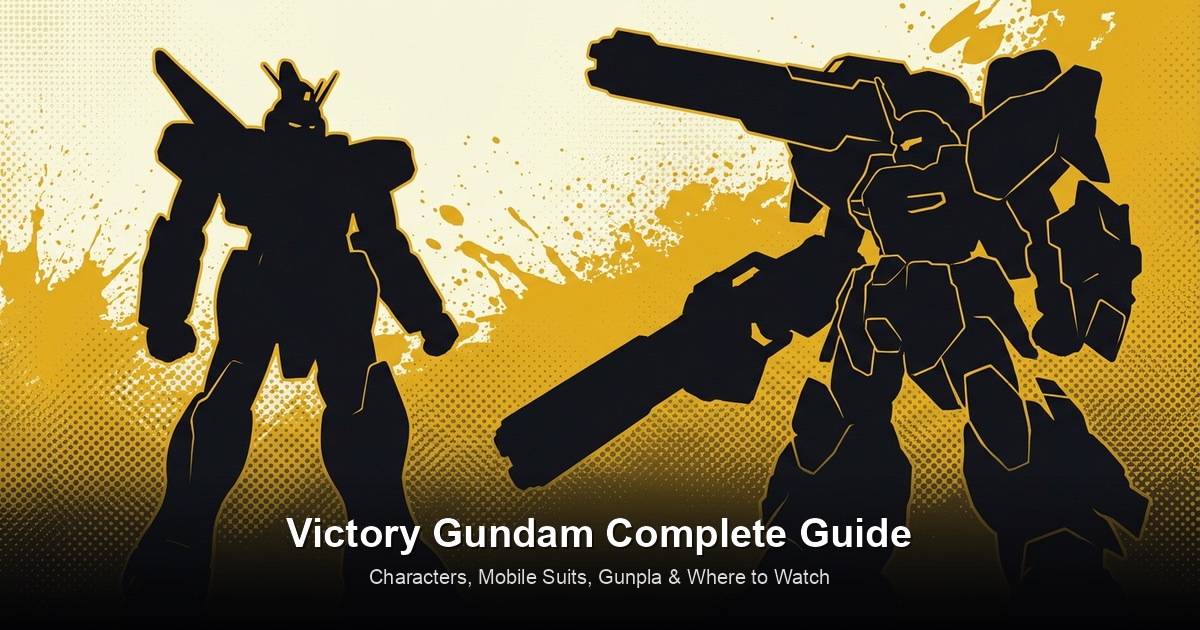
Mobile Suit Victory Gundam — Complete Guide— Story, Mobile Suits & Shocking Ending
Contents
- 01What Is Mobile Suit Victory Gundam? The "Forbidden Masterpiece" Set at the End of the Universal Century
- 02Complete Story Guide -- Reading the 51 Episodes in Four Acts
- 03Uso Ewin -- What a 13-Year-Old Newtype Witnessed
- 04Katejina Loos -- Dissecting the Most Terrifying Character in Gundam History
- 05The Zanscare Empire and the League Militaire -- Two Organizations, Two Ideologies
- 06Mobile Suit Guide -- From the Victory Gundam to the Motorad Battleships
- 07The Shrike Team -- Why the "Tragedy of the Big Sisters" Endures
- 08Angel Halo -- The Terror of a Weapon That Puts Minds to Sleep
- 09"Kill 'Em All Tomino" at His Peak -- Why So Many Characters Must Die
- 10Tomino's "Don't Watch This" -- Decoding a Forbidden Statement
- 11Music and Direction -- Akira Senju's Score and the Legendary Opening Theme
- 12Episode Guide -- Key Viewing Highlights and Turning Points
- 13Viewing Guide and Related Works -- Going Deeper with Victory Gundam
What Is Mobile Suit Victory Gundam? The "Forbidden Masterpiece" Set at the End of the Universal Century
Mobile Suit Victory Gundam is the most divisive entry in the entire Gundam franchise.
Aired from April 1993 to March 1994 on TV Asahi across 51 episodes, it is set in Universal Century 0153 -- the furthest point in the future of any UC Gundam series. The story follows 13-year-old Uso Ewin as he battles against the Zanscare Empire's invasion of Earth.
The director is Yoshiyuki Tomino, the creator of Gundam himself. Known by the fearsome nickname "Kill 'Em All Tomino" for his willingness to slaughter beloved characters, Victory Gundam is where that reputation reaches its absolute peak. Allied characters die one after another, one of the heroines descends into complete madness, and the final battle leaves an almost incomprehensible body count.
Yet this is far more than an exercise in cruelty. A 13-year-old boy constantly asks himself "Why must I be the one to fight?" while still choosing to stand on the battlefield to protect those he loves. In that struggle lies Tomino's rage against war and his prayer for the children who inherit the world.
And then there is the show's other defining fact: Tomino himself publicly declared, "You don't need to watch this series." A creator telling fans not to watch his own work -- there is no precedent for this in Gundam history, or perhaps in all of anime. This is the full story of that "forbidden masterpiece."
Series Overview
| Official Title | Mobile Suit V Gundam (Victory Gundam) |
|---|---|
| Format | TV Anime Series |
| Episodes | 51 |
| Original Run | April 2, 1993 -- March 25, 1994 |
| Network | TV Asahi (Friday 17:00 slot) |
| Director | Yoshiyuki Tomino |
| Character Design | Hiroshi Osaka |
| Mechanical Design | Kunio Okawara, Hajime Katoki, Junya Ishigaki |
| Music | Akira Senju |
| OP Theme (1st) | "STAND UP TO THE VICTORY" by Tomohisa Kawazoe |
| OP Theme (2nd) | "DON'T STOP! CARRY ON!" by RD |
| ED Theme (1st) | "WINNERS FOREVER" by infix |
| ED Theme (2nd) | "Mou Ichido Tenderness" by KIX-S |
| Studio | Sunrise |
| Timeline | Universal Century 0153 |
Universal Century 0153 -- What the Furthest Future Means for the Franchise
Universal Century 0153. That is 74 years after the One Year War (UC 0079), 60 years after Char's Counterattack (UC 0093), and 30 years after Gundam F91 (UC 0123).
Amuro and Char are long-dead historical figures. The Earth Federation government has rotted from within, having effectively lost the ability to govern. Space colonies have become semi-independent states, and from among them rises the Zanscare Empire -- a religious state led by Queen Maria Pia Armonia.
This setting is critical because the "Federation" -- the backbone of order throughout earlier UC stories -- no longer functions. In the original Gundam, the Federation fought Zeon as equals. In Zeta, the Titans and AEUG waged war within the Federation structure. In Char's Counterattack, Londo Bell represented the Federation's finest. But by Victory Gundam's era, the Federation military is a hollow shell with neither the strength nor the will to fight. The only force standing between Earth and conquest is a civilian resistance group called the League Militaire -- and that desperate reality is what forces a 13-year-old boy to fight.
A Show Designed for Children -- That Became Gundam's Darkest Story
Victory Gundam was originally conceived as a children's show. In the early 1990s, the SD Gundam boom had made the franchise popular among elementary school students. Bandai and Sunrise wanted to convert these young fans into viewers of "real" Gundam, so they set the protagonist's age at 13 -- the youngest Gundam lead in history.
Tomino himself initially aimed to create "a fun robot anime that returns to television's roots." But as the story progressed, it was drawn inexorably toward heavier themes -- religion, nationalism, the psychological destruction wrought by war. The result was a show intended for children that became the most harrowing narrative in Gundam history.
This gap between the original concept and the finished product is the key to understanding Victory Gundam.
Complete Story Guide -- Reading the 51 Episodes in Four Acts
Victory Gundam's narrative divides into four major sections: the ground war in Europe, the transition to space, the counterattack against the Zanscare homeland, and the final battle over Angel Halo.
Act I: "The Boy from Kasarelia" (Episodes 1-13) -- The End of Peace
Point Kasarelia, an illegal settlement in Eastern Europe. In this lush, green land, 13-year-old Uso Ewin lives quietly with his childhood friend Shakti Kareen. His parents have left for space and never returned, but under the care of Shakti's grandmother, life continues peacefully.
That peace is shattered when BESPA, the military arm of the Zanscare Empire, invades the region. During a skirmish between BESPA forces and the anti-Zanscare resistance group League Militaire, Uso is drawn into the conflict and ends up piloting the League's mobile suit -- the Victory Gundam -- to repel enemy pilot Chronicle Asher.
Notably, Episodes 1 and 4 were swapped during broadcast. Tomino originally planned to begin with Uso's peaceful daily life (what became Episode 4), but Bandai demanded that the first episode feature Gundam in combat from the start. This swap created a disorienting introduction that has confused viewers ever since.
Though reluctant at first, Uso continues piloting the Victory Gundam to protect Shakti and his companions. Guided by League Militaire adults such as Marbet Fingerhat and Oliver Inoe, the boy gradually transforms into a soldier.
This arc also introduces another crucial character: Katejina Loos, a 17-year-old girl and Uso's acquaintance. She will ultimately become one of the most terrifying antagonists in Gundam history.
Act II: "The Widening War" (Episodes 14-26) -- The Shrike Team and Escalation
As the League Militaire's forces consolidate, the war with Zanscare intensifies. This arc introduces the Shrike Team -- a unit whose tragedy has become legendary among Gundam fans.
The Shrike Team is an all-female mobile suit squad within the League Militaire. Junko Jenko, Connie Francis, Kate Bush, Peggy Lee, Helen Jackson, Mahalia Merrill, and Yuca Meilaas -- brave and beautiful women who treat Uso like a little brother, caring for him and supporting him in battle.
One by one, they are killed.
The manner of their deaths is devastating. Peggy dies shielding Uso. Helen is caught in an enemy trap and killed in an explosion. Kate falls while trying to stop a guillotine execution. The older sisters protecting the boy, dying one after another -- this pattern inflicted deep trauma on viewers, especially children watching in real time.
Meanwhile, Katejina Loos undergoes her pivotal transformation. She grows close to Zanscare officer Chronicle Asher and eventually defects to the Empire's side. Her motivations are complex: anger at Uso being dragged into war, romantic attraction to Chronicle, and sympathy for Queen Maria's "Marianism" ideology. Her betrayal casts a permanent shadow over the story.
Act III: "Into Space" (Episodes 27-39) -- The Counterattack Against Zanscare
The war moves from Earth to space. The League Militaire, in cooperation with remnants of the Federation military, launches a counteroffensive against the Zanscare Empire's home territory in Side 2.
Here, Uso receives his second machine: the V2 Gundam (Victory Two Gundam). Equipped with a Minovsky Drive, this revolutionary mobile suit's signature ability is the "Wings of Light" -- when the V2 operates at full power, excess energy is expelled from its back as massive luminous wings up to one kilometer in length. These wings function as both beam sabers and defensive barriers, making the V2 arguably the pinnacle of Universal Century mobile suit technology.
Yet even with the most powerful machine, Uso's suffering only deepens. In space, he learns of his mother Myra Miguel's whereabouts, but their reunion ends in horror. The scene where only Myra's helmet comes rolling toward Uso remains one of Victory Gundam's most traumatic moments.
Within the Zanscare Empire, power struggles escalate. Prime Minister Fonse Kagatie seizes real control from Queen Maria, while Tassilo Vago nurses his own ambitions. The empire that gathered under a beautiful ideology is rotting from within.
This arc also introduces Zanscare's most bizarre weapons: the "Motorad" (Bike) battleships -- enormous tire-shaped vessels that roll across the landscape, crushing everything in their path. These designs were reportedly demanded by Bandai for toy merchandising, and they represent a point where the show's real-robot sensibilities give way to something far stranger.
Act IV: "Angel Halo" (Episodes 40-51) -- The Final Battle and Mass Death
The story reaches its climax. The Zanscare Empire deploys its ultimate weapon: Angel Halo -- humanity's first strategic psychic weapon.
A massive fortress consisting of five concentric rings spanning approximately 20 kilometers in diameter, Angel Halo amplifies the psycho-waves of 20,000 psychickers (psychics) and can plunge every human being on Earth into an "eternal sleep." At its core sits Shakti Kareen -- Uso's childhood friend, whose powerful Newtype abilities serve as the weapon's activation key.
The final battle in the upper stratosphere between the League Militaire-Federation alliance and the Zanscare Empire is pure carnage. Named characters fall at an alarming rate. Oliver's suicide attack, the last members of the Shrike Team, countless League soldiers -- the battlefield becomes a literal hell.
And then there is Katejina Loos. Piloting the powerful Gottrlatan mobile suit, she gleefully slaughters her former allies, including Shrike Team members. A 17-year-old girl, transformed by ideology, love, jealousy, and hunger for power into a complete berserker.
In the final episode, Uso defeats Chronicle and confronts Katejina. Angel Halo collapses, and as Shakti's psycho-waves spread through the atmosphere, visions of flowers appear on the battlefield. The spirits of the fallen seem to tell Uso: "It's over. You can stop fighting now."
Katejina loses her memory and eyesight, living quietly on Earth tending flowers. Uso and Shakti return to Kasarelia to live together. The last words:
"Mother... I've come home."
A war too heavy for a 13-year-old boy to bear ends like this. But whether this quiet ending truly represents salvation is a question left for each viewer to answer.
Uso Ewin -- What a 13-Year-Old Newtype Witnessed
Uso Ewin is the youngest protagonist in Universal Century Gundam history. Amuro Ray was 15, Kamille Bidan was 17, Judau Ashta was 14 -- at 13, Uso stands apart.
The Brilliance and Tragedy of a Child Prodigy
Uso is a genius. He uses a paraglider to board a BESPA mobile suit and defeats an enemy in his very first sortie in the Victory Gundam -- an introduction that plays almost like an adventure story. His combat instincts rank among the best of any Gundam protagonist, and his Newtype potential is formidable.
But that genius is precisely what traps him. "Because he can do it, he can't stop." The adults of the League Militaire feel guilt about sending a 13-year-old into battle, but they continue to do so because no one else can match his abilities. Uso himself cannot look away from the reality that if he stops fighting, everyone dies.
Where Amuro "didn't want to pilot but was forced to," Uso "can pilot, and therefore does." This subtle but critical difference makes Uso's story all the more painful.
A Protagonist Who Remained "Normal"
Remarkably, Uso never breaks across all 51 episodes. Kamille suffered a mental breakdown, Amuro became withdrawn and reclusive -- but Uso maintains his ordinary human reactions to the very end. He laughs when happy, trembles when afraid, and cries when friends die.
Some criticize this as a lack of character development. But what Tomino entrusted to Uso was the image of "a child who is not destroyed by war." Facing death after death while retaining his humanity -- that itself is Uso's strength.
Uso's father Hangerg Ewin is a leader of the League Militaire, and his mother Myra Miguel designed the Victory Gundam. Both parents are on "the side that sends their son to fight" -- a cruel irony that underscores the story's examination of war's impact on families.
Uso and Shakti -- A Boy and a Girl's "Place to Return To"
The relationship between Uso and Shakti is less about romance than about the concept of "home." No matter how hellish the battlefield, the belief that he can return to Shakti in Kasarelia sustains Uso through everything.
But Shakti bears her own extraordinary burden. She is the daughter of Zanscare's Queen Maria, and her Newtype abilities make her the key to Angel Halo. Their relationship evolves from "protector and protected" to "two people who survived the battlefield together."
Katejina Loos -- Dissecting the Most Terrifying Character in Gundam History
The Gundam franchise has no shortage of compelling antagonists, but no character has inspired such intense revulsion and awe as Katejina Loos. She lacks Char Aznable's charisma and Haman Karn's cold calculation. What makes Katejina terrifying is watching an ordinary girl transform into a monster -- and understanding every step of that transformation.
The Arc of Descent -- From Girl to Berserker
Katejina appears early in the story as a 17-year-old girl living in the town of Woowig. Troubled by her parents' failing marriage and worried about Uso being dragged into war, she initially seems like a perfectly normal "big sister" figure.
The turning point is her encounter with Zanscare officer Chronicle Asher. Taken as a captive to the Zanscare side, Katejina becomes drawn to Chronicle and gradually embraces the Empire's "Marianism" -- the ideology of world governance through feminine maternal power.
Crucially, Katejina's defection is not brainwashing but a voluntary choice. She chooses Zanscare of her own free will, pilots mobile suits of her own free will, and kills her former allies of her own free will.
By the second half of the series, Katejina is unrecognizable. She fires the Gottrlatan's beams at former friends with obvious pleasure and employs every underhanded tactic to psychologically torment Uso. Her scenes killing Shrike Team members are among the most disturbing combat sequences in all of Gundam.
Tomino's Portrait of "The Terror of Conversion"
Tomino described Katejina as an exploration of "how far an ordinary person can change when they encounter ideology and power."
What makes Katejina so frightening is that her motivations are completely understandable. Dissatisfaction with her home life, dependence on a strong man, desperation for a place to belong, and the self-justification that "I'm fighting for a righteous cause." None of these are abnormal psychological impulses. They are ordinary human weaknesses, amplified by the extraordinary circumstances of war.
That is why Katejina is truly scary. She is not an evil genius or a mad dictator. She is an ordinary girl who, given the right environment, becomes capable of anything -- and that reality is one of Victory Gundam's heaviest messages.
Katejina's Ending -- "Living" as Punishment
In the final episode, Katejina is defeated in battle with Uso. But she does not die. She loses her memory and eyesight and is last seen living quietly in the countryside, tending flowers.
Tomino explained why he let Katejina live: "Living is a heavier punishment than death."
To go on living without knowing what you have done -- is that forgiveness or punishment? Even Tomino does not give a clear answer. Only the flowers in Katejina's hands offer a faint glimmer of something that might be hope.
The Zanscare Empire and the League Militaire -- Two Organizations, Two Ideologies
Victory Gundam's war is not a simple "good vs. evil" conflict. Both the Zanscare Empire and the League Militaire carry their own justice and their own contradictions.
The Zanscare Empire -- "Marianism," a Beautiful Poison
The Zanscare Empire is a religious autocracy based in Side 2. Its governing ideology is "Marianism" -- the belief that humanity should be guided by maternal power, embodied by Queen Maria Pia Armonia.
| Nation | Zanscare Empire |
|---|---|
| Base | Side 2 (Space Colony Cluster) |
| Head of State | Queen Maria Pia Armonia |
| True Power | Fonse Kagatie (Prime Minister) |
| Military | BESPA (League of Space Patrol Authority) |
| Ideology | Marianism (Governance Through Maternal Power) |
| Symbolic Punishment | Guillotine Execution |
| Ultimate Weapon | Angel Halo (Strategic Psychic Weapon) |
Marianism sounds noble on its surface: "Embrace humanity with a mother's love," "Bring peace through feminine power." But the reality is public guillotine executions and rule by terror. The gap between beautiful ideals and violent reality serves as a metaphor for the religious and ethnic conflicts erupting around the world in the early 1990s.
The Empire's internal power structure is equally complex. Queen Maria is the nominal head of state, but real authority belongs to Prime Minister Fonse Kagatie. Chronicle Asher, Maria's brother and a key military figure, is largely Kagatie's pawn. Tassilo Vago pursues his own ambitions, creating further internal conflict.
The Zanscare Empire is anything but monolithic. Idealists, power brokers, ambitious officers, and fanatics jostle against each other -- and that complexity is what makes the Empire feel disturbingly real.
The League Militaire -- Light and Shadow of a Civilian Resistance
The League Militaire is a civilian armed resistance organization formed to fight the Zanscare Empire's invasion.
| Organization | League Militaire |
|---|---|
| Nature | Civilian Armed Resistance |
| Leader | Jinn Gehennam (a shared identity used by multiple people) |
| Key Members | Marbet Fingerhat, Oliver Inoe, Shrike Team, and others |
| Primary Mobile Suits | Victory Gundam, then V2 Gundam |
| Flagship | Reinforce Jr. (later Reinforce II) |
The League's "leader," Jinn Gehennam, is not a single individual. Multiple people share the name so that the organization survives even if one falls -- a concept that symbolizes the inheritance of will beyond any single person.
But the League has its own moral problem: it is sending a 13-year-old boy to the front lines. The adults recognize Uso's talent while being torn between guilt over using a child soldier and the reality that without him, they face annihilation.
This ethical dilemma within "the good guys" is where Victory Gundam pushes beyond earlier Gundam series. The League Militaire is "right" but not necessarily "good." That ambiguity gives the story its depth.
Chronicle Asher -- Another "Lost Soul"
A Zanscare mobile suit pilot and Queen Maria's brother, Chronicle serves as Uso's direct rival throughout the series.
Chronicle belongs to the lineage of "masked enemy aces" that began with Char, but he lacks Char's charisma or tactical brilliance. He is, more than anything, a mediocre man elevated by his sister's status -- a "mundane prince."
That mediocrity is precisely what makes his suffering feel real. He wants to believe in the Empire's ideals but can see its corruption. He is confused by his feelings for Katejina and humiliated by repeated defeats at the hands of a boy. Chronicle embodies what happens when an ordinary person is consumed by war.
Mobile Suit Guide -- From the Victory Gundam to the Motorad Battleships
The mobile suits and weapons of Victory Gundam form the most unusual lineup in the Universal Century. Rational engineering coexists with designs that defy all common sense.
Victory Gundam (LM312V04) -- The Separating and Combining Revolution
| Model Number | LM312V04 |
|---|---|
| Height | 15.2m |
| Weight | 7.6t (base) |
| Armor | Gundarium Alloy Super Ceramic Composite |
| Pilot | Uso Ewin |
| Key Feature | Three-part separation system: Top Rim (upper body), Bottom Rim (lower body), Core Fighter |
The Victory Gundam's defining feature is its ability to separate into three independently operable units: the Top Rim (upper body), Bottom Rim (lower body), and Core Fighter (cockpit and central unit).
This design is used tactically throughout the show. If the Top Rim is damaged, it can be swapped with a spare part for immediate return to combat. The Core Fighter can eject independently as an escape vehicle. The concept overturns the traditional Gundam paradigm of "an irreplaceable, one-of-a-kind machine" in favor of "a mass-producible Gundam designed for attrition warfare."
At just 15.2 meters tall, it is significantly smaller than the original Gundam (18.0m), reflecting the mobile suit miniaturization trend established in Gundam F91 and the technological standards of UC 0153.
V2 Gundam (LM314V21) -- The "Wings of Light" and the Pinnacle of UC Technology
| Model Number | LM314V21 |
|---|---|
| Height | 15.5m |
| Weight | 11.5t (base) |
| Propulsion | Minovsky Drive |
| Pilot | Uso Ewin |
| Variants | V2 Assault Gundam, V2 Buster Gundam, V2 Assault Buster Gundam |
| Key Feature | Wings of Light, theoretical sub-light speed propulsion, inherited separation system |
The V2 Gundam represents the zenith of Universal Century mobile suit engineering.
Its core innovation is the Minovsky Drive -- a propulsion system theoretically capable of sub-light speed that requires no propellant. When the V2 operates at full output, energy that cannot be converted into thrust is expelled as charged particles, manifesting as enormous luminous wings extending from the back.
These Wings of Light are not merely beautiful -- they are devastatingly functional. The light bands, reaching up to one kilometer, serve as beam sabers capable of bisecting enemy units. When channeled into the beam shield, they create a defensive barrier enveloping the entire mobile suit. The electromagnetic field generated during Minovsky Drive deployment also disrupts the electronics of nearby enemy machines.
The V2's equipment options include the heavily armed V2 Assault Gundam, the artillery-focused V2 Buster Gundam, and the combined V2 Assault Buster Gundam -- the ultimate configuration used during the final assault on Angel Halo.
Zanscare Mobile Suits -- and the "Madness" of the Motorad Battleships
Zanscare's mobile suit forces feature a distinctive design language.
Zolo -- BESPA's primary mass-production unit. Features a transformation mechanism and can attack in separated form.
Tomliat -- A space-use mass-production unit forming the backbone of BESPA's fleet alongside the Zolo.
Contio -- Chronicle Asher's personal unit. A high-performance commander's machine.
Gedlav -- Chronicle's final machine, equipped with psycommu weaponry.
Gottrlatan -- Katejina's mobile suit. Equipped with a mega beam cannon, this high-mobility unit is responsible for killing multiple Shrike Team members.
And then there are the Motorad (Bike) Battleships (Adrastea-class, Lysithea-class). Enormous tire-shaped vessels that roll across the ground, crushing everything beneath them -- their appearance defies all real-robot conventions.
The Motorad battleships were reportedly born from Bandai's merchandising demands. Whether Tomino was satisfied with their design is debatable, but within the show, they function as icons of "war's insanity." Giant wheels crushing the earth -- there is no more fitting symbol for violence stripped of all rationality.
The Shrike Team -- Why the "Tragedy of the Big Sisters" Endures
Any discussion of Victory Gundam must address the Shrike Team. Their existence and their deaths represent the show's cruelty at its most iconic, and its depiction of wartime loss at its most devastating.
Shrike Team Roster and Record of Deaths
| Name | Mobile Suit | Episode of Death | Cause of Death |
|---|---|---|---|
| Helen Jackson | Gun-EZ | Episode 17 | Killed in BESPA trap explosion |
| Mahalia Merrill | Gun-EZ | Episode 20 | Crushed by Motorad battleship tire |
| Kate Bush | Gun-EZ | Episode 22 | Killed while trying to prevent a guillotine execution |
| Peggy Lee | Gun-EZ | Episode 26 | Killed shielding Uso |
| Junko Jenko | Gun-EZ | Episode 42 | Killed during Angel Halo battle |
| Connie Francis | Gun Blaster | Episode 49 | Shot down by Katejina's Gottrlatan |
| Yuca Meilaas | Gun Blaster | (Survived) | -- |
Of seven members, six are killed. Only Yuca Meilaas survives.
Why the Shrike Team Deaths Cut So Deep
Several factors give the Shrike Team tragedy its extraordinary emotional weight.
First, these women served as surrogate older sisters to Uso. They cooked for the 13-year-old, taught him how to fight, and sometimes held him when he needed comfort. The show carefully develops these warm relationships -- and then kills the women one by one. By the second half, viewers watch every episode with the dread of knowing: "Who will die this time?"
Second, each death is unique. Caught in a trap, crushed by a wheel, shot down in combat -- every loss has its own context and emotional texture. These are not anonymous mass casualties. They are individual deaths of people with names, faces, and personalities.
Third, their names are derived from real-world musicians -- Connie Francis, Kate Bush, Peggy Lee, Helen (Jackson), Mahalia (Merrill). This naming convention reinforces their identity as "real" people rather than disposable plot devices.
The "Swimsuit Sisters" Image vs. Reality
Among some fans, the Shrike Team is known as the "swimsuit sisters" due to their figure-revealing pilot suit inners and occasional bathing scenes.
But this, too, is part of Tomino's "cruel calculation." Draw viewers in with attractive, likeable characters, then kill them without mercy. Victory Gundam systematically destroys the convention that "pretty characters survive" -- and the Shrike Team is ground zero for that destruction.
Some real-time viewers stopped watching Victory Gundam because of the Shrike Team deaths. Others became even more deeply invested. Either way, the Shrike Team remains the defining trauma of Victory Gundam, still discussed more than 30 years later.
Angel Halo -- The Terror of a Weapon That Puts Minds to Sleep
The Gundam franchise has featured many superweapons -- Solar Ray, Colony Laser, Axis. But Angel Halo is unlike any of them. It does not destroy physically. It attacks the human mind itself.
Structure and Mechanism
| Name | Angel Halo |
|---|---|
| Builder | Zanscare Empire |
| Structure | Five concentric rings, maximum diameter approximately 20km |
| Function | Amplification and dispersal of psycho-waves for psychic attack |
| Required Personnel | Approximately 20,000 psychickers (psychics) |
| Core | Key Room (altar-type psycho system) |
| Effect | Subjects' minds placed in "eternal sleep," infantile regression |
"Angel Halo" means "the halo of an angel." Its five rings surrounding a battleship-type core unit evoke the luminous ring above an angel's head. But its true purpose is to amplify the psycho-waves of 20,000 psychickers and project them across the entire Earth, putting every human mind into an induced coma.
Where Colony Laser incinerates cities, Angel Halo leaves buildings intact while erasing human consciousness. In one sense, it is "the gentlest weapon" ever conceived. In another, it is the most cruel -- it does not kill, but strips people of their humanity. That is the logical endpoint of Marianism's vision of "peace."
Shakti Kareen's Role -- A Girl Made Into a Key
At Angel Halo's core sits Shakti Kareen. As Queen Maria's daughter and a powerful Newtype, her psychic waves serve as the weapon's activation key.
Shakti has been Uso's "home" throughout the series. Placing her at the heart of the enemy's ultimate weapon creates Uso's most impossible challenge: he must destroy Angel Halo to save his allies, but Shakti is inside it.
The dilemma of "save the one you love or save the many" recurs throughout Gundam, but Victory Gundam presents it in its most merciless form.
The Final Battle -- Carnage in the Stratosphere
As Angel Halo begins its descent toward Earth, the final battle erupts in the upper stratosphere. The combined League Militaire and Federation fleet clashes with the full might of the Zanscare Empire.
The scale and brutality of this battle surpasses every other UC Gundam finale. Named characters fall at an extraordinary rate -- and not just in heroic sacrifices, but in meaningless, sudden deaths.
The Reinforce Jr.'s final charge, Oliver's self-destruction, the last Shrike Team deaths. The battlefield becomes absolute hell.
But within that hell, flowers bloom. As Angel Halo disintegrates, Shakti's psycho-waves spread across the battlefield, and the spirits of the fallen appear as visions. Smiling, they seem to tell Uso: "It's okay now."
These "smiles of the dead" represent the extreme expression of Tomino's vision of Newtype potential. The lives lost in war do not return. But their feelings reach those who remain. Angel Halo -- "the weapon of the mind" -- becomes, at the very last moment, "the salvation of the mind." That reversal is Victory Gundam's true climax.
"Kill 'Em All Tomino" at His Peak -- Why So Many Characters Must Die
Any discussion of Victory Gundam inevitably confronts the nickname "Kill 'Em All Tomino." While not every Tomino work features mass character death, Victory Gundam is without question the series that best earns that title.
The Number and Quality of Deaths
The count of named character deaths in Victory Gundam is the highest in any Universal Century series. Six of seven Shrike Team members, the majority of the League Militaire's key personnel, and virtually every Zanscare Empire officer perish.
But what matters is not the quantity -- it is the quality. Each death in Victory Gundam is given individual meaning. Peggy Lee dies protecting Uso. Oliver sacrifices himself to save his comrades. Junko fights to the very end as squad leader.
At the same time, "meaningless" deaths are also depicted. Mahalia's death by Motorad battleship tire is neither heroic nor dramatic. She dies simply because she was on the battlefield. That senselessness is what Tomino identifies as "the reality of war."
Comparison with Zeta Gundam -- "Breaking" vs. "Killing"
Zeta Gundam is often cited as the predecessor of "Kill 'Em All Tomino." Many characters die, and protagonist Kamille Bidan suffers a mental breakdown.
But there is a clear distinction between Zeta and Victory. Zeta tells the story of "a boy destroyed by the power struggles of adults." Kamille's breakdown symbolizes war's psychological damage.
Victory is different. Uso does not break. Instead, everyone around him dies. Not "the protagonist is destroyed" but "the protagonist's world is destroyed" -- this difference creates Victory Gundam's unique brand of cruelty.
Kamille ultimately closed his mind, choosing to "stop seeing." Uso sees everything. He never looks away, never shuts down. He absorbs every death, one by one, and keeps fighting. For a 13-year-old, the agony of that is beyond imagination.
"Mother's Helmet" -- The Ultimate Trauma Scene
Victory Gundam contains many traumatic scenes, but the one that stands above all others involves the death of Uso's mother, Myra Miguel.
Just before reuniting with his mother in space, an enemy attack hits Myra's vessel. Only her helmet comes rolling toward Uso. What remains inside the helmet...
This scene sparked debate even at the time of broadcast: "Is this appropriate for a children's show?" But Tomino refused to sanitize war's horror. Rather than depicting a mother's death with tasteful restraint, he chose the most shocking possible image. That commitment defines Victory Gundam's approach.
Production Context -- Why Tomino Made Such a Dark Series
Victory Gundam's darkness stems not only from narrative necessity but from troubled production circumstances.
During its broadcast, Sunrise was in the process of being acquired by Bandai. Pressure from Bandai's merchandising demands was intense: "Feature the Gundam from Episode 1," "Design machines that can be sold as toys." The Motorad battleships are believed to be a product of these demands.
Tomino's frustration with this situation reportedly channeled itself into the show's darkness. In later years, he described the series as one created from "nothing but my resentments" and "the result of adult corruption."
However, this apparently did not reflect the entire production team's experience. In an interview 30 years later, episode director Yusuke Yamamoto stated: "The Victory Gundam production I saw was completely different from that impression. The morale was high, centered around Director Tomino." "Dark show" did not necessarily mean "dark workplace" -- an important nuance for understanding the series.
Tomino's "Don't Watch This" -- Decoding a Forbidden Statement
No discussion of Victory Gundam is complete without addressing Tomino's own public disavowal of the series. A creator telling audiences not to watch his work -- the background and true meaning of this unprecedented statement deserve examination.
"Don't Buy This" -- The Shocking DVD Box Comment
When Victory Gundam's DVD Box was released, Tomino contributed a comment that read:
"You don't need to watch this DVD. Please don't buy it."
Writing "don't buy this" on your own product's packaging is virtually without precedent. The fan community was stunned. "Does Tomino consider Victory Gundam a failure?" "Was he unhappy with the production process?" "Is this a message to fans?" -- interpretations flew in every direction.
Context -- The Bandai Acquisition and Production Friction
Understanding this statement requires the production background described above.
Victory Gundam's broadcast period coincided with Sunrise's acquisition by Bandai. Tomino reportedly was not informed of the acquisition until after Victory Gundam's production ended, and was furious when he learned the truth.
For Tomino, Victory Gundam was "a work created during a period when the fate of my company was being decided without my knowledge." That sense of betrayal and anger colors his entire perception of the series.
Did He Mean It? -- Multiple Interpretations
Whether to take "don't watch it" at face value remains debatable.
Interpretation 1: Genuine regret. Tomino felt that production compromises hurt the work's quality, and he sincerely wishes people would not watch what he considers a flawed version of his vision.
Interpretation 2: Reverse psychology. Telling people "don't watch" naturally makes them curious -- this may be classic Tomino provocation. The statement unquestionably drove interest in the series.
Interpretation 3: Self-criticism born of love. No one is harder on an artist than the artist themselves. For the perfectionist Tomino, Victory Gundam carries the weight of "what could have been," and that regret manifested as an extreme statement.
The truth likely contains elements of all three. But one thing is certain: Tomino saying "don't watch" does not make Victory Gundam unwatchable. If anything, a work that its own creator cannot face squarely -- precisely because it contains that much raw emotion -- is all the more worth watching.
Reassessment After 30 Years -- From "Problem Work" to "Masterpiece"
More than 30 years after broadcast, Victory Gundam is experiencing a wave of reassessment.
What was criticized as "too dark" and "unsuitable for children" at the time is now praised as "the Gundam series that most honestly depicts the reality of war" and "the purest expression of Tomino's artistic vision."
The depiction of war driven by religion and ideology, viewed through the lens of 21st-century geopolitics, proves remarkably prescient. Marianism -- "beautiful ideals used to justify violence" -- describes a pattern the modern world confronts daily.
Victory Gundam is not a show that asks "Should you watch it or not?" It is a show that asks "What will you feel after watching it?" And that answer is allowed to differ for every viewer.
Music and Direction -- Akira Senju's Score and the Legendary Opening Theme
Victory Gundam's music is, in fact, one of the show's most highly praised elements. In a dark story, the music often serves as the only source of light.
"STAND UP TO THE VICTORY" -- How One of Gundam's Greatest Openings Was Born
The first opening theme, "STAND UP TO THE VICTORY ~To the Victory~" (performed by Tomohisa Kawazoe), is one of the most beloved opening songs in the entire Gundam franchise.
The lyrics were co-written by Rin Iogi (Tomino's pen name) and Reo Mikami. A driving rock sound carries a straightforward message: "Stand up! Head toward victory!"
What makes this song special is that its tone is the complete opposite of the show's content. Against a bleak narrative, the opening is bright and powerful. This dissonance actually amplifies Victory Gundam's tragic quality. For repeat viewers who know what horrors follow those optimistic bars, the OP functions as "a beautiful lie."
The song consistently ranks among the top Gundam songs in karaoke popularity polls, and many people who have never seen the show still recognize the chorus. Its quality as a standalone piece of music is exceptional.
Second OP, Ending Themes
The second opening, "DON'T STOP! CARRY ON!" (by RD), takes a more restrained approach that matches the escalating gravity of the second half.
The first ending, "WINNERS FOREVER" (by infix), is a melancholic ballad that accompanies Uso's lonely fight. The second ending, "Mou Ichido Tenderness" (by KIX-S), deepens the emotional resonance of each episode's conclusion.
Akira Senju's Score -- Classical Grandeur on the Battlefield
The background music was composed by Akira Senju, known for his work in both anime and classical music. His orchestral compositions -- grand yet delicate -- fuse seamlessly with Victory Gundam's visuals.
The contrast between tense battle themes and gentle daily-life melodies is particularly effective. It is Senju's music that enables Victory Gundam's crucial balance between "cruelty" and "warmth."
The soundtrack was released across multiple CD albums and is widely regarded as one of the finest standalone musical works in Gundam history.
Episode Guide -- Key Viewing Highlights and Turning Points
Fifty-one episodes is a significant commitment. Here are the essential episodes and critical moments to watch for.
Essential Early Episodes (1-13)
Episode 1, "The White Mobile Suit" -- Originally produced as Episode 4. Uso boards the Victory Gundam and battles Chronicle's Shokew. The disorienting mid-story opening reflects the episode swap.
Episode 4, "Who Is the Battle For?" -- The original Episode 1. Uso's peaceful daily life and Kasarelia's landscapes are introduced as the story was meant to begin. Watching alongside Episode 1 reveals the differences between broadcast and intended order.
Essential Middle Episodes (14-26)
Episode 17, "Katejina Returns" -- The episode that makes Katejina's alignment with Zanscare unmistakable. Also features Helen Jackson's death -- the first Shrike Team casualty.
Episode 20 -- Mahalia is crushed by a Motorad battleship tire. A scene almost inconceivable in a "children's show."
Episode 26, "Maria and Uso" -- A pivotal episode bridging the first and second halves. Maria Pia Armonia's ideology is articulated, and the war's structure becomes clear. Peggy Lee also dies here, deepening the Shrike Team tragedy.
Essential Later Episodes (27-39)
Episode 29, "The New Suit, V2" -- The V2 Gundam's debut. The first deployment of the Minovsky Drive's Wings of Light is one of the series' most stunning scenes.
Episode 35 -- The tragedy of Uso's mother, Myra. The "helmet rolling toward Uso" trauma scene occurs here.
Essential Final Episodes (40-51)
Episodes 42-44 -- Angel Halo activates and the final battle begins. Junko Jenko is killed. The scale of destruction expands dramatically.
Episode 49, "Above the Angel's Ring" -- Katejina employs despicable tactics against Uso. Connie Francis is killed.
Episode 50, "A Duel Called by Hatred" -- The final confrontation between Uso and Chronicle. The Zanscare Empire begins to crumble.
Episode 51 (Finale), "The Angels' Ascension" -- Angel Halo's collapse, the resolution with Katejina, and the return to Kasarelia. The final scene, where visions of the fallen appear alongside flowers, encapsulates everything Victory Gundam has to say.
The Episode 1/4 Swap -- How Should You Watch?
The swap of Episodes 1 and 4 is an unavoidable topic when discussing Victory Gundam.
Tomino intended the peaceful Episode 4 to serve as the series premiere. Bandai demanded a combat-heavy opening, so the episodes were rearranged. This decision throws viewers into a battle with no context for the characters or world.
Some fans recommend watching in production order (4, 1, 2, 3, 5, ...). However, the broadcast order has its own rhythm, and neither is definitively "correct." Trying both is itself a valid way to engage with the series.
Viewing Guide and Related Works -- Going Deeper with Victory Gundam
To close, here is a comprehensive guide for watching and exploring Victory Gundam and its related media.
What to Watch Before Victory Gundam
Because Victory Gundam takes place at the furthest point in the UC timeline, no prior knowledge is strictly required. However, the following works deepen the viewing experience:
Recommended but not required:
- Mobile Suit Gundam (Original) -- The foundation of the Universal Century. Provides understanding of the Newtype concept.
- Mobile Suit Zeta Gundam -- The prior example of "Kill 'Em All Tomino." Comparing the two is fascinating.
- Mobile Suit Gundam F91 -- Set 30 years before Victory Gundam. Establishes the mobile suit miniaturization trend.
Optional but enriching:
- Mobile Suit Gundam ZZ -- A lighter-toned series, but comparing Uso and Judau as protagonists is illuminating.
- Char's Counterattack -- The Axis Shock and Newtype possibilities. Useful for comparing Angel Halo's "psychic weapon" concept.
Related Manga and Novels
Victory Gundam Novels (by Yoshiyuki Tomino) -- Five volumes. The novelization differs from the anime in several areas, with particularly detailed character psychology. It offers clues to "what Tomino originally wanted to do."
Mobile Suit Crossbone Gundam Series (manga by Yuichi Hasegawa) -- A sequel to F91 set in the UC 0130s, serving as prehistory to Victory Gundam. Understanding the space colony politics of this era makes Victory Gundam's world more three-dimensional.
Gunpla Recommendations
Victory Gundam mobile suits remain popular in the Gunpla (Gundam plastic model) lineup. These kits are particularly well-regarded:
| Kit Name | Grade | Features |
|---|---|---|
| V2 Gundam Ver.Ka | MG (Master Grade) | Supervised by Hajime Katoki. Compatible with Wings of Light effect parts |
| V2 Assault Buster Gundam Ver.Ka | MG | Final battle configuration with full weapon loadout |
| Victory Gundam | HG (High Grade) | Separation and combination mechanism reproduced. Core Fighter transforms |
| Gottrlatan | HG | Katejina's machine. Includes mega beam cannon |
| Wings of Light Effect Parts | MG V2 expansion | Premium Bandai exclusive. Reproduces V2's Wings of Light |
Where to Watch
Victory Gundam's 51 episodes represent a significant time investment, but once started, the series proves difficult to put down. Available on the following platforms:
- Crunchyroll -- Streaming availability varies by region
- Bandai Channel -- Official Gundam streaming service (Japan)
- Amazon Prime Video -- Available for rental/purchase in select regions
- Blu-ray Box -- High-quality home video with bonus features
Beyond Victory Gundam -- Imagining What Comes After
Victory Gundam is set in UC 0153 and stands as the final chronological point in Universal Century Gundam's animated works. What happens to the Universal Century after this point remains almost entirely untold.
But Victory Gundam's ending carries a clear message. Angel Halo collapses. Uso and Shakti return to Kasarelia. The war is over, and a boy and a girl stand on the earth.
"Mother... I've come home."
Those words mean that as long as there is a place to return to, humans can survive war. Victory Gundam is dark, cruel, and traumatizing. But at the very end, a small light of "living on despite everything" is lit.
Yoshiyuki Tomino said "don't watch it." But we will say this:
Victory Gundam deserves to be watched.
Within it lies the deepest exploration of "the pain of war" and "the meaning of being alive" that the Gundam franchise has ever achieved. The hell witnessed by a 13-year-old boy, and the light that exists beyond it. If you have the resolve to face that -- please, engage with this work.