Wing Gundam Zero Complete Guide— TV & Endless Waltz Versions Fully Explained [Gundam Wing]
Contents
- 01The Devil with Angel Wings — What Is Wing Gundam Zero?
- 02Development History — The Sealed "First Gundam"
- 03Basic Specifications — TV Version
- 04Basic Specifications — EW Version (Endless Waltz Version)
- 05Zero System — "The Price of Victory" That Consumes Its Pilot
- 06Armaments — Destructive Power That Erases Colonies
- 07Neo-Bird Mode — The "W"-Shaped Transformation
- 08Pilots — Those Chosen by Zero
- 09Variations — TV, EW, and Proto Zero
- 10Iconic Scenes
- Episode 24: "The Gundam They Called Zero" — The TV Version's Shocking Debut
- Heero vs. Zechs — The Final Battle Against Epyon (Near the TV Series Finale)
- Atmospheric Re-Entry — The Descent of the Angel in EW
- The Last Shooting — 90% of All Armor Lost
- "Tell Me, Wufei" — Gundam Wing's Greatest Scene
- Shooting Trowa — The Sin of Hurting a Friend
- 11Design Secrets — Kunio Okawara and Hajime Katoki, Two Designers
- 12Cultural Impact — The Wings That Brought Gundam to the World
- 13Gunpla Guide — Complete Coverage of All Grades
- 14Related Articles
- 15Sources
The Devil with Angel Wings — What Is Wing Gundam Zero?
"Wufei... tell me... how many more people must we kill? How many more times must I kill that girl and her dog? Zero won't tell me anything... tell me, Wufei."—
These words, wrung from Heero Yuy in the cockpit of Wing Gundam Zero, remain one of the most heartbreaking lines in all of Gundam history — still quoted and remembered more than 30 years later.
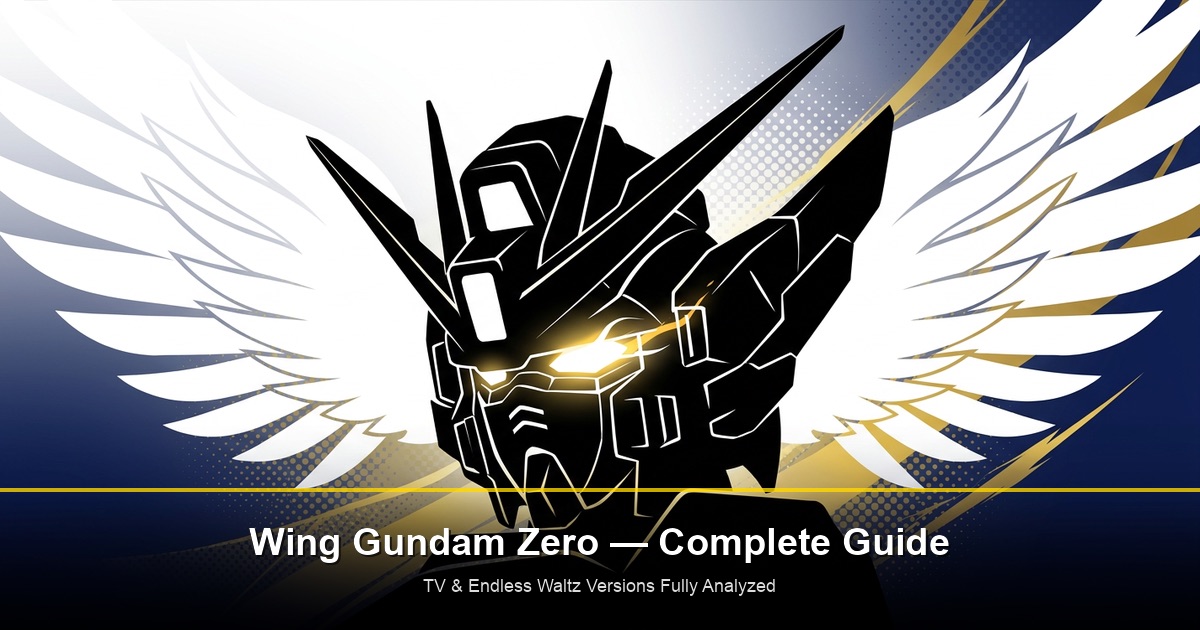
Wing Gundam Zero (XXXG-00W0) is a mobile suit from Mobile Suit Gundam Wing, which aired in 1995. But this machine is far more than a typical "upgrade for the protagonist." A Zero System that devours its pilot's sanity, a Twin Buster Rifle that can obliterate a space colony in a single shot, and a curse that drives every person who sits in its cockpit to the brink of madness — Wing Gundam Zero is an extraordinarily singular existence in the Gundam franchise, where "ultimate power" and "ultimate danger" coexist in the same machine.
And this mobile suit has another face entirely. When Hajime Katoki redesigned it for the 1997 OVA Endless Waltz, giving it four radiant angel wings, it changed Gundam history forever. The image of those white wings plunging through the atmosphere aired on America's Toonami block in the late 1990s, igniting an explosion of popularity that crossed oceans. It is no exaggeration to call Wing Gundam Zero the machine that brought Gundam to the world.
This article covers both the TV and EW versions comprehensively — specs, armaments, pilots, design secrets, and Gunpla — delivering the complete picture of Wing Gundam Zero.
Development History — The Sealed "First Gundam"
Five Scientists and the Forbidden Blueprint
In the timeline of the story, Wing Gundam Zero occupies a unique position: it is the origin point of all Gundams.
In the After Colony (A.C.) era, five scientists who belonged to OZ — Doctor J, Professor G, Doktor S, Instructor H, and Master O — collaborated to design the "ultimate mobile suit": Wing Gundam Zero. However, they sealed the design data away without ever completing the machine.
There were two reasons. First, the installed Zero System inflicted severe physical and psychological damage on its pilots. Second, the machine's destructive coefficient — epitomized by the Twin Buster Rifle — was far too extreme. The five scientists concluded that "this machine should never be controlled by a human being," and each used the design data as a foundation to independently develop a more manageable Gundam: Wing Gundam, Gundam Deathscythe, Gundam Heavyarms, Gundam Sandrock, and Shenlong Gundam.
Quatre's Construction — A.C. 195
Approximately 15 years after the original design, in A.C. 195, the fifth Gundam pilot — Quatre Raberba Winner — used design blueprints left behind by Instructor H to manufacture Wing Gundam Zero as an actual machine. The immense wealth and space-based resource procurement capabilities of the Winner family transformed the forbidden blueprint into reality.
However, it was Quatre — driven by grief over his father's death and despair for outer space — who first climbed into the cockpit, and this became a major turning point in the story. The normally gentle Quatre had his mind overtaken by the Zero System and went berserk, attempting to destroy a space colony. This shocking development starkly demonstrated the price of unleashing a machine that should have remained sealed.
Relationship to the Five Gundams
Using Wing Gundam Zero's design as their foundation, the five scientists each developed a Gundam specialized in their respective field of expertise.
| Scientist | Gundam Developed | Elements Inherited from Zero |
|---|---|---|
| Doctor J | Wing Gundam | Buster Rifle, transformation mechanism, wings |
| Professor G | Gundam Deathscythe | Stealth capabilities, close-combat specialization |
| Doktor S | Gundam Heavyarms | Heavy firepower concept |
| Instructor H | Gundam Sandrock | Armor strength, ground combat adaptation |
| Master O | Shenlong Gundam | Melee combat performance, extension arm |
Among these, Doctor J's Wing Gundam most strongly reflects Zero's core concept, inheriting all three defining elements: the Buster Rifle (Twin in Zero's case), the transformation mechanism, and the wings. Wing Gundam Zero is, quite literally, "the father of all Gundams."
Basic Specifications — TV Version
| Item | Details |
|---|---|
| Model Number | XXXG-00W0 |
| Name | Wing Gundam Zero |
| Classification | Prototype Transformable Mobile Suit |
| Head Height | 16.7m |
| Dry Weight | 8.0t |
| Armor Material | Gundanium Alloy |
| Generator Output | 3,732 kW |
| Total Thruster Output | 88,150 kg |
| Transformation | Neo-Bird Mode |
| Special Equipment | Zero System |
| Design | Five Scientists (Doctor J, Professor G, Doktor S, Instructor H, Master O) |
| Manufacture | Quatre Raberba Winner |
The TV version of Wing Gundam Zero was designed by Kunio Okawara. Its silhouette is defined by a blue, white, and red tricolor color scheme and mechanical wing thrusters mounted on its back. The generator output of 3,732 kW places it among the most powerful mobile suits in the series, with its base performance said to rival that of several Tallgeese units combined.
The astonishingly light dry weight of just 8.0 tons is attributable to the properties of its Gundanium Alloy armor. Gundanium Alloy is an ultra-rare alloy that can only be refined in outer space, combining strength and lightness far beyond any conventional metal. In the series, Wing Gundam Zero survives the self-destruction of Mercurius and a bomb equivalent to three Leo mobile suits without a scratch, demonstrating overwhelming defensive performance.
The total thruster output of 88,150 kg vastly surpasses the Leo (OZ-06MS), the standard production mobile suit of the A.C. era, clearly establishing Wing Gundam Zero as the direct evolutionary successor to Wing Gundam. Even OZ's high-performance prototype Tallgeese pales in comparison. The series describes Wing Gundam Zero as having "the base performance of several Tallgeese units," illustrating just how far beyond any existing standard this machine operates.
Basic Specifications — EW Version (Endless Waltz Version)
| Item | Details |
|---|---|
| Model Number | XXXG-00W0 |
| Name | Wing Gundam Zero (EW Ver.) |
| Classification | Prototype Transformable Mobile Suit |
| Head Height | 16.7m |
| Dry Weight | 8.0t |
| Armor Material | Gundanium Alloy |
| Generator Output | 3,732 kW |
| Total Thruster Output | 88,150 kg |
| Transformation | Neo-Bird Mode (EW Ver.) |
| Special Equipment | Zero System |
| Designer | Hajime Katoki |
In official lore, the TV version and the EW version are the same machine. The model number and all spec values are identical. However, the external appearance differs dramatically. For the EW version, Hajime Katoki completely redesigned Kunio Okawara's TV-era design, giving birth to its most iconic feature: the four angel wings (Feather Wings).
The color scheme shifted from the TV version's tricolor to a palette centered on white and blue, and the face design became markedly sharper. Where the TV version conveyed mechanical power and strength, the EW version projects divine majesty and beauty.
The wings are constructed from Gundanium Alloy in a 2-pair, 4-wing configuration. The forward pair serves as the main wings (wing binders) with a wide range of motion; when deployed to the front of the machine, they function as defensive shields against enemy attacks. During atmospheric re-entry, these wings fold forward to serve as heat shields. The rear pair houses internal thrusters that enable atmospheric flight.
The internal structure of the wings employs what is called the "Fractal Feather Layer Structure" — an assembly of nano-scale components that dissipate and reassemble like feathers when subjected to heat radiation or impact shock, representing an extraordinarily advanced design philosophy.
Zero System — "The Price of Victory" That Consumes Its Pilot
What Is the Zero System?
The formal name of the Zero System is "Zoning and Emotional Range Omitted System." As the name implies, this system eliminates the pilot's "emotions" and forcibly selects actions oriented purely toward "achieving victory."
Specifically, it measures and predicts battlefield conditions across countless variables every fraction of a second, transmitting the results directly into the pilot's brain in a form resembling precognition. Simultaneously, it scans the pilot's brain and regulates neurotransmitter secretion, mitigating the shock of extreme acceleration and sharp maneuvers that a normal human could not endure, thereby enabling machine control that surpasses human limitations.
The Terrifying Side Effects
The actions prescribed by the Zero System pursue one objective only: victory for the individual unit. It does not factor in damage to allied forces, destruction of the surrounding environment, or even the pilot's own survival.
Pilots with insufficient mental fortitude are crushed under the avalanche of information from the system, losing the ability to distinguish reality from hallucination. When Quatre first piloted the machine and went berserk — attempting to destroy a colony — this occurred because the Zero System amplified Quatre's latent desire to "eliminate all weapons in space" and presented him with the shortest route to achieving it.
The only person who ultimately achieved not "mastery over" but "coexistence with" the Zero System was Heero Yuy alone. Heero reached a state where he could accept the futures the Zero System showed him while still choosing his own actions through his own will. This was only possible thanks to Heero's extraordinary mental fortitude and the rigorous psychological conditioning he endured from early childhood.
Those Who Sat in Zero's Cockpit
| Pilot | Result |
|---|---|
| Quatre Raberba Winner | Went berserk. Attempted colony destruction |
| Trowa Barton | Consciousness collapse. Attacked allies |
| Duo Maxwell | Rejection reaction. Evacuated cockpit shortly after |
| Chang Wufei | Adapted after intense internal struggle |
| Zechs Merquise | Adapted. Control ability rivaling Heero |
| Heero Yuy | Complete adaptation. Achieved coexistence with the system |
| Trant Clark | Mental collapse. Died |
All five Gundam pilots sat in this machine's cockpit, as did Zechs Merquise and OZ soldier Trant Clark. Trant was completely consumed by the Zero System, suffering a total mental breakdown and losing his life. This episode stands as the most stark demonstration of the Zero System's horror.
Armaments — Destructive Power That Erases Colonies
Twin Buster Rifle
The signature weapon of Wing Gundam Zero. A massive beam cannon formed by linking two individual Buster Rifles together.
At maximum output, it can destroy a space colony in a single shot — a level of firepower that is extraordinary for any mobile suit-carried weapon in the Gundam franchise. In the EW version, it is depicted penetrating an 18 km colony shaft along with every bulkhead in its path, making the sheer scale of its destructive power unmistakable.
The two rifles can be separated and used one-handed, which halves the output but improves handling. The weapon can fire continuously as long as the machine's energy holds out, a critical distinction from ammunition-limited projectile weapons. The EW version also adds a mechanism for storing the Twin Buster Rifle inside the wings.
Beam Sabers
Two close-combat weapons with distinctive green blades. A green beam saber is a rarity across the entire Gundam franchise, further highlighting Wing Gundam Zero's unique identity.
These sabers possess sufficient output to go toe-to-toe with Gundam Epyon's beam sword in melee combat, and the final battle between Heero and Zechs features a fierce, breathtaking clash of these blades.
Machine Cannons
Four-barreled machine guns built into both shoulders. While overshadowed by the beam sabers and Twin Buster Rifle, they possess enough firepower to destroy OZ's mass-produced Virgo mobile dolls in just a few seconds of sustained fire, proving their worth in mid-range suppression and chaotic engagements against multiple enemies.
Shield (Wing Shield) — TV Version Only
The TV version features a dedicated Wing Shield. During transformation to Neo-Bird Mode, it becomes the nose section of the aircraft, and it can also be used as a striking weapon — a multi-function piece of equipment. In the EW version, this shield was eliminated, with the wings (wing binders) taking over its defensive function.
Wing Binders
Large wing-type units mounted on the back. In the TV version they appear as mechanical wing thrusters; in the EW version, as feathered wings. Their appearance differs drastically, but their functions are shared: flight, thrust augmentation, attitude control, and defensive shielding.
The EW version's wing binders possess a particularly elaborate structure. The two forward main wings have a wide range of motion and can deploy to the front of the machine to shield against enemy attacks while also serving as heat shields during atmospheric entry. The two rear sub-wings house internal thrusters, and by varying their surface area, they enable precise control of flight performance. The coordinated movement of all four wings evokes the graceful image of an angel in flight.
Drei Zwerg Buster (Glory of Losers Version)
An enhanced weapon added in the manga Endless Waltz: Glory of Losers. This ultra-massive weapon possesses enough destructive power to annihilate the Moon's Aitken Basin, far exceeding even the Twin Buster Rifle's output. However, this armament does not appear in the TV or OVA versions — it is a manga-original addition.
Armament Comparison (TV Version vs. EW Version)
| Armament | TV Version | EW Version |
|---|---|---|
| Twin Buster Rifle | Equipped | Equipped (wing storage mechanism added) |
| Beam Sabers | 2 units | 2 units |
| Machine Cannons | Built into both shoulders | Built into both shoulders |
| Shield (Wing Shield) | Equipped | Not equipped (replaced by wings) |
| Wing Binders | Mechanical wing type | Feather wing type |
| Wing Vulcans | Setting only (unused) | — |
Neo-Bird Mode — The "W"-Shaped Transformation
Wing Gundam Zero is a transformable mobile suit capable of shifting into a flight-optimized "Neo-Bird Mode."
TV Version Transformation Process
- Deploy the covers on the back-mounted wings
- Rotate the head and lower body 180 degrees
- Fold the knees and shoulder armor
- Retract the ankles while simultaneously exposing the Zero Verniers
- The shield becomes the nose section
The post-transformation silhouette is said to trace the letter "W" — a nod to the series title Gundam W(ing) — and enables high-speed travel in both space and atmosphere. During landing, the shoulder-to-arm section forms an L-shape to serve as landing gear, a cleverly detailed design feature.
EW Version Neo-Bird Mode
Initially, the EW version was considered incapable of the complete transformation seen in the TV version because it lacked a shield. However, the manga Glory of Losers reintroduced the shield, establishing two new types of Neo-Bird Mode: an atmospheric flight configuration and a space navigation configuration. During atmospheric entry, the wings deploy forward to serve as a heat shield — a descent posture unique to the EW version and strikingly beautiful in its own right.
Pilots — Those Chosen by Zero
Heero Yuy — The Perfect Soldier's Fusion with Zero
Heero Yuy is the "primary pilot" of Wing Gundam Zero, operating the machine more than anyone else across both the TV series and Endless Waltz.
Heero is one of five Gundam pilots sent to Earth as part of Operation Meteor, a mission to secure the space colonies' independence. He initially piloted Wing Gundam before transitioning to Wing Gundam Zero midway through the story.
"I'll kill you." "It hurts like hell." — These signature lines embody Heero as the "perfect soldier," raised with his emotions systematically suppressed. Yet ironically, it was through his fusion with the Zero System — a device designed to eliminate emotion — that Heero gradually recovered his humanity.
Confronting the "futures" shown by the Zero System and still choosing his own path through his own will — the relationship between Heero and Wing Gundam Zero transcends the simple framework of pilot and machine, bound together by a bond more like that of partners who need each other.
Quatre Raberba Winner — The Gentle Boy Who Went Berserk
Quatre himself manufactured Wing Gundam Zero as a physical machine. Normally the gentlest and most mild-mannered of the five Gundam pilots, the despair of his father's death triggered the Zero System's rampage within him.
In Episode 24, "The Gundam They Called Zero," Quatre's mind is seized by the Zero System. He attacks and completely destroys his ally Trowa's Vayeate, then declares his intent to destroy a colony. "I can see everything! The space heart is telling me to fight!" — The sight of the gentle Quatre's transformation accompanying this cry left an indelible impression on viewers, crystallizing the Zero System's horror into one unforgettable scene.
Heero, piloting Mercurius, intervened to stop Quatre's rampage, but this incident left deep psychological scars on Quatre.
Zechs Merquise — The Rival Who Piloted Zero
Zechs Merquise (real name: Milliardo Peacecraft), Heero's greatest rival, is another significant pilot of Wing Gundam Zero.
Zechs controlled the Zero System with mental fortitude rivaling Heero's, handling the machine with complete mastery. In the latter stages of the TV series, Zechs pilots Wing Gundam Zero against Heero's Gundam Epyon in a climactic duel — a remarkable scenario in which two aces fight each other having swapped their respective machines.
Zechs, too, struggled with the futures revealed by the Zero System, yet continued to fight for his own conviction — the realization of peace through military force.
Other Pilots
- Trowa Barton: Piloted the machine temporarily, but under the Zero System's influence, his consciousness deteriorated and he attacked allies
- Duo Maxwell: Attempted to pilot it but displayed a strong rejection reaction to the Zero System, evacuating the cockpit in short order
- Chang Wufei: Adapted to the Zero System after intense inner turmoil. In Endless Waltz, he becomes Heero's final conversation partner
- Trant Clark: An OZ soldier. Boarded Zero as a test pilot but suffered total mental collapse and lost his life — the most tragic embodiment of the Zero System's danger
Variations — TV, EW, and Proto Zero
TV Version Wing Gundam Zero
The "original" Wing Gundam Zero designed by Kunio Okawara. Characterized by its blue, white, and red tricolor color scheme and a powerful silhouette equipped with mechanical wing thrusters. The transformation mechanism is an evolution of Wing Gundam's design, with the shield/nose integration serving as a distinctive design accent.
Heero's first encounter with the TV version occurs in Episode 24. After Quatre's rampage, the machine ultimately becomes Heero's personal suit. The final battle features a fierce clash against Zechs's Gundam Epyon.
EW Version Wing Gundam Zero (Commonly Known as: Zero Custom)
The "redesigned version" by Hajime Katoki. While it is canonically the same machine as the TV version, its external appearance differs substantially.
Its most defining feature is the white angel wings. The four Feather Wings, modeled after avian plumage, are regarded as one of the most beautiful designs in Gundam history. The face is also distinct from the TV version — sharper and more dignified. The color scheme shifts to a pure, clean image centered on white and blue.
The name "Wing Gundam Zero Custom" became established as a Gunpla product name. In canon, the machine was not actually "customized" — it is simply a redesign of the same unit. However, the manga Endless Waltz: Glory of Losers later depicted the actual process of the machine being refitted from its TV appearance to its EW appearance, establishing "Custom" as an in-universe designation in both name and substance.
Wing Gundam Proto Zero
A mobile suit appearing in the manga Endless Waltz: Glory of Losers, positioned as the pre-refit form of Wing Gundam Zero (EW version). Its appearance is nearly identical to the TV version of Wing Gundam Zero, establishing the flow of "TV appearance → Proto Zero → EW appearance" as the refit sequence — serving as a bridge connecting the two designs.
Prototype (FT Version)
In the novel Frozen Teardrop, the story reaches even further back to reveal a prototype Zero unit manufactured by Doctor J around A.C. 186. This machine was reportedly piloted by Heero's biological father, Odin Lowe, but the technology of the era meant that neither the Zero System nor the Twin Buster Rifle was yet complete, making it a fundamentally different existence from the Wing Gundam Zero we know today.
Variation Overview
| Variation | Designer | Appearance | Features |
|---|---|---|---|
| TV Version | Kunio Okawara | TV anime Gundam Wing | Tricolor, mechanical wings, transformation |
| EW Version (Zero Custom) | Hajime Katoki | OVA/Film Endless Waltz | Angel wings, white-blue color scheme, redesign |
| Proto Zero | — | Manga Glory of Losers | TV-era appearance. Pre-EW refit designation |
| Prototype | — | Novel Frozen Teardrop | Earliest prototype. Incomplete state |
Iconic Scenes
Episode 24: "The Gundam They Called Zero" — The TV Version's Shocking Debut
The episode where Wing Gundam Zero first appears. After Quatre manufactures and pilots it, the machine single-handedly annihilates an OZ force with overwhelming combat power — only for the Zero System's rampage to cause Trowa's Vayeate to be completely destroyed. Quatre then declares his intent to destroy a colony in a shocking turn of events. Heero confronts Quatre in Mercurius, putting his own life on the line to halt the rampage — a sequence that perfectly captured the "terror" inherent to Wing Gundam Zero as a machine.
Heero vs. Zechs — The Final Battle Against Epyon (Near the TV Series Finale)
The climax of the TV series sees Heero's Wing Gundam Zero collide with Zechs's Gundam Epyon. A battle between two Zero System-equipped machines becomes a transcendent duel where their respective "futures" clash and intersect. The spectacular footage of the Twin Buster Rifle meeting Epyon's beam sword is a scene worthy of crowning the TV series at its zenith.
Atmospheric Re-Entry — The Descent of the Angel in EW
One of the most iconic scenes in Endless Waltz. Wing Gundam Zero spreads its four wings and plunges into the atmosphere, looking for all the world like an angel descending to earth. The image of white wings blazing with atmospheric friction yet continuing to shine is remembered as the most beautiful descent sequence in all of Gundam.
The Last Shooting — 90% of All Armor Lost
The finale of Endless Waltz. In the final battle against the Mariemaia Army, Wing Gundam Zero fights on until it has lost 90% of its total armor. Reduced to little more than its frame — the "Zero Frame" — Heero executes one final precision shot, penetrating the presidential shelter's shield with the Twin Buster Rifle and completing the mission.
"Zero... can you still move?" "Alright... this will be our last sortie." — Heero's words to his battered machine in that moment carry both deep attachment and absolute resolve, creating one of the series' most moving scenes. And with this sortie, Wing Gundam Zero's duty comes to an end.
"Tell Me, Wufei" — Gundam Wing's Greatest Scene
In fan polls for the best scenes of Endless Waltz, this moment — Heero speaking to Wufei from Zero's cockpit — consistently takes the top spot. "How many more people must we kill?" — Confronted with a question that even the Zero System has no answer for, the "perfect soldier" Heero reveals his anguish as a human being. In this instant, Wing Gundam Zero ceases to be a mere weapon and becomes a mirror reflecting Heero's soul.
"Zero won't tell me anything." — The system that seemed so omnipotent falls silent when faced with a question of the human heart. This cruel irony strikes at the very essence of what Wing Gundam Zero is. Tactical "victory" can be calculated, but the question "Why do we fight?" is one no machine can answer. A scene that simultaneously depicts the limits of technology and the value of human will — one of the finest moments not just in Gundam Wing, but across the entire Gundam franchise.
Shooting Trowa — The Sin of Hurting a Friend
The scene in Episode 24 where Quatre's berserk Wing Gundam Zero completely destroys Trowa's Vayeate is another critically important moment. The gentle Quatre injuring the comrade he trusted most with his own hands — this tragedy demonstrated that the Zero System is a terrifying device capable of destroying even human bonds. Trowa lost his memories as a result of this battle, and Quatre carried the weight of his guilt long afterward.
Design Secrets — Kunio Okawara and Hajime Katoki, Two Designers
Kunio Okawara's TV Version Design
The TV version of Wing Gundam Zero was created by Kunio Okawara, who handled the mechanical design for all of Mobile Suit Gundam Wing. It was born as the powered-up successor to Wing Gundam, which had already been designed around the concept of "a machine with wings that transforms."
The hallmarks of Okawara's design are mechanical power and structural logic in the transformation mechanism. The wing thrusters prioritize functional beauty as thrust-generating devices, designed not as "bird-like wings" but as "wings that double as propulsion systems." The blue, white, and red tricolor visually signals the lineage from Wing Gundam while also lending a heroic vibrancy to the machine's appearance.
Hajime Katoki's EW Version Design — The Birth of the Angel Wings
For the production of the 1997 OVA Mobile Suit Gundam Wing: Endless Waltz, Hajime Katoki took charge of redesigning Wing Gundam Zero. Notably, while all five Gundams were redesigned for the EW version, the other four (Deathscythe Hell, Heavyarms, Sandrock, and Altron) received detail-up refinements by Junya Ishigaki, whereas Wing Gundam Zero alone received an entirely new design from Hajime Katoki.
Katoki himself has explained that "It's called 'Wing Gundam,' so it needs proper wings" — a conviction that led him to replace the TV version's mechanical wings with angel wings modeled after avian plumage. This seemingly simple idea generated an impact that changed the course of Gundam history.
Katoki has also described the relationship between the two designs by saying that "the EW version is a curtain call for the TV series" — a position from which he enriched the fan service. In other words, "they are canonically the same machine, but as a visual production, it's an alternative interpretation — a celebration." This stance gave him the freedom to design without constraint.
These "angel wings" influenced robot designs far beyond Gundam, establishing a new icon for the concept of "a robot with wings."
TV Version vs. EW Version — The Enduring Fan Debate
Among Wing Gundam Zero fans, the debate over "which is the true Wing Gundam Zero — TV or EW?" has persisted for years. TV version advocates argue that "Kunio Okawara's original design is the orthodox one" and that "mechanical wings are more appropriate for a mobile suit." EW version advocates counter that "Katoki's angel wings are the completed form of Wing Zero" and that "the union of beauty and strength is Wing's true essence."
This debate has no resolution, but examining Gunpla releases reveals an interesting trend. For many years, kit development focused almost exclusively on the EW version, but more recently — with the 2014 HGAC and the 2025 RG — the TV version has been receiving new kits. It is precisely because both designs have their own devoted fan bases that this machine continues to be beloved nearly 30 years on.
Cultural Impact — The Wings That Brought Gundam to the World
The Shock to the Toonami Generation
Wing Gundam Zero — particularly the EW version's angel wings — was the driving force behind Gundam's true breakthrough in North America.
In March 2000, Mobile Suit Gundam Wing began airing on Cartoon Network's anime block "Toonami" in the United States. Within just one week of its premiere, it became the highest-rated program across all demographics. For a time it surpassed even Pokemon and Dragon Ball Z in popularity, and by the summer of 2000, it maintained a #1 or #2 rating on Toonami while being rebroadcast 12 times per week — an extraordinary achievement.
Among all the imagery from the show, the EW version's angel wings left the most vivid impression on American children. A robot that was simultaneously as beautiful as an angel — an existence that shattered every preconception about mechanical design. The American children of the 1990s who became interested in Gunpla because of this machine are known as the "Toonami Generation," and they built the foundation for Gundam's ongoing popularity in North America today.
Gunpla Culture's Expansion into the West
Following the success of Gundam Wing on Toonami, Bandai launched a full-scale Gunpla distribution effort in North America. Wing Gundam Zero kits became the catalyst that introduced the Gunpla hobby to the Western hemisphere. The EW version's PG (Perfect Grade) and MG (Master Grade) in particular have remained highly sought-after as collector's items, and to this day they rank among the most expensive kits in the Gunpla lineup.
Presence in Cosplay Culture
The EW version of Wing Gundam Zero is a popular subject at cosplay events worldwide. Large-scale cosplays that recreate the four wings are guaranteed to draw attention at any convention. While mechanical Gundam designs are notoriously difficult to cosplay, the angel wing motif offers natural compatibility with cosplay construction, making Wing Gundam Zero one of the most frequently cosplayed mobile suits in all of Gundam.
How "Angel Wings" Changed Gundam History
The success of the EW version of Wing Gundam Zero had a profound influence on Gundam's design philosophy. Prior to this machine, Gundam design had trended toward "realism as a weapon of war," but the EW version of Zero introduced new values — beauty, mysticism, and fantasy — into the Gundam design vocabulary.
This lineage was carried forward by later designs such as Strike Freedom Gundam (with its wings of light) from the Gundam SEED series and 00 Qan[T] from Gundam 00, giving rise to a tradition of "beautiful Gundams with wings."
Iconic Lines That Transcended Borders
"I'll kill you." "It hurts like hell." — Heero's signature lines have permeated anime fan culture both in Japan and internationally. "I'll kill you" in particular — delivered to a stranger upon their very first meeting (Relena Darlian) — is famous not only among Gundam fans but across the broader anime fandom. His characteristically terse phrases like "Mission complete" and "Mission accepted" have also become beloved hallmarks of his character.
Internationally, "I'll kill you," "It hurts like hell," and "Mission complete" have become common parlance among Gundam Wing fans, quoted routinely on social media and in fan communities. Heero and Wing Gundam Zero have become icons that unite fans across language barriers.
Super Robot Wars Series Appearances
Wing Gundam Zero is a perennial fan-favorite unit in the Super Robot Wars video game franchise. The combination of the Twin Buster Rifle's overwhelming firepower and the Zero System's pilot ability augmentation makes it one of the strongest units in many installments. The EW version is particularly celebrated for its gorgeous combat animations with wings fully spread, extending Wing Gundam Zero's recognition to the gaming audience as well.
Gunpla Guide — Complete Coverage of All Grades
Wing Gundam Zero boasts an exceptionally extensive Gunpla lineup for both the TV and EW versions.
HGAC 1/144 Wing Gundam Zero (TV Version)
| Item | Details |
|---|---|
| Price | 1,760 yen (tax included) |
| Release Date | March 8, 2014 |
| Scale | 1/144 |
| Features | Reproduces the TV version design. Transformation to Neo-Bird Mode possible via parts swapping. Twin Buster Rifle can be linked or separated. Shoulder machine cannons can be deployed |
The ideal entry-level kit for TV version Wing Gundam Zero. The price is affordable, the transformation gimmick is enjoyable, and the overall cost-performance ratio is excellent.
RG 1/144 Wing Gundam Zero EW
| Item | Details |
|---|---|
| Price | 3,080 yen (tax included) |
| Release Date | December 26, 2014 |
| Scale | 1/144 |
| Features | Reproduces the EW version's angel wings at 1/144 scale. Wings articulate in three dimensions, achieving curved shapes reminiscent of real bird wings. Twin Buster Rifle combination mechanism included |
Despite being 1/144 scale, this kit achieves a remarkably high-fidelity rendition of the EW version's beautiful wings. The extensive wing articulation allows for a wide range of expressive poses. Highly recommended as an entry point for the EW version.
RG 1/144 Wing Gundam Zero (TV Version)
| Item | Details |
|---|---|
| Price | 4,620 yen (tax included) |
| Release Date | September 27, 2025 |
| Scale | 1/144 |
| Features | Completely new sculpt. Wing binders feature a 5-axis articulation system — an RG-original mechanism. Internal verniers rotate, nozzles extend, and fins deploy in an interconnected motion. Parts swapping enables Neo-Bird Mode transformation |
The latest kit, released in 2025. An ambitious work that reconstructs the TV version's design with cutting-edge technology. The wing binder linked mechanism showcases RG-caliber precision engineering. The definitive kit that TV version fans have been waiting for.
MG 1/100 Wing Gundam Zero EW Ver.Ka
| Item | Details |
|---|---|
| Price | 6,050 yen (tax included) |
| Release Date | November 28, 2020 |
| Scale | 1/100 |
| Features | Fully supervised by Hajime Katoki. Thorough pursuit of wing deployment and linked mechanisms. Twin Buster Rifle can be stored inside the wings. Transformation to Neo-Bird Mode achieved. Precision Ver.Ka decals included |
The definitive Gunpla rendition of EW version Wing Gundam Zero. The wing deployment mechanism, supervised by Katoki himself, is nothing short of breathtaking, and many voices call this "the most beautiful Gunpla ever made." Displayed with its wings fully spread, it commands an overwhelming presence that captivates all who see it.
MG 1/100 Wing Gundam Zero (Endless Waltz Version)
| Item | Details |
|---|---|
| Price | 4,620 yen (tax included) |
| Release Date | October 2004 |
| Scale | 1/100 |
| Features | The MG kit preceding the Ver.Ka. Well-regarded for its voluminous wing presence. More affordable than the Ver.Ka while still delivering the EW experience |
The predecessor to the Ver.Ka MG kit. Priced more accessibly than the Ver.Ka while maintaining impressive wing volume. An excellent option for those who want an MG-scale EW version without the premium price point.
PG 1/60 Wing Gundam Zero Custom
| Item | Details |
|---|---|
| Price | 16,500 yen (tax included) |
| Release Date | November 23, 2000 |
| Scale | 1/60 |
| Features | The ultimate Wing Gundam Zero. Fully reproduces the internal "Zero Frame" skeleton. Wings employ cutting-edge "Hybrid Injection" technology to replicate the natural "flex" of feathers. Stands approximately 30 cm tall |
The pinnacle kit at 1/60 scale. It faithfully reproduces the internal skeleton known as the Zero Frame, and to achieve the natural "flex" of the angel wings, Bandai deployed Hybrid Injection — the most advanced molding technology available at the time. A kit that gives physical form to the ultimate love for EW version Wing Gundam Zero.
How to Choose Your Kit
| Your Type | Recommended Kit |
|---|---|
| Gunpla beginner | HGAC Wing Gundam Zero (TV Version, 1,760 yen) |
| TV version fan | RG Wing Gundam Zero (2025, 4,620 yen) |
| Drawn to the EW wings | RG Wing Gundam Zero EW (3,080 yen) |
| Want the best single kit | MG Wing Gundam Zero EW Ver.Ka (6,050 yen) |
| Pursuing the ultimate | PG Wing Gundam Zero Custom (16,500 yen) |
| Value-conscious | HGAC Wing Gundam Zero (1,760 yen) |
Note: Numerous special editions are also available, including Gundam Base-exclusive Titanium Finish and Clear Color versions.
Limited and Special Edition Kits
Wing Gundam Zero has an exceptionally wide range of limited editions, with high demand among collectors.
- MG Wing Gundam Zero EW Ver.Ka Titanium Finish: Gundam Base exclusive. Metallic coating reproduces the gleam of the wings
- MG Wing Gundam Zero EW Ver.Ka Clear Color: Gundam Base exclusive. Clear molding reveals the internal structure
- RG Wing Gundam Zero EW & Drei Zwerg Titanium Finish: Limited edition. Includes Drei Zwerg weapon add-on
- HGAC Wing Gundam Zero Clear Color: Released January 2025. 1,760 yen (tax included)
- PG Wing Gundam Zero (EW Ver.) Pearl Mirror Coating Ver.: Special coating finish for enhanced luminosity
All of these are primarily sold through Premium Bandai and Gundam Base locations, making them difficult to obtain through standard retail channels.
Related Articles
- Gundam Wing — Complete Series Guide: A comprehensive guide covering the story, characters, and mobile suits of the entire series
- Gundam Epyon — Complete Mobile Suit Guide: Wing Gundam Zero's arch-nemesis. Zechs's personal machine and the other Zero System-equipped mobile suit
- Tallgeese — Complete Mobile Suit Guide: The ancestor of all mobile suits, whose design influenced Wing Gundam Zero
- Heero Yuy — Character Guide: The complete profile of the "perfect soldier." Iconic lines, machines piloted, and signature moments
Sources
- Mobile Suit Gundam Wing TV Series, Sunrise, 1995–1996
- Mobile Suit Gundam Wing: Endless Waltz OVA / Theatrical Film, Sunrise, 1997–1998
- Mobile Suit Gundam Wing: Endless Waltz — Glory of Losers Manga, Katsuyuki Sumizawa (original work) / Tomofumi Ogasawara (illustration), Kadokawa Shoten
- Mobile Suit Gundam Wing: Frozen Teardrop Novel, Katsuyuki Sumizawa, Kadokawa Shoten
- Bandai Spirits Hobby Official Website (bandai-hobby.net)
- GUNDAM.INFO (gundam.info)
- Gundam Wiki (gundam.fandom.com)
- Gundam Wiki JP (gundam.wiki.cre.jp)
- Pixiv Encyclopedia (dic.pixiv.net)
- MG Wing Gundam Zero EW Ver.Ka Development Documentation (bandai-hobby.net)
If you spot any errors or have updated information, please let us know. Accuracy matters to us.