Turn A Gundam Complete Guide— The Heretical White Mustache Born from Syd Mead's Vision
Contents
- 01The "Mustache" That Changed Everything — What Is Turn A Gundam?
- 02Specifications — Transcendent Performance with Twin Degeneracy Reactors
- 03Weapons Arsenal — The Power to End Civilization
- Weapons List
- Beam Rifle — A Resonance Particle Cannon That Defies the Atmosphere
- Beam Saber — A Blade of Light That Changes Shape
- Shield — A Bulwark That Heals Itself
- Chest Beam Cannon — A Spread Beam That Pierces I-Fields
- Gundam Hammer — Primitive Yet Devastating
- Nuclear Warhead Missiles — Doomsday Weapons in Its Chest
- Moonlight Butterfly — The Ultimate Weapon That Turns Everything to Sand
- 04Pilot — Loran Cehack, the Moonrace Boy Who Fell in Love with Earth
- 05Variants — The Turn Type Lineage
- 06Design Secrets — The Day Syd Mead Reinvented "Gundam"
- 07Role in the Story — From Sacred Idol to Washing Machine
- 08Cultural Impact — The Gundam That Coined "Dark History"
- 09Gunpla Guide — Getting Your Hands on the Mustache
- 10Related Articles
- 11Sources
The "Mustache" That Changed Everything — What Is Turn A Gundam?
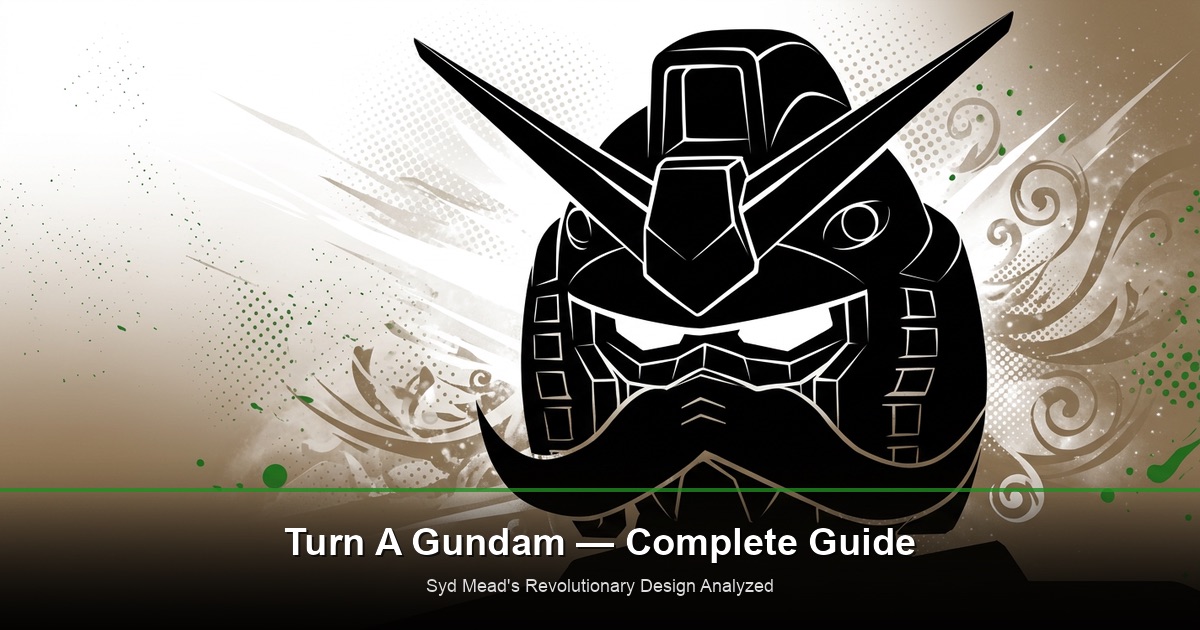
In 1999, a single piece of concept art stopped the Gundam fandom in its tracks. White body, blue chest — so far, so "Gundam." But the moment your eyes reached its face, words failed. A mustache, growing from its cheeks. Instead of the signature V-fin, two sweeping protrusions extended from either side of its jaw — a design that shattered every convention the franchise had established.
"It's ugly." "That's not a Gundam." — The fan reaction at the time was, to put it mildly, a firestorm. The man behind the design was Syd Mead, the legendary Hollywood visual futurist known for Blade Runner and Tron. It was the first time a foreign designer had ever been brought in to lead mecha design for a major Japanese anime production.
Yet a quarter-century later, Turn A Gundam holds a singular place in the franchise. Not simply because its design was unconventional, but because of the burden it carries — the "Dark History" — a setting that positions it as the final destination of every Gundam timeline, a machine with the power to reduce entire civilizations to sand, the key that ties every Gundam story into one.
"The Turn A has been called the White Doll and worshipped by the people. If its true form is a machine, then depending on how it's used, it can serve everyone's benefit." — Loran Cehack
This article covers everything about Turn A Gundam — specs, weapons, pilot, design backstory, cultural impact, and Gunpla — the complete picture of this heretical white-mustached machine.
Whether you're brand new to Gundam or a lifelong fan, learning the story of Turn A Gundam just might change how you answer the question: "What is Gundam?"
Specifications — Transcendent Performance with Twin Degeneracy Reactors
Spec Sheet
| Category | Details |
|---|---|
| Model Number | System-∀99 (pre-Correct Century) / WD-M01 (Militia designation) |
| Name | ∀ Gundam (Turn A Gundam) |
| Nicknames | White Doll, White Mustache, Mustache |
| Overall Height | 20.0m |
| Dry Weight | 28.6t |
| Armor Material | FE-type (Nanoskin) |
| Main Power Plant | DHGCP (Degeneracy Reactor) ×2 |
| Generator Output | Estimated 27,000kW (±5,000) |
| Drive System | IFBD (I-Field Beam Drive) |
| Lead Designer | Syd Mead |
| Appears In | Turn A Gundam (1999–2000) |
| Pilot(s) | Loran Cehack, Merrybell Gadget |
The Astonishing Power Source: DHGCP
The first thing that leaps off Turn A Gundam's spec sheet is its estimated generator output of 27,000kW. That's roughly 20 times the original Gundam (RX-78-2) at 1,380kW, and about 9 times the Nu Gundam's 2,980kW. The source of this staggering output is the DHGCP (Discontinuous Hyperoscillation Gauge Field Degeneracy Reactor).
Fundamentally different from the thermonuclear fusion reactors found in conventional mobile suits, the DHGCP harnesses "degeneracy" phenomena that transcend the known laws of physics. And Turn A carries two of them, granting it a virtually limitless energy supply. This astronomical power is what fuels the Moonlight Butterfly, the I-Field, and every other superweapon in its arsenal.
IFBD: A Revolutionary Drive System
Turn A Gundam's internal structure is fundamentally unlike any other mobile suit. The entire machine is enveloped in an I-Field, and that field itself generates the motive force — a system known as IFBD (I-Field Beam Drive).
The greatest advantage of this approach is that the volume traditionally occupied by actuators and generators is dramatically reduced. The result is vast open space inside the frame, allowing for remarkably comfortable cockpit accommodations. This is precisely why Turn A Gundam was able to store and transport cows and pigs in its chest cavity during the show — a direct consequence of its design philosophy.
Nanoskin — Living Armor
Turn A Gundam's armor is composed of a special material called Nanoskin. This is an aggregate of countless nanomachines that continuously self-repair, much like biological cells undergoing metabolism.
When the armor sustains combat damage, a scab-like substance forms over the wound, and over time, the armor restores itself to its original state. According to legendary supplementary lore, the Nanoskin is even said to be capable of complete regeneration, pilot included. When Turn A first awakened from its long slumber, residual Nanoskin debris clogged the thruster vanes, preventing them from functioning properly — but by mid-series (Episode 12), full capability was restored.
Comparison with Other Gundams
Just how far beyond the norm Turn A Gundam sits becomes immediately clear when compared to other protagonist Gundams throughout the franchise.
| Mobile Suit | Output | Armor | Special Abilities |
|---|---|---|---|
| RX-78-2 Gundam | 1,380kW | Luna Titanium Alloy | None |
| Zeta Gundam | 2,020kW | Gundarium Alloy | Transformation (Waverider) |
| Nu Gundam | 2,980kW | Gundarium Alloy | Psycho-Frame, Fin Funnels |
| Unicorn Gundam | 3,480kW | Gundarium Alloy | NT-D, Destroy Mode |
| ∀ Gundam | 27,000kW | FE-type (Nanoskin) | Moonlight Butterfly, Self-Repair, IFBD, Teleportation |
In output alone, Turn A Gundam boasts roughly 8 times the power of the Unicorn Gundam, the Universal Century's ultimate weapon. Add self-repairing armor, civilization-scale destructive capability, and I-Field defense, and every stat reads like the "final destination" it was designed to be.
Thruster Vanes: A Unique Propulsion System
Turn A Gundam's propulsion system also stands in a class of its own. The thruster vanes mounted on its lower body are clusters of two-dimensional nozzles with built-in micro-engines. These vanes generate thrust not only in space but also within the atmosphere, embodying the Turn A's core design philosophy of "independent solo operation."
The dorsal vanes double as nanomachine dispersal ports when the Moonlight Butterfly is deployed — a multi-purpose unit that handles propulsion, offense, and defense within a single system, reflecting an efficient and elegant design.
Weapons Arsenal — The Power to End Civilization
Turn A Gundam's armament spans an unparalleled range, from conventional combat equipment to weapons capable of annihilating entire civilizations.
Weapons List
| Weapon | Type | Features |
|---|---|---|
| Beam Rifle | Ranged | Resonance particle cannon. No attenuation in atmosphere |
| Beam Saber | Melee | Two units on back. Shape-adjustable blade |
| Shield | Defensive | Elliptical multi-layer construction. Self-repairing |
| Chest Beam Cannon | Spread Shot | Special design unaffected by I-Field defenses |
| Gundam Hammer | Melee | Spiked iron ball with built-in rocket booster |
| Nuclear Warhead Missiles | Strategic | Stored in chest. Weapons of mass destruction |
| Moonlight Butterfly | Nanomachine Weapon | Civilization-scale indiscriminate destruction |
| Missiles | Ranged | Launchable from multiple body sections |
| Minchi Drill | Melee | For excavation and close-range combat |
Beam Rifle — A Resonance Particle Cannon That Defies the Atmosphere
Turn A Gundam's beam rifle employs a unique mechanism called a resonance particle cannon. Standard beam weapons lose energy to atmospheric resistance when fired within Earth's atmosphere, but the resonance particle cannon overcomes this problem entirely, delivering space-equivalent firepower even on the ground.
In the show, the rifle features a telescoping mechanism that allows the barrel length to be adjusted depending on the tactical situation. This design embodies Turn A Gundam's philosophy of being fully operational in any environment as a self-sufficient combat unit.
Beam Saber — A Blade of Light That Changes Shape
The two beam sabers mounted on the dorsal platform generate high-temperature, high-pressure beam blades. Unlike beam sabers on other Gundams, these can be shape-adjusted into a sword-like configuration, allowing the pilot to switch between a narrow thrusting blade and a wide sweeping edge depending on the situation.
In the final battle, these beam sabers played a starring role in the climactic clash against Turn X. The scene where Loran raises his saber and crosses blades head-on with Gym Ghingham's Turn X is one of Turn A Gundam's most iconic moments.
Shield — A Bulwark That Heals Itself
The elliptical, multi-layered shield possesses the same self-repair capability as the main body's Nanoskin. While ordinary shields degrade and eventually become useless after taking hits, Turn A Gundam's shield restores itself given enough time. In prolonged battles where defense and offense must coexist, this trait provides an overwhelming advantage.
Chest Beam Cannon — A Spread Beam That Pierces I-Fields
The spread beam cannon housed in the chest is specifically designed to bypass conventional I-Field defenses. The I-Field is widely known as a technology that neutralizes beam weapons, but Turn A Gundam's chest cannon defies that logic. This serves as proof that Turn A Gundam represents the absolute pinnacle of I-Field technology.
Gundam Hammer — Primitive Yet Devastating
Reminiscent of the original Gundam's signature weapon, this spiked iron ball comes with a critical upgrade in the Turn A version — a built-in rocket booster. When hurled, the booster ignites, delivering impact velocity and force far beyond what a physical throw could achieve. The contrast of a primitive bludgeoning weapon mounted on the most advanced mobile suit ever built is part of what makes Turn A Gundam so uniquely charming.
Nuclear Warhead Missiles — Doomsday Weapons in Its Chest
Turn A Gundam's chest houses storage space for nuclear warhead missiles. These strategic weapons possess destructive capability far beyond the scope of normal mobile suit combat. In the series, Loran Cehack agonizes over their existence — a reflection of Turn A Gundam's dual nature, caught between "weapon" and "tool."
Notably, this same chest compartment can be repurposed for non-combat uses, as demonstrated when it was used to transport the aforementioned cows and pigs. The galaxy's most devastating weapons bay serving as a livestock carrier — that's Turn A Gundam for you.
Moonlight Butterfly — The Ultimate Weapon That Turns Everything to Sand
No discussion of Turn A Gundam is complete without addressing the Moonlight Butterfly. This is the ultimate weapon that cements Turn A Gundam's status as the most powerful Gundam of all time.
The Moonlight Butterfly disperses nanomachines across a vast area via the dorsal thruster vanes, carried on I-Field currents. These nanomachines possess the terrifying ability to break down the molecular bonds of artificial objects, reducing them to sand. They can even decompose and absorb beam energy.
When deployed on Earth's surface, it generates massive hurricanes, and true to its name, luminous bands of nanomachines spread outward like the wings of a butterfly. The contrast between its breathtaking beauty and apocalyptic destructive power stands among the most memorable scenes in the entire Gundam franchise.
During the Dark History era, the Moonlight Butterfly reduced every civilization on Earth to sand, forcing humanity through what amounted to a complete civilizational reset. But the crucial point is this: the Moonlight Butterfly is activated by the pilot's will — the machine itself didn't go berserk. Turn A Gundam is ultimately a "tool," and whether it's used to destroy civilization or to help people live their daily lives depends entirely on whoever sits in the cockpit.
Pilot — Loran Cehack, the Moonrace Boy Who Fell in Love with Earth
Loran Cehack Profile
| Category | Details |
|---|---|
| Name | Loran Cehack |
| Age | 15 (at start of story) |
| Origin | The Moon (Moonrace) |
| Affiliation | Militia (Earth-based citizen army) |
| Mobile Suit | ∀ Gundam (WD-M01) |
| Voice Actor | Romi Park |
| Notable Trait | Occasionally cross-dresses and goes by "Laura" |
A Boy from the Moon
Loran Cehack is a boy of the Moonrace — descendants of humanity who live in underground cities on the Moon. He arrives on Earth as part of the advance team for "Diana Counter," the Moonrace's Earth return operation.
However, after two years of living on Earth, Loran becomes deeply captivated by the planet's natural beauty and the warmth of its people. During a coming-of-age ceremony, the Diana Counter launches its attack, and amid the chaos, Turn A Gundam — sealed within the mountain of Acle — activates. Loran becomes its pilot, placing himself in the agonizing position of fighting to protect the people of Earth while being one of the Moon's own.
The Maverick Among Gundam Pilots
Among the long lineage of Gundam pilots, Loran is a profoundly unusual figure. He possesses neither Amuro's prodigious combat instincts, nor Kamille's volatile temperament, nor Heero's cold-blooded warrior mentality. Loran is a gentle, polite boy who dislikes conflict.
His uniqueness shines through in how he uses Turn A Gundam not just as a "weapon" but as a "tool." Using it as a washing machine, as a makeshift bridge, as a livestock transport — no other Gundam pilot has ever done anything like that.
"The Earth is such a wonderful place! Everyone, come back soon!!!" — Loran Cehack
The pure love that this boy from the Moon holds for Earth — that is the very heart of Turn A Gundam as a series.
Loran's Iconic Moments
White Doll Activation (Episode 2)
Turn A Gundam, enshrined as a stone idol on Mount Acle, awakens in response to the Diana Counter's attack. During the coming-of-age ceremony, Loran stumbles into the cockpit and activates the machine — a dramatic scene worthy of the story's opening act.
The Laundry Sortie (Episode 21)
To handle laundry for a field hospital, Loran launches the Turn A on a "laundry sortie." He dams a river to create a makeshift pool, spins the manipulator hands as an improvised washer, strings clotheslines between the arms as a drying rack, and runs the head-mounted fan as a dryer. This "laundry-doing Gundam" has become one of the series' most enduring and iconic scenes. Loran's words — "Machines can be tools that help people" — capture the very essence of this moment.
Transporting Cattle (Episode 8)
Stuffing cows and pigs into the nuclear warhead missile bay and hauling them across the countryside — an unprecedented use for a Gundam. The most powerful mobile suit in existence, one with the power to annihilate civilizations, reduced to serving as a cattle truck. This scene captures the essence of Loran Cehack as a pilot and the thematic core of Turn A Gundam as a work of fiction.
The Final Battle — Moonlight Butterfly vs. Moonlight Butterfly (Episodes 49–50)
In the climactic showdown with Gym Ghingham's Turn X, Loran activates Turn A Gundam's Moonlight Butterfly. Turn X deploys its own Moonlight Butterfly in response, and the collision of two Moonlight Butterflies creates a breathtaking spectacle of destruction. Ultimately, both machines are encased in a cocoon of Moonlight Butterfly nanomachines, bringing the battle — and the war — to its end.
Merrybell Gadget
During the middle portion of the story, when Turn A Gundam is captured by the Diana Counter, Merrybell Gadget briefly takes the controls. Although her time in the cockpit is short, it reinforces the series' central theme that Turn A Gundam is a universal tool — one that doesn't choose its user.
Gym Ghingham — The Lord of the Moon
The ultimate antagonist who stands against Turn A Gundam is Gym Ghingham, the Moon's military commander. As the pilot of Turn X, he wages the final battle against Turn A Gundam at the story's climax.
Gym Ghingham is the head of the Ghingham family, which has overseen the Moon's military for generations. A war-obsessed man who has grown desperately bored during a long era of peace, he greets the opportunity to invade Earth with undisguised euphoria — the living embodiment of war's madness.
"Moonlight Butterfly!" — Gym Ghingham (Episode 49)
This single line has become one of the most quoted phrases in Gundam history. Combined with the powerhouse performance of voice actor Takehito Koyasu, Gym Ghingham is affectionately known among fans as "The Lord" ("Otaishou"). His grandiose, theatrical manner of speaking has spawned countless parodies and memes across the internet.
Harry Ord — Diana's Loyal Knight
Harry Ord, commander of Queen Diana Soreil's royal guard, pilots the Gold-type SUMO — and he is formidable. Throughout the series, he repeatedly fights alongside and against Turn A Gundam, forging an unlikely bond of trust with Loran. Known for his battle cry "UNIVERRRRRSE!", Harry is a passionate warrior and one of the most beloved characters in the Turn A Gundam universe.
Variants — The Turn Type Lineage
Turn Type Mobile Suit List
| Model Number | Name | Pilot | Features |
|---|---|---|---|
| System-∀99 | ∀ Gundam | Loran Cehack | Earth-built Turn Type. Equipped with Moonlight Butterfly |
| Concept-X 6-1-2 | Turn X | Gym Ghingham | Sibling unit from deep space. Capable of shining/dissolving separation and recombination |
| — | SUMO (Gold Type) | Harry Ord | Royal guard unit using Turn Type technology |
| — | SUMO (Silver Type) | Militia soldiers | Mass-production SUMO. Gold coloring changed to silver |
Turn X — Turn A Gundam's "Big Brother"
The most important sibling unit to Turn A Gundam is the Concept-X 6-1-2 Turn X. Piloted by Gym Ghingham, this machine serves as the final boss at the story's climax.
The origin of Turn X is debated, but the prevailing theory goes as follows: Newtypes who once ventured into deep space constructed the machine, which somehow drifted back to the Earth Sphere. Earth's people recovered and reverse-engineered the Turn X, using its technology as the foundation for developing Turn A Gundam — making Turn X the technological "big brother" of Turn A.
Gym Ghingham himself is aware of this relationship and delivers a memorable line in the series:
"This Turn X is incredible! As expected of Turn A's big brother!" — Gym Ghingham
Turn X's defining feature is its ability to dissolve and separate its body into multiple independent parts, each capable of carrying out all-range attacks autonomously. These separated parts can then recombine — a mechanism unlike anything seen in other mobile suits. And as revealed in the final battle, Turn X is also capable of deploying the Moonlight Butterfly.
SUMO — The Mass-Production Lineage of the Turn Types
The SUMO, used by the Moon's royal guard, partially inherits Turn Type technology. The Gold Type piloted by Harry Ord is a commander variant that employs the same I-Field drive system as Turn A Gundam. Its rounded, distinctive silhouette — one of Syd Mead's most popular designs — has earned it the affectionate nickname of "the sumo wrestler mobile suit."
The SUMO's existence demonstrates that Turn A Gundam's technology isn't a standalone superweapon but belongs to a broader technological lineage — the Turn Types. The Moon's civilization had refined this technology far enough to produce practical mass-production units.
Kapool and Flat — Correct Century Earth-Side Mobile Suits
The world of Turn A Gundam also features mobile suits operated by Earth's forces during the Correct Century. The Kapool — a round, charming machine descended from the original Capule lineage — serves as the Militia's mainstay. The Flat is a civilian mobile suit from the Moon, also designed by Syd Mead with a distinctive form all its own. These machines reflect Mead's philosophy of "functional beauty" and play important roles in establishing Turn A Gundam's world.
Turn A Gundam Full Equipment Type
Mentioned in supplementary materials, the Full Equipment Type represents Turn A Gundam with every one of its weapons deployed and systems fully operational — nuclear warhead missiles, Moonlight Butterfly, beam drive unit at maximum output. This is the state where all abilities sealed during the main series are unlocked, and its combat power is considered immeasurable. It has been released as a Gunpla kit: the HGCC "Turn A Gundam Full Equipment Type."
Turn A Gundam's Place in the Lineage
Through the "Dark History" setting, Turn A Gundam is positioned at the absolute endpoint of every Gundam timeline. The Universal Century's Nu Gundam and Unicorn Gundam, the Alternate Universe's Wing Zero and God Gundam — every Gundam in every timeline ultimately leads to Turn A.
This was a setting introduced by director Yoshiyuki Tomino to put an end to the intensifying rivalry between Universal Century purists and Alternate Universe fans. The declaration that "every Gundam world eventually arrives at Turn A" was a grand answer that transcended the fandom's fruitless debates.
Design Secrets — The Day Syd Mead Reinvented "Gundam"
The Outsider from Hollywood
In May 1998, director Yoshiyuki Tomino and Sunrise tapped Syd Mead as the mechanical designer for their 20th anniversary Gundam project. Syd Mead was a visual futurist who had shaped the look of science fiction cinema — the Spinner (flying car) and cityscape of Blade Runner (1982), the USS Sulaco in Aliens, and the Light Cycles of Tron, among many other legendary designs.
When asked why he chose Mead, Tomino explained: "After 20 years of Gundam, Japanese designers alone couldn't produce something truly new. We needed a design completely divorced from the existing Gundam grammar."
"Why Does a Robot Have to Be Humanoid?"
The first question Mead posed was one that Japanese mecha designers had long accepted as a given: "Why does a mobile suit have to be humanoid?"
Starting from this fundamental challenge, Mead's design process systematically dismantled every convention of existing Gundam aesthetics. He approached the Gundam as if "a 20-meter giant actually existed in the real world," carefully calculating cockpit dimensions and arm lengths to true scale before sketching. Mead's methodology was "70% functional ideas, 30% fantasy and humor."
The Truth Behind the "Mustache"
Regarding the "mustache" that shocked fans the most, Syd Mead's intention was something entirely different.
To Mead, it wasn't a "mustache" at all — it was a cheek guard. He had taken the V-fin, traditionally mounted as a crest projecting from the forehead, freed it from the "helmet ornament" paradigm, and repositioned it at the cheeks. Functionally, it was still an antenna; aesthetically, it evoked protective gear. But Japanese fans could only see a "mustache" — and this gap in perception became the most talked-about incident in Turn A Gundam's history.
The Katsushi Murakami Episode
Mead himself was uncertain whether this unconventional design would be accepted in Japan. He consulted his friend Katsushi Murakami — the legendary designer behind the Super Sentai series and the Chogokin toy line — who responded:
"Don't worry, no problem at all. I've done something like this too."
He then showed Mead his design for Space Emperor God Sigma — a mecha with enormous spikes growing from its cheeks. Reassured by this, Mead completed his design with confidence. This anecdote has become one of the most beloved behind-the-scenes stories in Turn A Gundam's history.
Tomino's Resolve
Director Tomino himself was prepared for the fan backlash. He stated openly: "If I were a Gundam mecha fan, I wouldn't approve of Turn A." He even wrote scenes into the show where characters look at Turn A Gundam and call it "ugly" — boldly preempting the audience's reaction within the story itself.
But this wasn't self-deprecation. It was the expression of a challenge worthy of Gundam's 20th anniversary — to create a new Gundam even if it meant shattering the mold of what Gundam design could be.
Collaboration Beyond the Language Barrier
Naturally, there was a language barrier between Mead and the Japanese production staff — but they overcame it through drawing. Character designer Yoshihito Hishinuma and Mead reportedly found that "even without a shared language, they could communicate by drawing pictures for each other." The jet aircraft-inspired propulsion system concept, for example, was born from this visual dialogue.
Tomino also expressed satisfaction after their meetings, saying "the collaboration is going very well." The process of creators from different cultural backgrounds coming together to build a single mobile suit mirrors Turn A Gundam's own central theme of cross-cultural understanding.
Syd Mead's Legacy
Syd Mead passed away on December 30, 2019, at the age of 86. Turn A Gundam was one of the last major projects he worked on, and his contributions to Japanese animation history are immeasurable. The mobile suits Mead designed — Turn A Gundam, Turn X, SUMO, Kapool, Flat, and others — are collected in MEAD GUNDAM, a 300+ page art book featuring concept sketches and even the fax correspondence between Mead and Sunrise.
Role in the Story — From Sacred Idol to Washing Machine
White Doll — A Machine Worshipped as a God
Turn A Gundam's story is set in Correct Century 2343, on an Earth that has regressed to roughly Industrial Revolution-level technology. Having once used the Moonlight Butterfly to annihilate civilization, Turn A Gundam slumbered for thousands of years before being sealed within Mount Acle on the American continent as a stone idol known as the "White Doll." The local population worshipped it as a sacred object, and it became tradition to hold coming-of-age ceremonies before the statue.
No one knew it was a machine. The most powerful weapon ever built, the destroyer of civilizations — enshrined as a symbol of peace. This single setup encapsulates the thematic essence of Turn A Gundam.
The Duality of Weapon and Tool
What fundamentally distinguishes Turn A Gundam from every other protagonist mobile suit is the sheer number of scenes where it's used for purposes other than combat.
- Makeshift bridge: Turn A serves as a bridge pillar for people who can't cross a river
- Washing machine: The "Laundry Sortie" of Episode 21
- Livestock transport: Cows and pigs crammed into the chest compartment
- Civil engineering: Drafted for road maintenance and building repairs
- Drying rack: Clotheslines strung between the arms
These portrayals embody Turn A Gundam's central theme: "A tool is defined by how you use it." A machine with the power to turn civilization to sand, used to support people's everyday lives — this contrast is what sets Turn A Gundam apart from every other work in the franchise.
The Strongest Machine of the Dark History
The single most extraordinary aspect of Turn A Gundam's lore is its position as the final destination of every Gundam timeline. In the Correct Century world, the Universal Century, After Colony, Future Century, Cosmic Era — all of them are recorded as "Dark History." And the event that capped off the Dark History was Turn A Gundam's Moonlight Butterfly burying civilization beneath the sand.
Yet astonishingly, the performance Turn A Gundam demonstrated in the series was said to be only about 30% of its true capability. It had just awakened from thousands of years of dormancy, the Nanoskin repairs were incomplete, and Loran as a pilot didn't know how to unlock its full potential. How powerful Turn A Gundam would be at full specs — that remains a question left to the imagination.
Core Fighter — Escape Pod and Reconnaissance Unit
Housed within Turn A Gundam's abdomen is a Core Fighter — a compact fighter craft that serves as both an emergency escape vehicle and a reconnaissance unit. Reminiscent of the original Gundam's Core Block System, this mechanism significantly enhances pilot survivability. Loran operates the Core Fighter independently on several occasions, demonstrating his ability to take action without relying on the Turn A itself.
Cultural Impact — The Gundam That Coined "Dark History"
"Dark History" Became a Real Word
Turn A Gundam's greatest legacy in Japanese pop culture is the phrase "Dark History" ("kuro rekishi") itself.
Within the show, "Dark History" literally referred to sealed-away records of the past — specifically, the wars depicted across every Gundam series. But after the broadcast, the term rapidly entered common usage as slang meaning "a past you'd rather pretend never happened" or "memories so embarrassing you want to keep them sealed away" — spreading far beyond the anime fandom into mainstream Japanese.
As of 2026, "Dark History" appears in standard Japanese dictionaries, and most people who use it have no idea it originated from Gundam. For a single anime's fictional terminology to become embedded in a language at this level is extraordinarily rare.
The Fan Earthquake at the Initial Reveal
When the design was first unveiled in 1999, the fan community erupted. Internet forums overflowed with posts like "This isn't a Gundam" and "I refuse to accept a robot with a mustache." Gunpla sales hit a franchise low, and the series got off to a commercially difficult start.
But among fans who actually watched the show, opinion shifted dramatically. The pastoral setting, the depth of the political drama, the compelling protagonist in Loran, and Yoko Kanno's exquisite soundtrack — together, these elements established Turn A's reputation as a work that should never be judged by its cover.
The Wave of Reappraisal
More than 25 years after its original broadcast, Turn A Gundam is one of the most "reappraised" works in the entire franchise.
- Testimonials like "I avoided it because of the design, but once I watched it, I realized it was the best in the series" are countless
- Director Yoshiyuki Tomino himself has publicly stated that "my greatest work is Turn A Gundam"
- Yoko Kanno's opening theme "Turn A Turn" and insert song "Moon's Cocoon" are widely regarded as the pinnacle of Gundam music
- Even the "mustache" design has gained appreciation over time, with fans acknowledging its unique dignity and charm
The Spread of "Moonlight Butterfly!"
Final boss Gym Ghingham's iconic battle cry — "Moonlight Butterfly!" — has become a widely quoted meme among Gundam fans. Combined with Ghingham's bombastic speaking style, it's frequently used online as a humorous declaration whenever someone is about to "activate" something. In the Super Robot Wars game series, the Moonlight Butterfly attacks of both Turn A Gundam and Turn X are perennial fan-favorite ultimate moves, making the technique well-known even to gamers who haven't seen the anime.
A Philosophy That Affirms Every Gundam
Turn A Gundam's deepest cultural significance lies in its affirmation of every Gundam series ever made. During the 1990s, when Universal Century loyalists and Alternate Universe fans were locked in mutual denial, director Tomino used the "Dark History" concept to unify every Gundam timeline into a single chronology.
"No Gundam is wrong. Every timeline eventually leads to the Correct Century." — This grand declaration was the director's answer to protecting the franchise's diversity, a statement that transcended the fandom's futile arguments.
Yoko Kanno's Music — "Moon's Cocoon" and "Turn A Turn"
No discussion of Turn A Gundam's cultural impact is complete without acknowledging Yoko Kanno's soundtrack. The opening theme "Turn A Turn" (performed by Hideki Saijo) features an upbeat yet wistful melody that stands out as one of the most atypical Gundam themes ever produced.
But the track most often celebrated is the insert song and ending theme "Moon's Cocoon" ("Tsuki no Mayu," performed by Aki Okui). This piece distills the very essence of Turn A Gundam's world — the Moon and Earth, past and future, destruction and rebirth — into a song widely considered the finest piece of music in the entire Gundam franchise.
Including the background score, Yoko Kanno's work for Turn A Gundam transcends the category of "anime soundtrack" and is evaluated as a standalone musical achievement.
Presence in Super Robot Wars
In the Super Robot Wars game series, Turn A Gundam consistently appears as one of the most powerful units available. The Moonlight Butterfly is implemented as an ultimate weapon dealing catastrophic damage across a wide area to friend and foe alike, sometimes reaching the ceiling of the game's damage system.
Many fans have discovered Turn A Gundam through these games and gone on to watch the original anime. The Super Robot Wars series has contributed significantly to expanding Turn A Gundam's recognition.
The cut-in animations for the Moonlight Butterfly attack receive special attention in every installment, and it's not uncommon to hear fans say they "bought the game just to use Turn A Gundam." Gym Ghingham's "Moonlight Butterfly!" voice clip is also widely recognized among the gaming community.
Gunpla Guide — Getting Your Hands on the Mustache
Turn A Gundam Gunpla Lineup
| Grade | Kit Name | Scale | Price (Tax Incl.) | Highlights |
|---|---|---|---|---|
| HGCC | WD-M01 Turn A Gundam | 1/144 | ¥1,760 | Best entry point. Includes Core Fighter |
| MG | WD-M01 Turn A Gundam | 1/100 | ¥4,840 | Historic MG #100. Chest missile hatch mechanism |
| MG | Concept-X 6-1-2 Turn X | 1/100 | ¥7,040 | The sibling unit. Dissolving separation gimmick |
HGCC 1/144 WD-M01 Turn A Gundam
The perfect starting point for any Turn A Gundam Gunpla experience. At ¥1,760 (tax included), it's affordably priced while faithfully capturing the Turn A's distinctive proportions — the rounded chest, the signature mustache, and the thruster vanes.
Included accessories are the beam rifle, beam saber, shield, and a Core Fighter. The beam rifle features swap-out parts to recreate the telescoping gimmick. The Core Fighter's inclusion is a welcome bonus, letting you appreciate a portion of the show's mechanical detail in the palm of your hand.
True to its HG grade, the kit is easy to assemble — even beginners can complete it in 2–3 hours. However, the color separation through molded plastic isn't perfect, so partial painting will be needed for a fully accurate finish.
MG 1/100 WD-M01 Turn A Gundam
This Turn A Gundam holds the distinction of being the 100th kit in the Master Grade series — a fact that speaks volumes about how important Bandai considers this mobile suit.
Priced at ¥4,840 (tax included), the 1/100 scale delivers a size that truly lets you appreciate Turn A Gundam's unique form. The standout feature is the chest missile hatch opening/closing mechanism, recreating the nuclear warhead storage bay — yes, the same chest compartment where Loran stuffed cattle actually opens.
Accessories include the beam rifle, two beam sabers, shield, Gundam Hammer, and even a miniature cow figurine. Alongside the laundry scene, this allows you to recreate one of Turn A Gundam's most beloved moments — a delightfully playful inclusion.
The internal frame reflects the MG standards of its era, so articulation is somewhat limited compared to modern kits, but it beautifully reproduces Turn A Gundam's rounded silhouette.
MG 1/100 Concept-X 6-1-2 Turn X
The MG kit of Turn A Gundam's sibling machine, Turn X. Priced at ¥7,040 (tax included) — more expensive than the Turn A MG, but with proportionally richer gimmicks.
The key feature is the dissolving separation mechanism, allowing you to split the body into multiple parts and recreate the series' all-range attacks. The organic surface texture is also faithfully reproduced, letting you hold in your hands the "macro-fibrous outer skin" that Mead designed.
How to Choose
| Your Type | Recommended Kit |
|---|---|
| First time with Turn A | HGCC Turn A Gundam (¥1,760) |
| Want to enjoy gimmicks | MG Turn A Gundam (chest hatch + cow included) |
| Love the final boss | MG Turn X (dissolving separation gimmick) |
| Want the full Turn A world | MG Turn A Gundam + MG Turn X set |
Painting and Customization Tips
Turn A Gundam's Gunpla, with its simple white body, is actually a machine that shines with panel lining. Running a gray panel lining pen along all the surface details dramatically enhances the sense of three-dimensionality.
The "mustache" section comes in yellow plastic, but repainting it in gold adds a premium feel. Applying pearl paint to the blue chest area further accentuates Turn A Gundam's mystical atmosphere.
For weathering, the show frequently depicts Turn A fighting while caked in dirt, so brown-tone washes concentrated around the feet and legs are particularly effective.
Diorama Ideas — Ways to Enjoy That Only Turn A Offers
Turn A Gundam Gunpla offers something rare among Gundam model kits — the opportunity to create dioramas with a lived-in, everyday quality.
- Laundry scene: Position Turn A by a riverbank, string thread between its arms, and hang tiny painted tissue scraps as laundry
- Cattle transport: Place the MG kit's cow figurine in the chest compartment and display with the hatch open
- White Doll shrine: Paint the entire kit in stone-gray tones and add moss and vine details for a ruins-style diorama
- Moonlight Butterfly effect: Craft butterfly wing-shaped effects from clear parts or resin spreading from the back
The "White Doll" diorama is especially impactful — even people unfamiliar with Turn A Gundam will stop and ask "What is that?" — making it a strong choice for exhibitions and social media.
Purchasing Tips
Turn A Gundam-related Gunpla tends to see slightly less frequent reprints compared to more popular series. The MG Turn A Gundam and MG Turn X can become temporarily difficult to find when a reprint window is missed. Checking Bandai's official reprint schedules regularly or reserving when pre-orders open is recommended.
On the other hand, the HGCC Turn A Gundam is relatively easy to find and maintains stable availability at hobby shops and online retailers. Starting with the HGCC and upgrading to the MG once you've been hooked by Turn A's charm is a smart approach.
These kits are available at major online retailers including Amazon, Rakuten, Yodobashi Camera, and Hobby Search.
Related Articles
- Nu Gundam — Complete Mobile Suit Guide: Amuro's final ride in the Universal Century. Turn A Gundam lies beyond
- Unicorn Gundam — Complete Mobile Suit Guide: The "Beast of Possibility" is also a stop on the road to the Dark History
- Wing Gundam Zero — Complete Mobile Suit Guide: One of the Alternate Universe's strongest Gundams. All paths lead to Turn A
- Zaku — Complete Mobile Suit Guide: The original mass-production mobile suit. In Turn A's world, everything was returned to sand
- Gelgoog — Complete Mobile Suit Guide: Zeon's final Universal Century mass-production unit. In the Correct Century, it's all "Dark History"
To know Turn A Gundam is to know the "final destination" of the Gundam franchise. And the message waiting at that destination is not one of destruction — but a remarkably simple truth: "A tool can help people, depending on how you use it."
Sources
- Turn A Gundam TV series (50 episodes), Sunrise, 1999–2000
- Turn A Gundam I: Earth Light / Turn A Gundam II: Moonlight Butterfly, theatrical films, Sunrise, 2002
- MEAD GUNDAM — Syd Mead Turn A Gundam Design Art Book, Kodansha, 2000
- Yoshiyuki Tomino, Turn A Gundam novelization, Kadokawa Sneaker Bunko
- Turn A Gundam Web (turn-a-gundam.net)
- Gundam Wiki (gundam.wiki.cre.jp)
- Gundam Channel Mechanic Manual (gundam-c.com)
- Pixiv Encyclopedia: "Turn A Gundam," "Turn X," "Loran Cehack," "Moonlight Butterfly" entries
- Bandai Spirits Hobby Official Site (bandai-hobby.net)
- Syd Mead Interview — Turn A Gundam DVDs (turnafeezy.wordpress.com)
- "When Gundam Came to Hollywood," Zimmerit (zimmerit.moe)
- FRIDAY Digital: "Gundam Director Tomino's Dream — Master Designer Syd Mead"
If you spot any errors or have updated information, please let us know. We value accuracy above all.